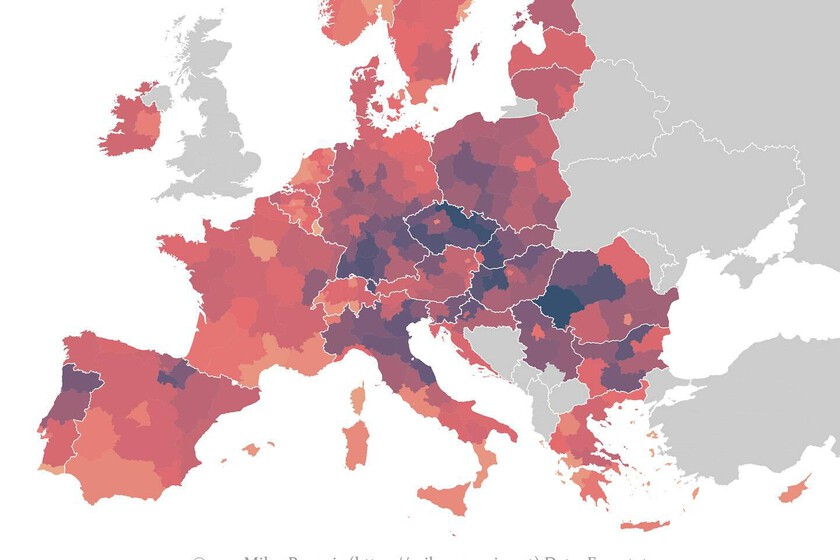
Europe is a continent and many different realities and the economy is no exception. We see it in the industrial fabric, in the GDP, in salaries and in the map that you see above these lines: the weight of the industry in employment, or what is the same, what population that works does so in a factory. Although we are going to see it in a big way and with the legend, at first glance something stands out: while there are states that have industry as their main source of employment, in others what rules are services.
The weight of the industry in employment in Europe. More specifically, the map represents the percentage that factory employment represents in total employment in each European region in a range that goes from 3% (the lightest areas) to 34% (the dark red areas). The map in question is the work of cartographer Milos Popovic and for its preparation it takes the data corresponding to 2023 from Eurostat, the official statistical office of the EU, which publishes these series systematically for the member states, allowing them to be compared.
Why it is important. Because beyond offering direct employment, the industry is the sector that contributes the most to productivity growth throughout the economy, according to data from Eurostat and analysis by the European Center for Austrian Economics Foundation.
When there is no industry (or there is it in small doses), the services that replace it tend to concentrate on activities with lower productivity and lower wages. On the other hand, losing industry implies dependence on third parties: we saw it in the pandemic when buying masks and we continually suffer it in strategic products such as semiconductors. And it also takes its toll on exports and deteriorates R&D capacity.
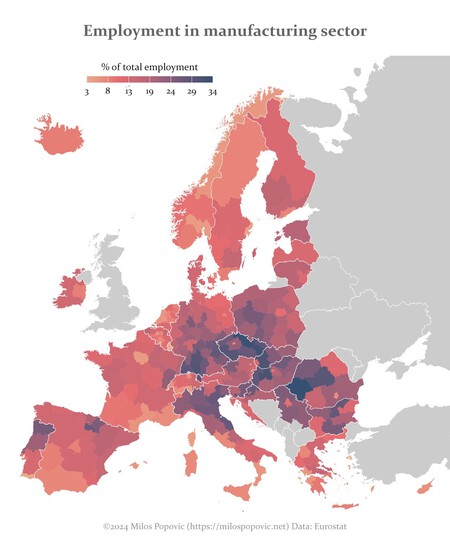

What percentage of total employment does the industry occupy? Eurostat via Milos Popovic
The two Europes: that of industry and that of services. Broadly speaking, Europe is divided into two blocks: the center, the east and some exceptions in the north of the Iberian Peninsula concentrate between 24 and 35% of its employment in manufacturing. On the other side of the coin, Ireland, the Nordic countries, Greece or southern Spain are below 13%. This division is due to several moments but the reasons are identical.
Central Europe is the factory of the old continent and much of the blame lies with the enlargement of the EU in 2004, a time when European and global multinationals relocated their production to those economies taking advantage of low labor costs, the existence of labor and obviously, this new scenario of access to the common market.

Germany, the exception and the industrial anchor of Europe. Germany is simply an anomaly in Europe. While France, the United Kingdom and the Nordic countries have been reducing their industrial weight for decades, Germany has managed to maintain robust manufacturing: it represents around 19.7% of the country’s gross added value compared to the European average of 15.6% thanks to an industrial fabric made up of medium-sized companies specialized in machinery, automotive, chemicals and capital goods.
But it is not being easy at all: energy is expensive, competition (especially Chinese) is fierce in industries such as the automobile industry and the drop in demand is forcing the Central European country to undergo a profound restructuring. And layoffs: without going any further, ThyssenKrupp Steel announced in 2024 a workforce cut from 27,000 to 16,000 workers, an example that summarizes what is happening throughout the German heavy industry.
The deindustrialization of the West. The loss of industrial weight in Western Europe is not new and does not stop: according to the GMK Center with data from the World Bank, the EU’s share of global industrial added value fell from 20.8% in 2000 to 16.3% in 2023 and between 2018 and 2024 alone, 700,000 jobs in industry were lost on the old continent.
France is a magnificent example because it is the most illustrative case: the industry barely represents 10.6% of its gross added value, almost half that of Germany. Spain stands at 11.7% although it has abysmal differences between the more industrial north (La Rioja and Navarra) and the tourist south.
In | There is one fact that summarizes Europe better than any speech: the minimum wage gap between the east and west of the continent.
In | The best paid jobs in Spain in 2026: from 56,000 euros for a doctor to 250,000 for directing private banking
Cover | MilosGis