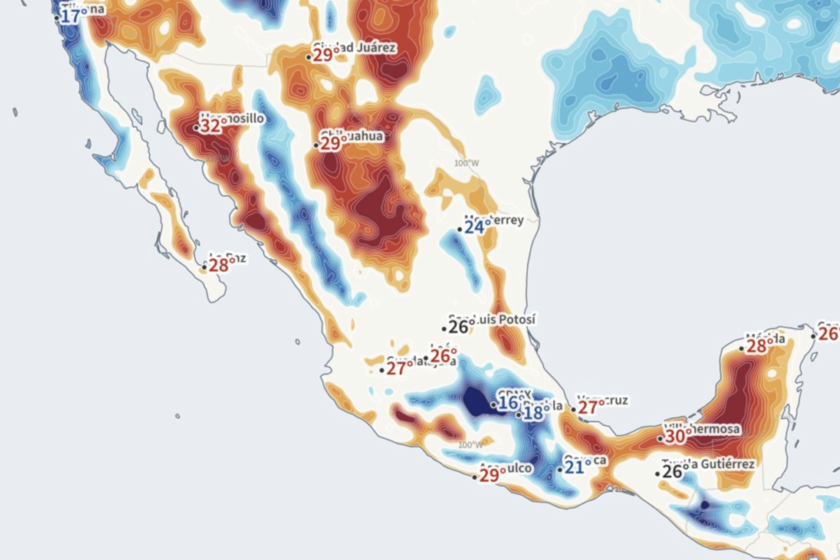
Mexico is experiencing the first major consolidated heat episode of 2026 and there are more than 22 entities affected on the Pacific slope and the southeast. That’s highs of up to 45 degrees in a country that is warming up to three times faster than the last century. And despite everything, no one seems too worried.
Why would they be? Mexico closed 2025 with reservoirs at 72% and by April 15 only 12.3% of the territory is affected by drought. You only have to go to 2024 to find a spring with 76% of the country in a critical situation: no matter how much the heat is getting earlier, it is logical that no one takes it very seriously.
Especially if we take into account that experts do not agree on the nature of the event. Once it has been ruled out that, technically, it is a ‘heat wave’; The National Meteorological Service says that we are talking about a ‘color wave’ and services like Meteored doubt whether we can even talk about that.
The great Mexican mess. While the thermometers of Sinaloa, Durango, Nayarit, Guerrero, Michoacan, Chiapas and, occasionally, Jalisco will be above 40 degrees; The rain will reach the eastern half of the country: it is a clear example that the asymmetry in how climate change affects Mexico means that the country is beginning to live in several seasons at the same time.
And that is the central issue: Mexico is warming rapidly and that means innumerable problems.
Heating up rapidly? According to the UNAM Climate Change Research Program, before 2012 the warming rate per century was 1.9 degrees. Now that rate has catapulted to 3.5. This means that projections speak of 1.95 degrees only for 2026, while the average is 1.5.
And El Niño is knocking on the doors. Therefore, the fact that there is water in the swamps does not solve anything: it simply makes us trust.
But let’s talk about the problems. Because, although we do not usually emphasize it, heat has a direct impact on public health. In 2024 alone, 306 people died from heat stroke in Mexico. The fact that the heat is ahead is not good news.
Above all, because as we already know, the Mexican hot season produces peak values between April and May. In this way, it is reasonable to think that all this heat is nothing more than part of what is coming.
Image | BenBaso |
In | We are living in the hottest years on Earth and the consequences will be so severe that not even our grandchildren will see the end.