A team of researchers from Massachusetts Institute of Technology (MIT)led by Professor Yet-Ming Chiang, published in the journal Science a method that changes the rules of the game for obtaining lithium.
The problem ? Current mining from hard rock is a energy and ecological nightmarerequiring ovens at more than 1000°C and generating tons of waste.
This dependence has left China quasi-monopoly on refiningwhich creates a major strategic obstacle for the West. The start-up Rock Zero is now responsible for bringing this technology from the laboratory to the industrial scale.
How does this new extraction method work?
This new approach, developed by MIT researchers, reverses the usual logic. Instead of roasting the rock, it uses a chemical reagent, ammonium fluorideto dissolve the spodumene (a silicate mineral rich in lithium) at low temperatures, around 95°C.
The big trick is to tackle the silica firstthe strongest element in traditional methods, which then easily releases lithium and aluminum.
Once the rock dissolves, a chemical “mechanic” game begins to separate the different components. Lithium is isolated to produce battery-grade salts, aluminum is recovered as smelter-ready alumina, and silica is precipitated for use as an additive in cement.
What makes this process so superior to current techniques?
The main advantage is the abandonment of the oven at 1000°C, an extremely energy-intensive and costly step. This process low temperature drastically reduces energy bills and carbon footprint.
Furthermore, it is a closed loop system : ammonium fluoride is recovered and reused at the end of the cycle, approaching “zero waste”. This is a total break with the current model which leaves the majority of the treated rock on the ground.
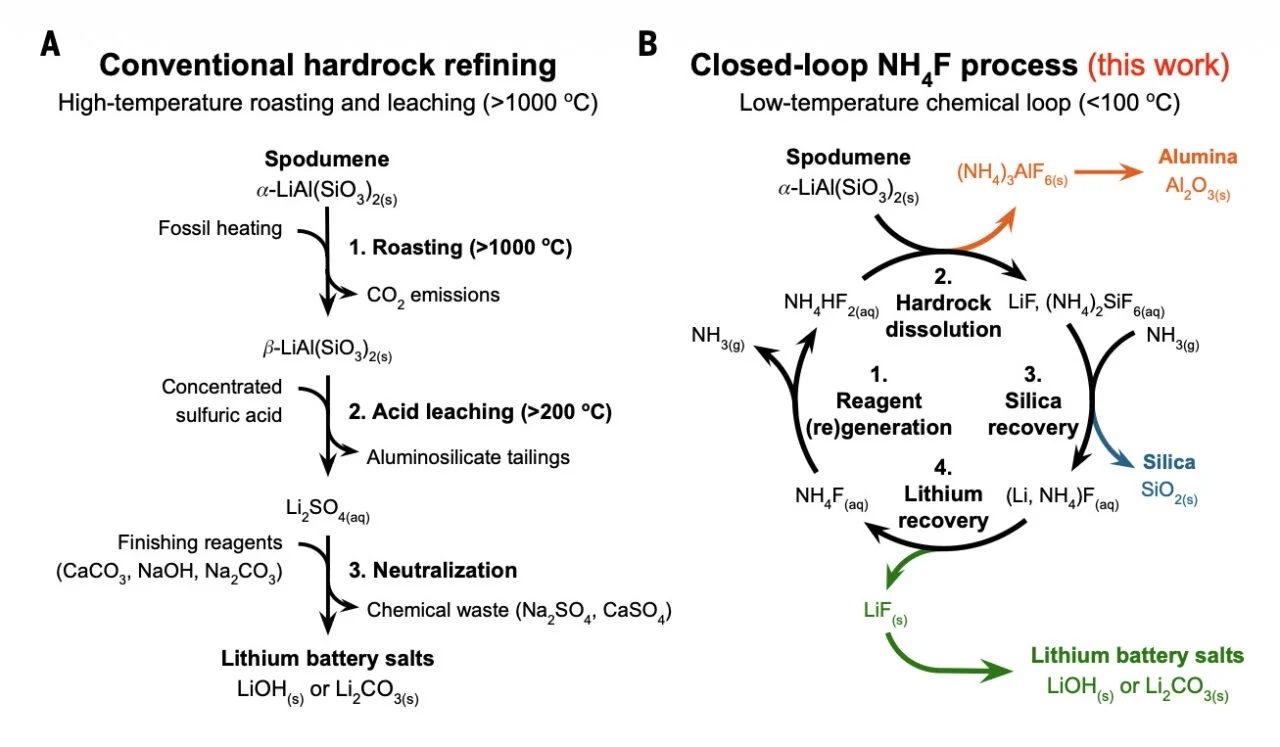

The second major advantage is the full recovery of the raw material. Researchers call this the “nose-to-tail” mine (nose-to-tail mining). Instead of a single product (lithium) and a massive waste, we obtain three marketable products.
This approach makes theextraction of lithium from the rock not only cleaner, but also potentially as profitable as that from brineswithout the ecological disadvantages of the latter.
What are the concrete impacts for industry and the environment?
The geopolitical impact is potentially immense. By making hard rock mining economically viable in the United States, Europe or Australia, this technology could break Chinese domination on lithium refining.
This would allow secure supply chains for the batteries lithium-ionan issue of national sovereignty for many countries engaged in the transition to electric vehicles.
On an environmental level, the gain is twofold. Less energy consumed means less CO2 emissions. And the virtual absence of mining waste radically changes the perception of this industry.
No more mountains of sterile residue, each component of the rock finds a use. This could finally reconcile mining, essential to our technologies, with ecological imperatives.
Is this technology already an industrial reality?
Not yet, but the path is clear. The research was transferred to the MIT spin-out, Rock Zerowhich has been operating since The Enginean incubator specializing in disruptive technologies.
The team is currently working on optimizing and scaling the process from batches of a few kilograms in the laboratory to much larger capacity. There credibility of the project is reinforced by its success on 17 different types of spodumene, proving its robustness.
Rock Zero has already designed a pilot plant and plans to build it by the end of 2026 for operations to begin in 2027. Of course, challenges remain, including the volatility of the lithium market and competition from established giants.
But with an estimated production cost below $6,000 per toncompetitive with the best current processes, the company has solid arguments to convince mining partners and establish itself as a key player in the energy transition.