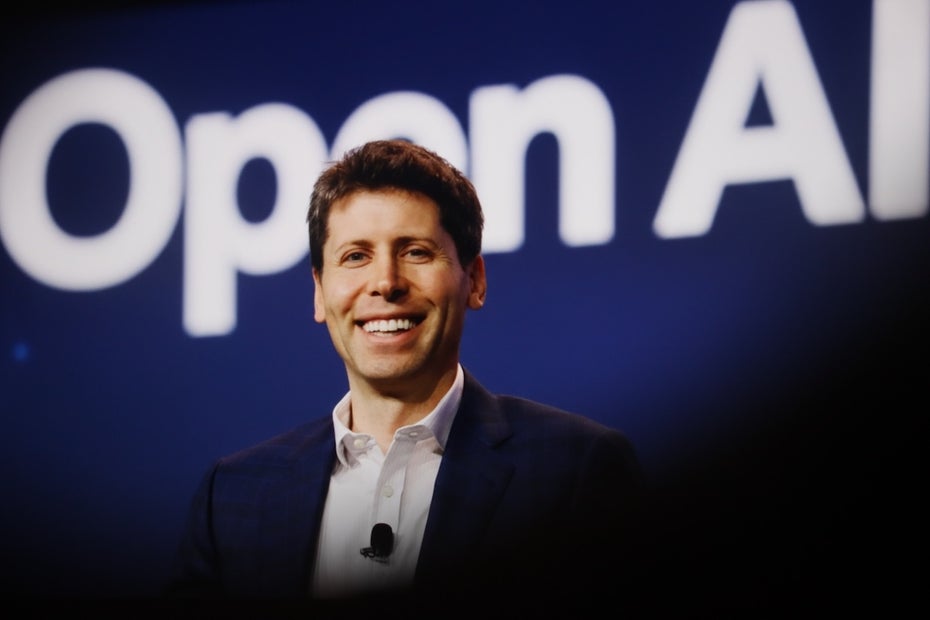
According to a report from the Wall Street Journal (WSJ), OpenAI is said to have recently missed its own targets for sales and user numbers. The result: CFO Sarah Friar is said to have expressed her concern to other executives that, in the worst case, there could be a lack of funds for the massive expansion of computing capacity.
OpenAI denies WSJ report
According to the WSJ report, which cited company insiders, Friar said it might not be able to pay more for future computing jobs if sales didn’t grow fast enough. OpenAI dismissed the report as “ridiculous” to CNBC.
Editorial recommendations
${content}
${custom_anzeige-badge}
${custom_tr-badge}
${section}
${title}
Nevertheless, there were strong price fluctuations on the stock exchanges as a result of the report. The shares of Softbank, one of the largest OpenAI investors, fell by over ten percent. The papers from AMD, Broadcom, Coreweave, Nvidia and Oracle suffered declines of between one and four percent.
Chip stocks slide, Microsoft up
The shares of OpenAI investor Microsoft, on the other hand, were able to turn positive again over the course of April 28, 2026 after a price slide. Ahead of the publication of the quarterly results after the market closed, Microsoft reported the largest rollout of its AI software to date, namely 743,000 Copilot users at Accenture.
Meanwhile, other industry observers are less worried about the rumored sales problems than the stock market traders. Mizuho analyst Jordan Klein explained that it was unlikely that the investors who recently pumped $122 billion into OpenAI were unaware of these problems.
Observers are not worried
John Belton of Gabelli Funds once again classified the WSJ article as a description of long-known developments. It is no secret that the ChatGPT provider has lost market share to competitors such as Anthropic and Google’s Gemini in recent months, as CNBC quotes Belton.


These CEOs were kicked out of their own companies
In general, adds Luke Rahbari, CEO of Equity Armor Investments, forecasts like those from OpenAI are difficult to make accurately in such a rapidly developing industry. Predictions at large AI companies can have error margins of 25 to 50 percent, Rahbari said.

Top Article
${content}
${custom_anzeige-badge}
${custom_tr-badge}
${section}
${title}