




The latest report from theInternational Energy Agency comes to place figures on an underlying trend. For 2026, forecasts are based on 23 million electric vehicles elapsed, a progression of 15% compared to 20 million in 2025.
This dynamic means that on a global scale, almostone in three new cars will be electric this year. This movement is amplified by the energy crisis in the Middle East which makes thermal engines less and less attractive in the face of volatile fuel prices.
The global fleet could thus go from 80 million electric vehicles today to 510 million by 2035.
Why are we talking about a slowdown when sales are exploding?
The perception of a braking comes from a overall drop of 8% in sales in the first quarter of 2026, a figure directly linked to political adjustments in China and the United States.
However, this average hides a extremely contrasting dynamics. This is a statistical sham that masks the true health of the market. Behind this overall figure, growth remains spectacular in many regions of the globe.


Sales of electric vehicles (Source: IEA report)
Indeed, over the same period, Europe saw its sales of electric vehicles jump by almost 30%. The Asia-Pacific region (excluding China) recorded a dizzying growth of 80% and Latin America is not left out with an increase in 75%.
The electric market is becoming international and is no longer dependent on one or two growing markets. Adoption is becoming a global and structural phenomenon.
Which country outrageously dominates the electric vehicle market?
Without any ambiguity, China remains the nerve center of electric vehicles in 2026. The IEA confirms that manufacturers from the Middle Kingdom supplied 60% of electric vehicles sold worldwide in 2025 and provided nearly 75% of planetary production.
This supremacy extends to the entire value chain (all stages of production), particularly with more 80% of global manufacturing of battery cells.
This industrial firepower has a direct consequence: a doubling of Chinese exportswhich exceeded 2.5 million vehicles. Significantly, outside the three major markets (China, Europe, USA), 55% of electric cars sold come from China, compared to less than 5% five years ago.
This situation is redrawing the geopolitical map of the automobile, forcing historic manufacturers into a chase so as not to be completely left behind.
What are the new emerging trends in the sector?
Beyond passenger cars, two fundamental phenomena are materializing strongly. On the one hand, electrification of heavy transport is accelerating: global sales of electric trucks more than doubled in 2025, now representing almost one truck in ten sold worldwide.
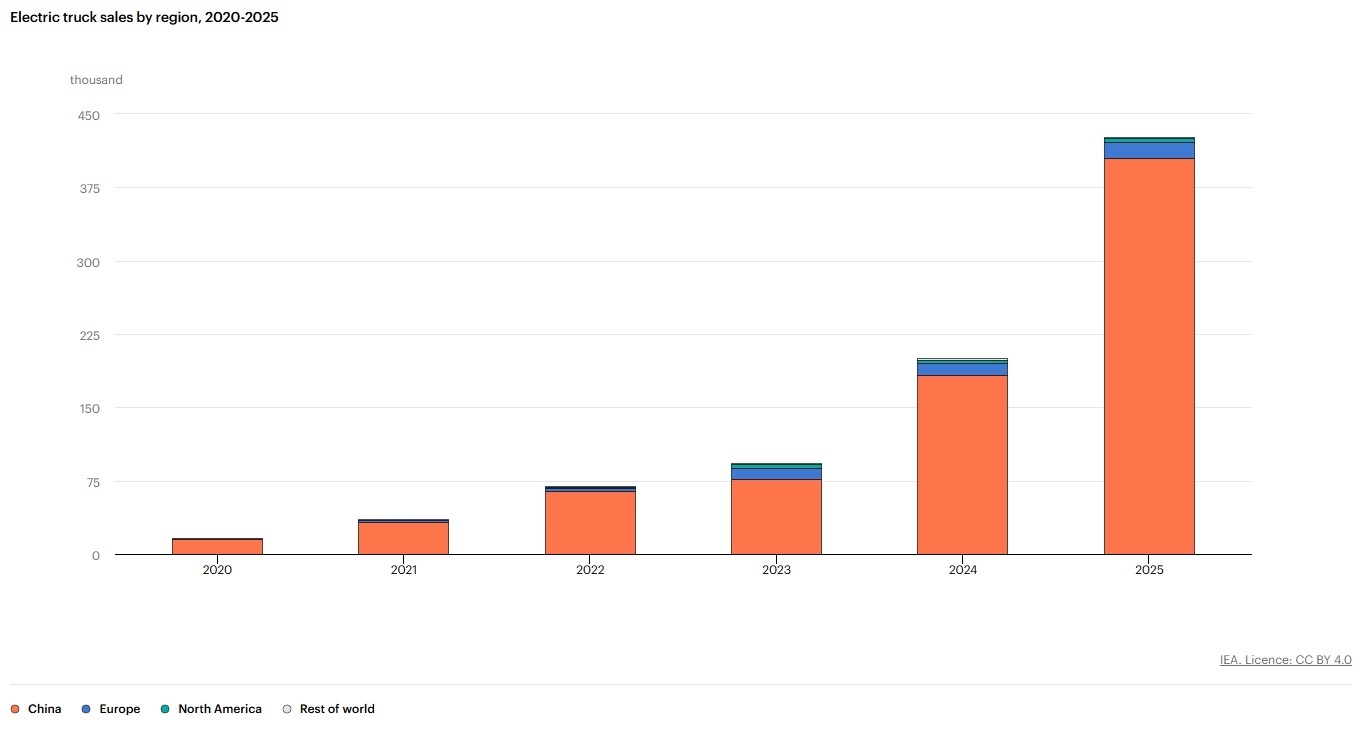

China, once again, is leading this dance. On the other hand, South-East Asia stands out as a new major growth pole. In this region, EV sales also doubled last year, reaching a market share of almost 20%.
Vietnam, in particular, is establishing itself as the regional leader. IEA projections suggest that EVs could represent 60% of new car sales there by 2035, driven by incentive policies and more accessible prices.
We are witnessing a silent democratization: electricity is no longer a Western luxury and is instead becoming a pragmatic solution which is established where demand is strongest.


