In September 2021, a cosmic visitor of colossal energy hit the detectors of the IceCube observatoryburied under the ice of Antarctica. Baptized IC 210922Athis energy signal came from the constellation Eridanus.
Immediately, a veritable ghost hunt was launched across the world to find its source. But the telescopes found nothing. No gamma-ray burst, no black hole devouring a star, no supernova.
The culprit had left a spectacular trace but seemed to have disappeared, leaving scientists with a mystery. They ended up determining the origin of the particle: Shadow Blaster !
Why is this detection so unusual?
The detection is exceptional because the identified source, the galaxy Shadow Blasterdoes not have an active supermassive black hole which are the usual suspects for producing such particles.
Until now, scientists mainly linked these events to blazars, galactic nuclei extremely luminous where a black hole projects jets of matter at a speed close to that of light.
Illustration of a blazar projecting a jet of matter
Here the scenario is totally different. The absence of any powerful X-ray or gamma signal forced the team led by Yuji Urata to look at the sky with different eyes, particularly in the field of submillimeter waves.
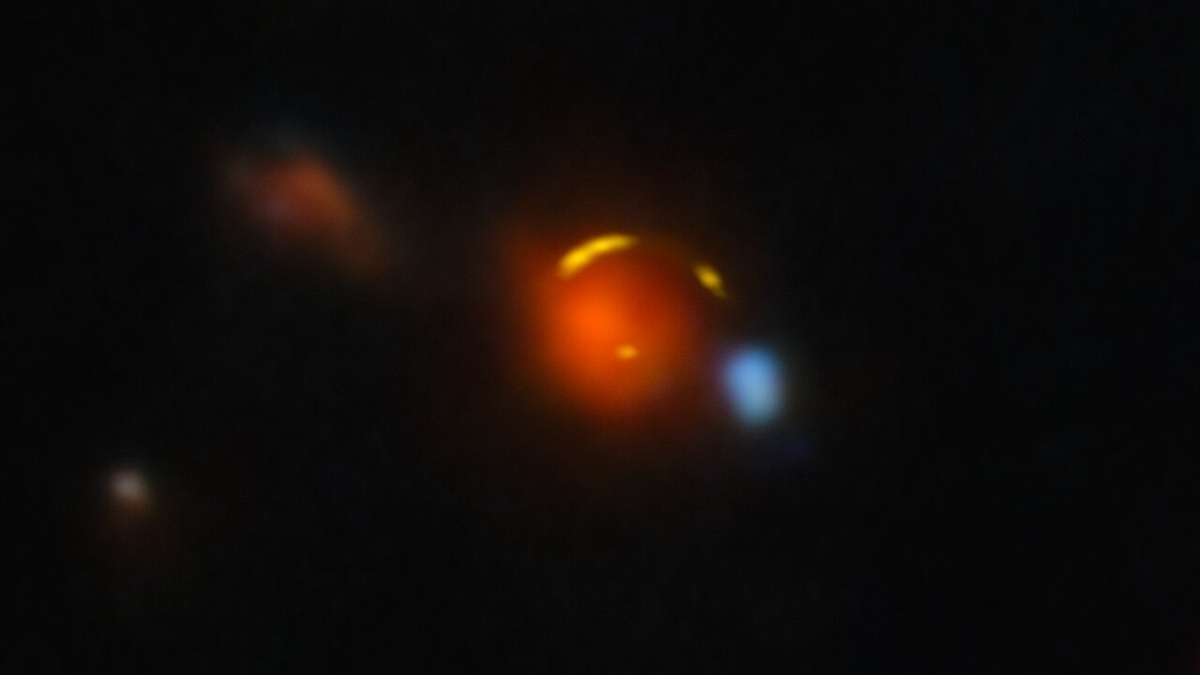
That’s where they found this distant galaxya ” starburst » (star formation burst galaxy) hidden behind a thick curtain of dust. A culprit who did not fit any known profile.
How were astronomers able to see a galaxy so distant?
Astronomers have benefited from a cosmic stroke of luck called gravitational lens. A massive galaxy, located between Earth and Shadow Blaster, acted as a gigantic natural magnifying glass.
By bending spacetime with its mass, it deflected and amplified the light from the background galaxy, making it more than ten times brighter than it actually is.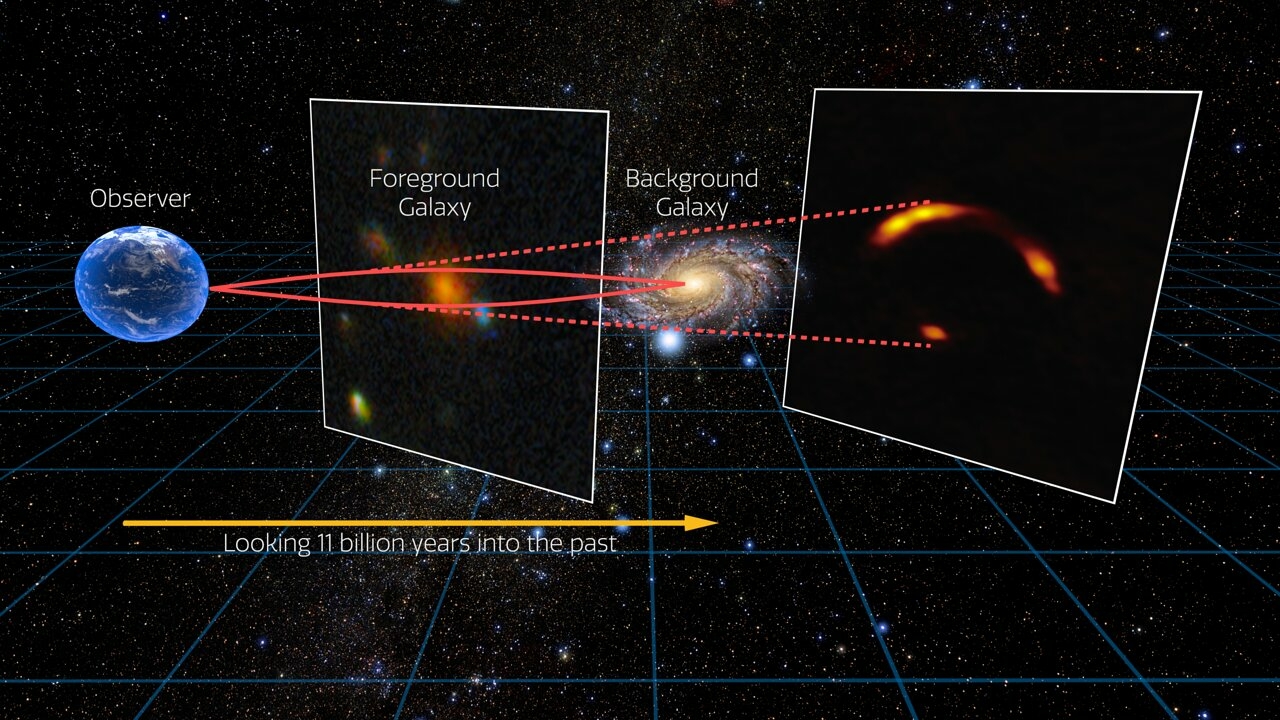

Gravitational lensing effect that allowed Shadow Blaster to be detected
Without this providential effect, Shadow Blaster would have remained a simple blurtoo weak to be studied in detail. Thanks to telescope observations Gemini North et ALMAthe researchers were able to model the lens, then “de-warp” the image to reveal the true nature of the source.
It is this amplification which made it possible to link this galaxy to the detection of this ghost particle.
What is the mechanism of production of this neutrino?
The neutrino superpower detected in 2021 was therefore not produced by a black hole but by the frenetic star formation activity at the heart of the galaxy. The center of Shadow Blaster is an extremely compact region and rich in gas where new stars are born at a breakneck pace.
This intense agitation creates a chaotic environment in which cosmic rays (accelerated protons and atomic nuclei) are trapped. These energetic particles, propelled by supernova explosions, collide with the surrounding dense gas.
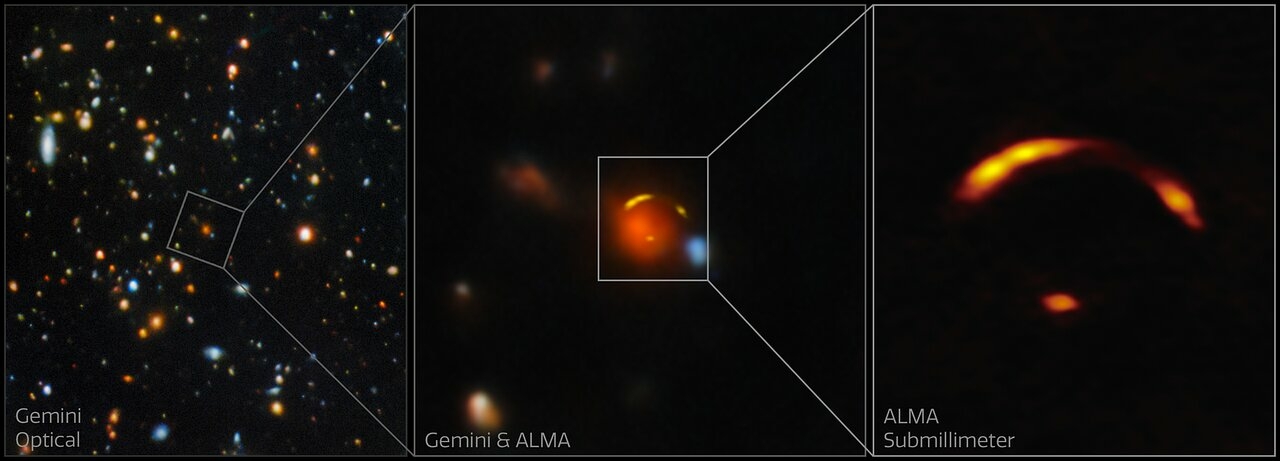

Shadow Blaster Galaxy, identified by different observation instruments
These high energy impacts act as a particle accelerator natural, producing pawnsunstable particles which disintegrate almost instantly by emitting neutrinos.
What is the implication for our understanding of the Universe?
This discovery suggests that an entire population of galaxies, so far ignored in the hunt for neutrinos, could play a major role.
Star-forming burst galaxies like Shadow Blaster were extremely common about 10 billion years agoa period nicknamed the “ cosmic noon “. Individually weak, they could collectively explain a significant part of the diffuse neutrino flux that we receive.
The researchers believe that this population of galaxies could be responsible for nearly 20% of the cosmic neutrino background measured by IceCube. This forces scientists to rewrite part of the catalog of the most violent cosmic sources.