
Facing the proliferation of threats agile and low-cost weapons like kamikaze drones and sophisticated missiles, the US Department of Defense officially launched the program Joint Laser Weapon System (JLWS).
This ambitious project, led by the Office of the Undersecretary of War for Research and Engineering, aims to provide the armed forces with a directed energy defense capability.
This program aims to create a prototype oflaser armor of 500 kWhoused in a transportable container, capable of neutralizing advanced aerial threats like swarm drones and next-generation cruise missiles, with unrivaled effectiveness and cost per shot.
The contracts, with an initial value of $86 million, were awarded to two industry giants, Lockheed Martin Aculight et nLIGHT Defenseto design and produce a functional prototype of never before achieved power in such a compact format.
Why is the Pentagon investing massively in 500 kW laser weapons?
The American army is investing in 500 kW lasers to address a flaw in traditional defenses: saturation and cost. A laser weapon offers light speed response, a virtually infinite magazine as long as there is energy, and a paltry cost per shotestimated at a few dollars.
It is a strategic break in the face of interceptor missiles which cost millions of dollars each and can be exhausted by a swarm attack.
This technology makes it possible to attack and destroy multiple targets in seconds, a rate impossible to maintain for traditional kinetic systems.
Against swarms of drones or a wave of missiles, the laser does not aim to intercept each threat one by one, but to create a real impassable “wall of energy”.
The objective is to protect airspace with a new generation of air defense directed energymore resilient and economically viable in the long term.
What are the technical challenges in creating such a powerful laser?
The main obstacle for a laser of this magnitude is managing its own power. Engineers face three major challenges: size, weight and power (summarized in the acronym SWaP : Size, Weight, and Power), cooling, and atmospheric disturbances.
A 500 kW system generates significant heat which must be removed instantly to avoid damaging its own components. In addition, we must overcome the “ thermal blooming ”, a phenomenon by which the laser beam heats the surrounding air, causing it to disperse and lose focus.
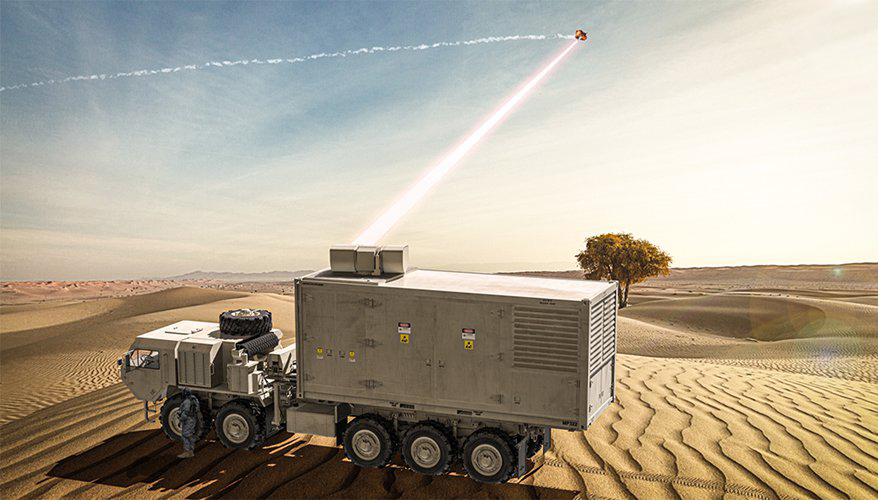

Fitting such power, its cooling system and its enormous energy storage banks into a standard container is a true feat of engineering.
This is where the complexity lies: combining several laser beams via ultra-specialized optics without them self-destructing. The real challenge depends on miniaturizing a physics laboratory in a box ready to be deployed on a ship or truck.
How does Lockheed Martin intend to make this ambitious project a reality?
Lockheed Martin relies on more than fifteen years of expertise in tactical laser weapons to meet this challenge. The company takes a staged development approach, designed to quickly deliver operational capabilities.
The program will begin with the deployment of a premier prototype the 150 kW to meet the urgent needs of the field, before ramping up to intermediate versions of 300 kWthen the final system of 500 kW.
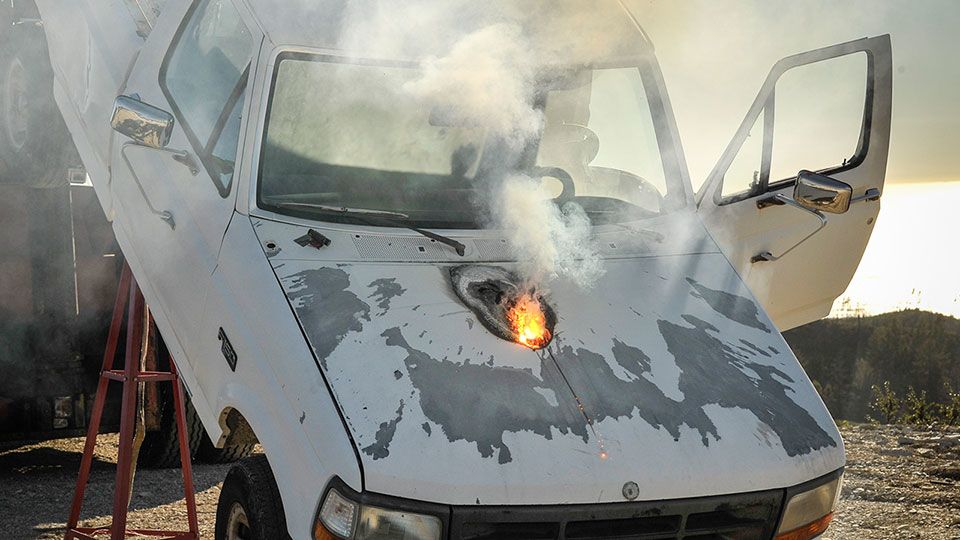

Lockheed Martin High Power Laser Test
This agile method, facilitated by the contractual framework OTA (Other Transaction Authority), allows you to bypass the usual administrative burdens.
This mastery of integration makes it possible to envisage rapidly building containerized laser weapons in the short term. By capitalizing on its previous successes, the firm Lockheed Martin positions itself as a key player in this technological race.
What is the real impact of the JLWS program on tomorrow’s war?
The arrival of Joint Laser Weapon System (JLWS) is a direct response to new threats. By providing a low-cost, unlimited ammunition protection solution, it offers commanders unprecedented tactical flexibility.
The ability to neutralize fast and numerous threats almost instantly, from small drones to fast anti-ship weapons, is a game-changer. This is a major transition from kinetic weapons to directed energy.
This energy shield represents more than a change in weapons technology. Where a warship might exhaust its stock of interceptor missiles in minutes, a laser system can continue firing as long as it is powered by electricity.
The end goal is to make any attempt at a saturation attack prohibitive, ensuring that defense is always more economical and durable than attack. The threat of futures cruise missiles will she find her master?