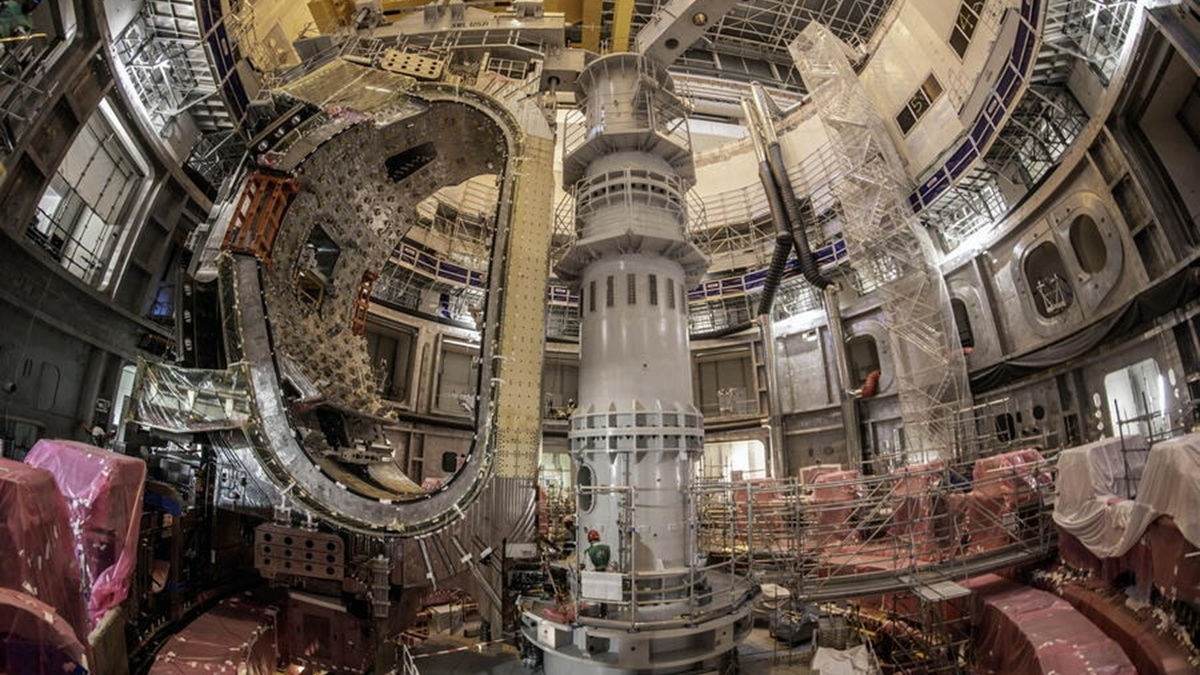
The international project ITER has just reached a major milestone. The American entity, US ITERhas officially completed its deliveries for the central solenoidone of the most complex and powerful systems ever designed for nuclear fusion.
This part, manufactured in California after 15 years of effort, is now in the hands of the assembly teams in Cadarache, in the south of France.
The completion of this ” magnetic heart ” is the sine qua non condition for being able to generate and maintain the plasma (a gas of charged particles heated to millions of degrees) within the tokamak, the machine designed to demonstrate the feasibility of fusion as a large-scale energy source.
What is this central solenoid, the “heart” of ITER?
The central solenoid is a pulsed superconducting magnetthe most powerful in the world, forming the true backbone of the ITER magnetic system. It is made up of six stacked modules, reaching a total height of 18 meters and 4.25 meters wide.
Each module weighs more than 122 tons and is rolled up with nearly 6 kilometers of niobium-tin superconducting cable. Its function is twofold: to induce an electric current of several million amperes in the plasma to heat it and then to keep it stable during the experiments.
This technological titan is the result of long-term work carried out by General Atomics in Poway, California. The manufacture of each module required more than two years of meticulous work.
To ensure the success of the operation, a seventh spare module was even built. Everything is held together by an external support structure, an exoskeleton, designed to counter the titanic electromagnetic forces generated by the magnet itself.
Why is this delivery so crucial to the project?
This delivery is an absolutely critical milestone because without the central solenoid there is simply no fusion possible in the ITER reactor. It is he who gives the initial impulse, the magnetic “kick-off” which will tear the electrons from the atoms and create the plasma.
It is the piece that allows you to transform the gaseous fuel in a specific state of matter (an ultra-hot plasma), necessary for atomic nuclei to fuse and release colossal energy.

The completion of this American contribution, which represents 9.1% of the participation in the project, is also a validation of the international collaboration model d’ITER.
The majority of contributions are not monetary, but “in kind”, in the form of finished components. The fact that the United States managed to deliver such a complex and demanding system, managed by the laboratoire d’Oak Ridgestrengthens confidence in the ability of other members (Europe, China, Russia, Japan, India, South Korea) to meet their commitments for the years to come.
What are the next steps to assemble this titan?
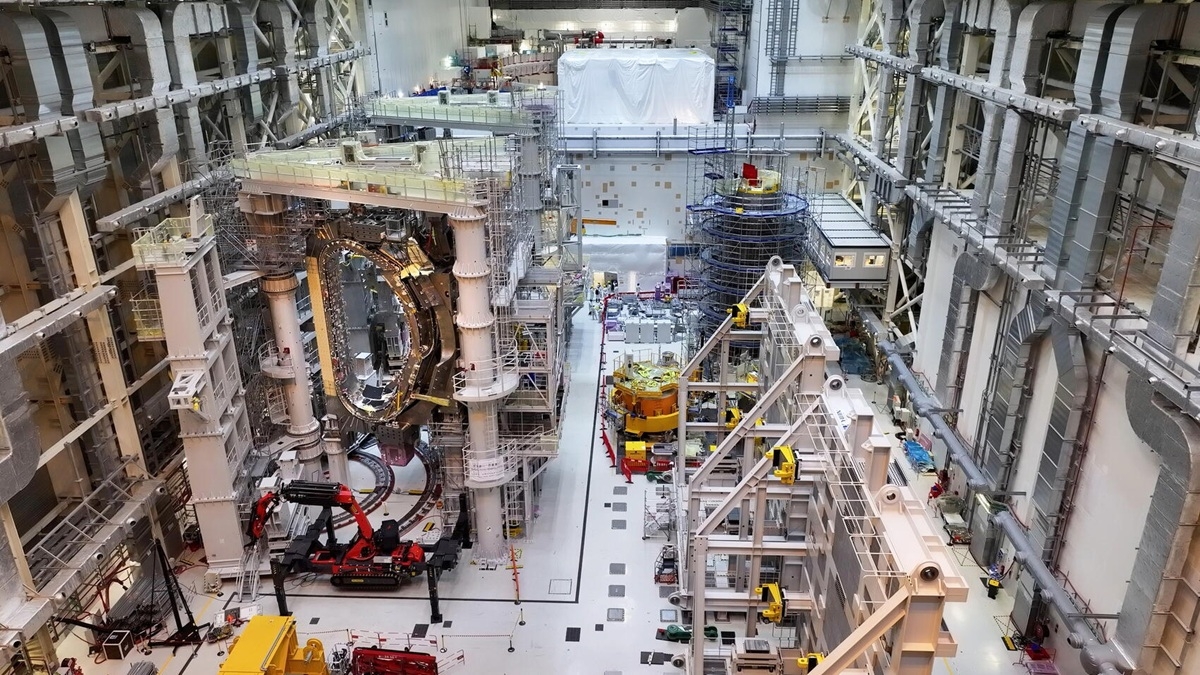
The work is far from finished. It is now entering a delicate integration phase on the French site. Five of the six solenoid modules are already stacked in the assembly hall.
The sixth and final module, arriving in September, must be added to the stack during 2026. Once the stack is completed, a compression structure will apply a colossal force to the whole to guarantee its cohesion and resistance.
This immense coil will only be moved to the center of the tokamak pit after the installation of the nine sectors of the vacuum chamber, another monumental stage of the construction site.
It is a puzzle of gigantic proportions where each piece must be positioned with millimeter precision. The updated schedule now targets a first operation, or “ premier plasma », in 2035. An ambitious goal that depends on the perfect synchronization of thousands of complex tasks.
Is nuclear fusion for tomorrow?
The ITER project is an ambitious step but there will be a long way to go before we have a workable nuclear fusion reactor. Its objective is not to produce electricity for the commercial network but to serve as a scientific demonstrator.
It must prove that nuclear fusion is technically viable and can produce a positive net energy balance. Concretely, it aims to produce 500 MW of fusion energy for 400 seconds, using only 50 MW to heat the plasma.
The success of ITER will pave the way for the design of future fusion power plantsthe DEMO reactors, which could be connected to the electricity network. The delivery of the American central solenoid is therefore an essential step but above all it reminds us of the very nature of this quest: a long-term scientific and human adventure, a planetary collaboration to try to master the energy of the stars and prepare the energy future of humanity.