Sometimes, an image can trigger unexpected consequences in international politics. During the Kosovo war, at the end of the 1990s, a photograph released without clear context of alleged civilian victims provoked immediate reactions from governments and international organizations before its real origin could be verified. That episode left a lesson that is still valid: in high-tension scenarios, the impact of a story can be as rapid as the difficulty of proving if it is true.
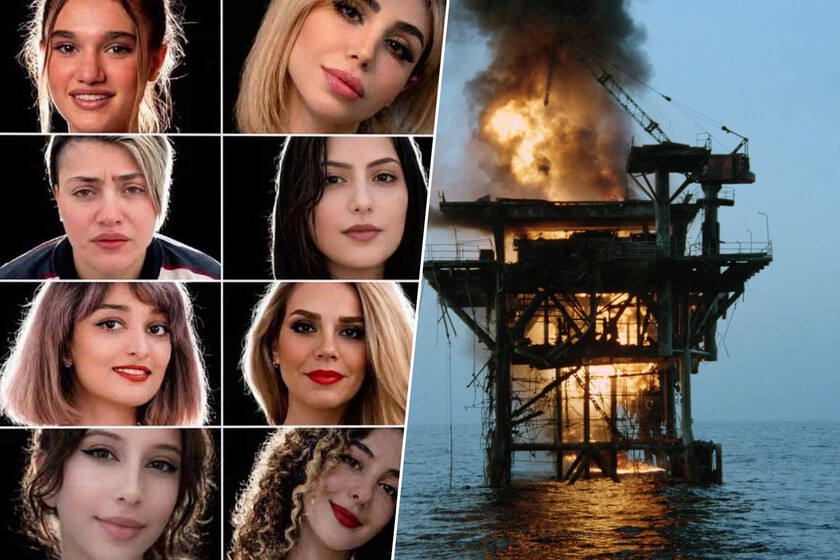
Two versions for the same photos. The episode begins two days ago with Donald Trump asking, through his social network, Iran to stop the execution of eight women detained after the protests. He also does so by publishing the image of the eight women, an anomalous situation that, coincidence or not, takes a radical turn in a matter of hours when Trump himself goes on to affirm that he has achieved it.
According to their version, some would be released and others would receive light sentences, presenting it as a gesture of good will before the alleged new negotiations. The problem: that from the beginning there is no clear verifiable data about the identities or their judicial situation, which leaves the story supported by information that is, at the very least, incomplete.
Iran not only denies it, it dismantles the story. The Iranian response could not have been more direct: there were no planned executions. They assure that some of the women were already free and that the rest, if convicted, would only face prison sentences.
In addition, they accuse Trump of relying on false information and trying to build political success without a real basis. The shock quickly moves from the facts to the credibility of the person telling them.

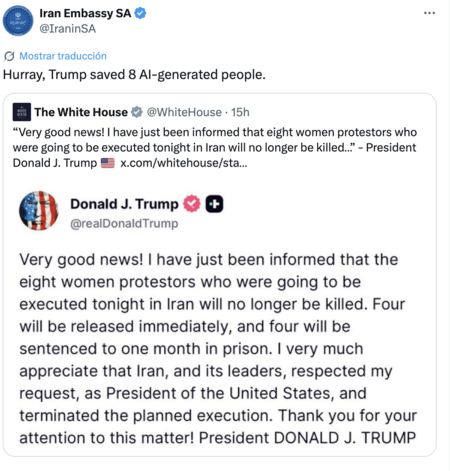

The leap into confusion. The situation escalates towards complete surrealism when official Iranian channels from their different embassies go one step further and affirm that part of the images broadcast would have been generated with artificial intelligence.
At that point, the discussion stops being whether they were going to be executed or not, and begins to question whether some of the protagonists exist as they have been presented, or if they simply exist. That change introduces such a crazy level of uncertainty and propaganda that it makes it very difficult to verify what part of the story is real.
A real context that does not disappear. Be that as it may, and despite the confusion, the environment in which it occurs is documented. The Times newspaper recalled that, after the protests in Iran, there are thousands of detainees and complaints of unfair trials.
In fact, there are human rights organizations that have pointed out recent executions and the use of the death penalty as a pressure tool. This means that, although this specific case is doubtful, the underlying problem is still relevant.
Propaganda faster than facts. In any case, what we see is not new in a war, far from it. Throughout recent conflicts, several stories have shown how narrative can prevail over verification. For example, during the invasion of Kuwait in 1990, the testimony of a young woman known as “Nayirah,” who reported alleged crimes in hospitals, influenced international public opinion before it was learned that it was linked to a public relations campaign.
In the 2003 Iraq war, claims about weapons of mass destruction marked strategic decisions without conclusive evidence, and in the Ukraine conflict, narratives such as that of the “Ghost of kyiv” or some viral videos spread on networks quickly became popular before being qualified or denied. In all cases, the pattern repeats itself: in war environments, political and emotional urgency accelerates the spread of stories that can influence real decisions long before their veracity is confirmed.

Strategic tension that sets the pace. Of course, all this occurs while pressure continues in the Strait of Hormuz, with attacks on ships and blockades of ports despite the ceasefire.
Iran has conditioned any progress on lifting that blockade, while the United States maintains it as a pressure tool. And in that context, the episode of the eight women is not isolated: it is an essential part of a scenario where the political narrative and the situation on the ground always advance in parallel.
Image | Trump Social, Nara
In | Europe has gotten down to work on one of its biggest geopolitical challenges: opening Hormuz without help from the US
In | Iran has 300 internal reports where it models the war against the US. They are all based on the same thing: Ukraine