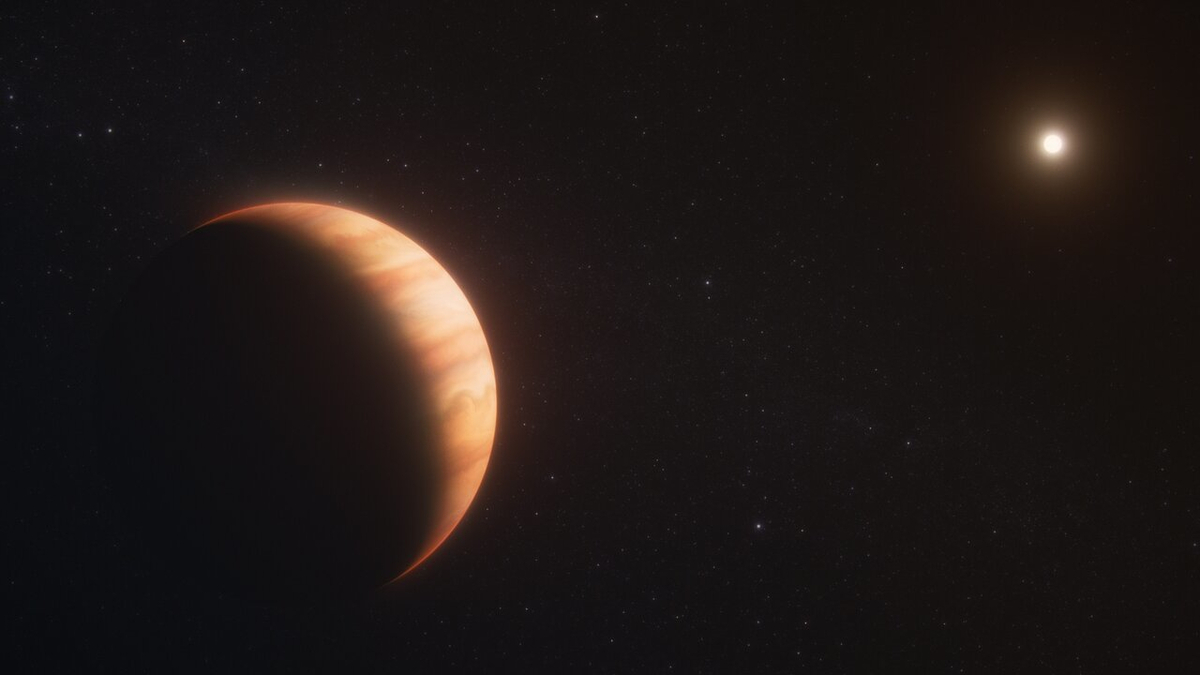
An international team of astronomers used the James Webb Space Telescope (JWST) to study the exoplanet in detail WD 1856 ba gas giant located about 80 light years away.
Discovered in 2020, this planet is intriguing because it orbits very closely around a woman blanchethe ultra-dense remnant of a Sun-like star. The new observations made it possible to measure its mass, its temperature and to detect its atmosphere, offering a scenario for its unexpected survival.
How can we explain its high temperature?
Analysis of JWST data revealed a major surprise: the temperature of WD 1856 b reached approximately 126 °C. It’s significantly hotter than models predicted, because its only current heat source is the white dwarf’s faint light.
This abnormal heat is actually a residual energy. The researchers concluded that it came from an intense heating event that occurred well after the star transformed.
” The big mystery is how WD 1856 b got to where it is today “, explains Christopher O’Connor, co-author of the study.
What is the origin of its current orbit?
Two main theories were considered. The first suggested that the planet had been swallowed by the star during its red giant phase and survived inside. The second relied on a late migration due to gravitational interactions.
The high temperature of the planet made it possible to decide. Models show warming must have happened between 3 and 5.5 billion years later that the star has become a white dwarf. This timing excludes the engulfment scenario.
The planet therefore migrated much later, and ” its interactions with the white dwarf’s strong gravity warmed it considerably “, specifies Christopher O’Connor.
What does this planet teach us about our own future?
In about 5 billion years, our Sun will become a red giant and then a white dwarf, destroying Mercury, Venus and perhaps Earth. The fate of giant planets like Jupiter and Saturn is more uncertain. The study of WD 1856 b offers a glimpse of this distant future.
The discovery opens a new field of research into post-apocalyptic planetary atmospheres and the possibility of radically transformed worlds orbiting dead stars.