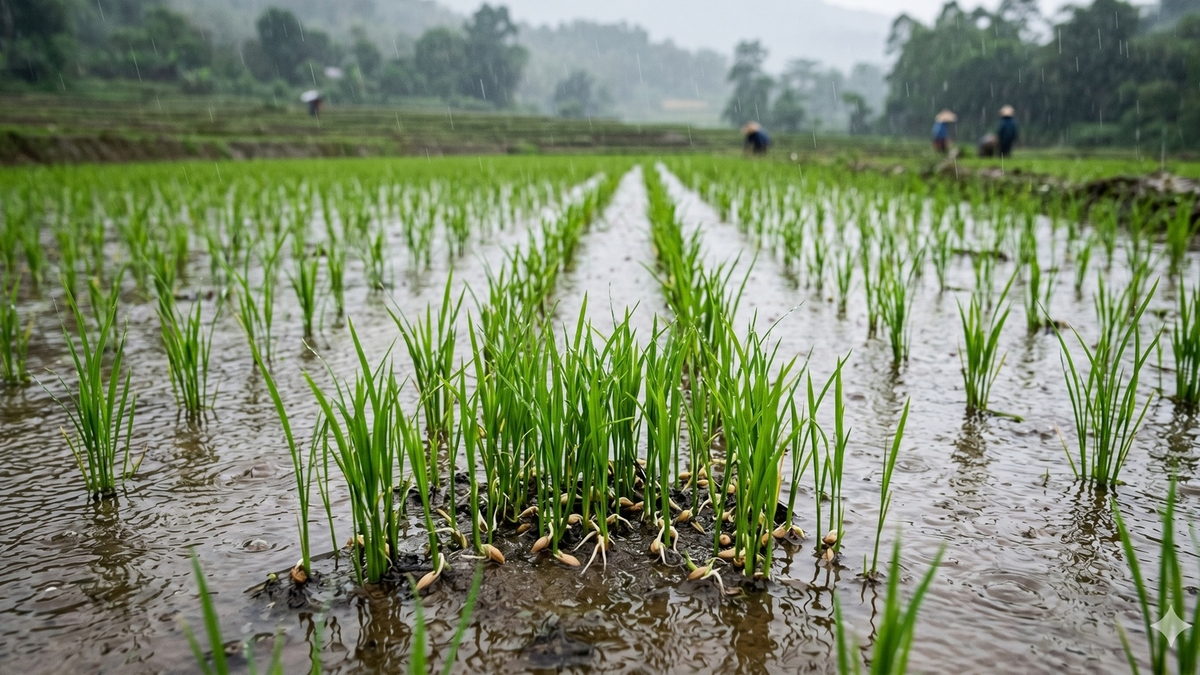
Researchers from Massachusetts Institute of Technology (MIT), led by Professor Nicholas Makris, published a major study in the journal Scientific Reports.
They provide the first direct proof that plant seeds can feel the sounds of natureand more particularly that of the rain. Using rice grains, they discovered that the acoustic vibrations generated by the impact of water drops act as a catalystaccelerating germination significantly.
The implication is significant: plants have a much more complex and reactive sense of perception than we imagined. This mechanism allows them to detect an ideal planting depth for their survival and optimize their chances of growth.
How can a simple seed “hear” the rain?
The secret lies in a fascinating mechanism that combines physics and biology. When a raindrop hits the ground or a puddle, it generates a much more powerful sound wave in water or land than in air.
These vibrations spread and reach the seeds. Inside some seed cells there are microscopic organelles called statolithes which are small, dense particles usually used to sense gravity to direct the growth of roots and stems.
The sound energy from the rain is strong enough to literally shake these statoliths. This upheaval is interpreted by the seed as a signal. This is the “start” to come out of dormancy and start to germinate.
MIT researchers compare the sound pressure a seed experiences under a few centimeters of water to that we would feel a few meters from a jet engine.
What is the scientific evidence behind this discovery?
To validate their hypothesis, the MIT team conducted a large-scale experiment. They submerged about 8,000 grains of rice in trays of shallow water, mimicking their natural habitat.
A portion of the grains was exposed to water drops falling from different heights to simulate light to heavy rain while a control group remained in identical but silent conditions.
The key to the experiment was that the seeds were not affected by the drops, but only by the sound waves that they produced.
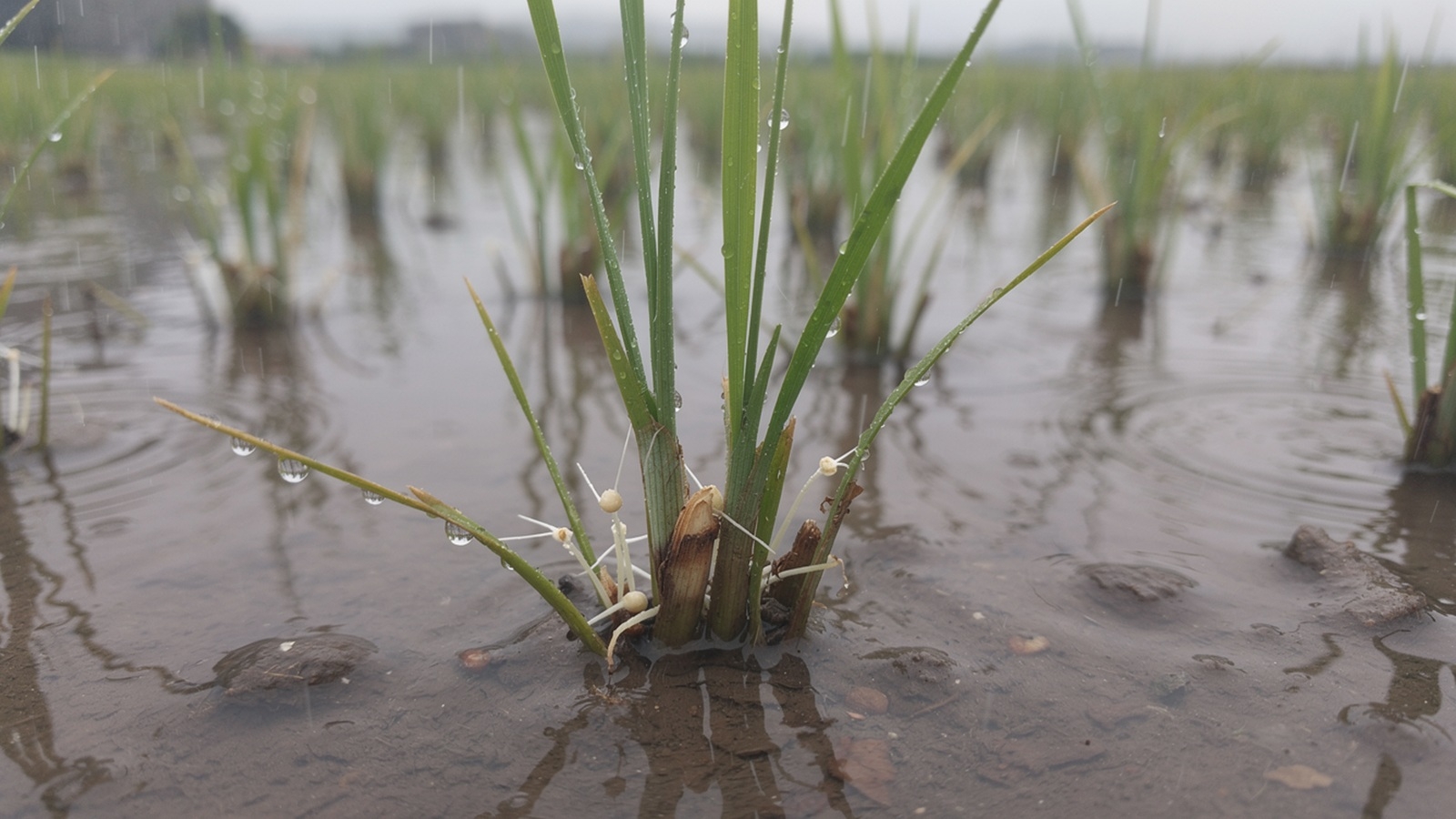

The results are clear. Grains exposed to the “sound of rain” germinated 30-40% faster than the others. In addition, the grains closest to the surface, therefore the most exposed to vibrations, reacted even faster.
Using hydrophones, the scientists confirmed that the laboratory vibrations were identical to those recorded during real downpours, validating the relevance of their experimental protocol.
What is the evolutionary advantage for a plant to sense rain?
This ability is a real major evolutionary advantage. By “listening” to the rain, a seed (or a grain of rice) can estimate its depth. If it clearly perceives the vibrations, this means that it is close enough to the surface for its young shoot to reach sunlight after germination, while being deep enough to benefit from humidity. It’s an extremely sophisticated survival strategy.
A seed buried too deep would not pick up the signal and would wait for better conditions. Germination at the wrong time or in the wrong place is a fatal energy expenditure.
This sound perception therefore acts as life insurance and guarantees that the seed is only activated when the conditions for success are optimal. Nature has equipped the seeds with a real survival sonar to read the score of their environment.
What are the future implications of this research?
This discovery opens up dizzying perspectives. First, it forces us to reconsider plant intelligence. Plants are not passive organisms; they actively perceive their world through channels that escape us.
This forces us to see the ecosystem as a complex network of information where sound plays as crucial a role as light or soil chemistry. Researchers suspect plants could also be sensitive to the sound of the wind or other natural vibrations.
On a more practical level, this work could influence agriculture. Understand how the sound stimuli affect germination could lead to the development of new techniques to improve crop yields.
We could imagine acoustic treatments to synchronize and accelerate the emergence of seedlings, optimizing the use of water and resources. This research, as Professor Makris nicely puts it, gives a new meaning to a Japanese micro-season: “The falling rain awakens the earth”.