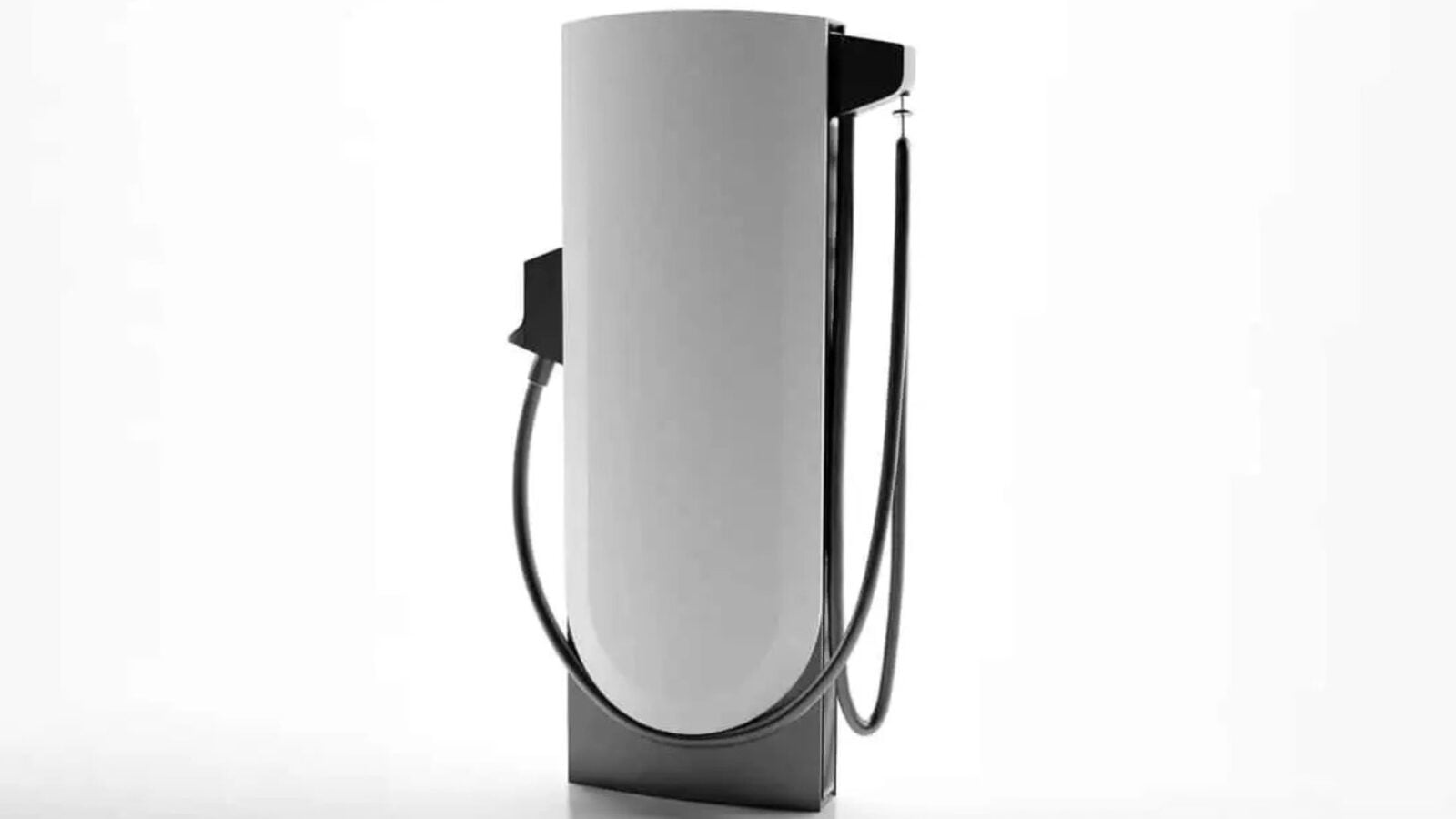
Tesla presents a new type of fast charger that is not a Supercharger. Here is the Basecharger, which closely resembles it, but which is intended for a very different use. This will power heavy goods vehicles like the Tesla Semi.
If BYD is gradually developing its Flash Charging network by planning 6,000 terminals around the world, including 100 in France by the end of the year, Tesla is in no hurry. Recharging in 9 minutes with a peak power of 1,500 kW promised by the Chinese therefore does not impress the American brand, which prefers to focus on another type of fast charger. So here is the Tesla Basecharger, which will not break power records. If it very closely resembles a Supercharger V4, it is in fact intended for a very different use.
125 kW versus 500 kW: why does Tesla voluntarily limit its power?
With a maximum power of 125 kW, exactly four times less than the flow rate that can be delivered by V4 Superchargers, the Basecharger will not make an impression. And since it will not be placed on the roads, it will be even more confidential. However, its deployment is well established, being intended for electric heavy goods vehicles such as the Tesla Semi, whose production is gradually ramping up. The idea here is not to quickly recharge trucks, but to reinvigorate their batteries overnight.
One night to leave: the challenge of intelligent slow charging
Logical when you think about it, because the Tesla Semi has batteries that can exceed 800 kWh. Charging on a 7 kW Wallbox would result in catastrophic downtime. However, all carriers know that a truck that does not run is a truck that loses money. The Basechargers therefore allow you to reinvigorate most of the batteries in one full night to resume the tour the next day. Tesla even claims that it will be possible to recover 60% charge in around four hours.
In this sense, the Basecharger will mainly be present in warehouse parking lots. To facilitate its installation, Tesla managed to integrate one of the 16 trays of the Supercharger V4’s electronic power cabinet directly into the body of the terminal. There is therefore no need to use a separate electrical cabinet which will clutter up the company parking lot. Up to three Basecharger terminals can be connected in series to a single circuit breaker to reduce installation costs.
$20,000 per unit: an economical investment for businesses
Tesla confirms that a Basecharger will be priced at a minimum of $20,000 per unit. Companies will nevertheless have to order at least two, and the price indicated does not include the installation of the terminals. Each terminal can supply up to 150 amps continuously with an output voltage between 180 and 1,000 volts. The cable is 6 meters long, double that of Superchargers for greater practicality. However, only the MCS connector fitted to the Tesla Semi is available.
CCS incompatibility: Does Tesla reserve the Basecharger for its own trucks?
Heavy trucks equipped with a CCS combo connector are therefore incompatible with Basechargers. An adaptation of the connectors will nevertheless be possible in the event of high demand. The arrival of the Basechargers is planned for next year if the schedule is respected. As a reminder, the equivalent of Superchargers for Tesla Semis are Megachargers, currently being deployed. These are capable of restoring up to 60% battery in half an hour.
👉🏻 Follow tech news in real time: add 01net to your sources on Google, and subscribe to our WhatsApp channel.