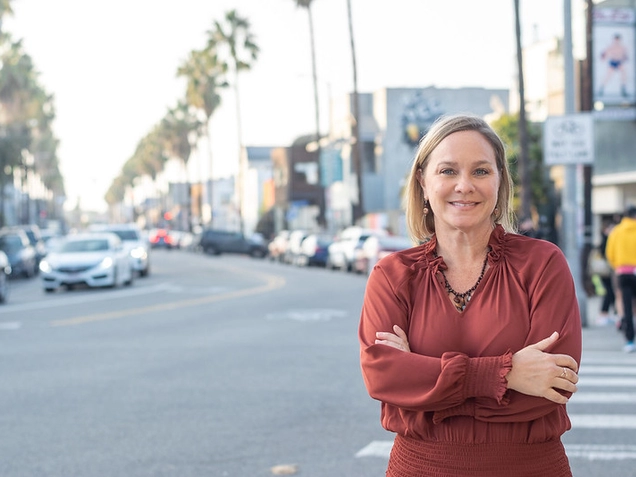
If you’re living in Westside LA Council District 11, represented by Councilmember Traci Park, every breath you take, every move you make, they’ll be watching you — at least if you’re driving a car.
Following up on an initiative first outlined by Park in December 2024, installation of 100 Automated License Plate Readers (ALPR), funded by discretionary funds from Park’s office, is underway in places like Mar Vista, Brentwood, Venice, and Westchester, with more sites to come.
The sheer number of cameras involved in the Westside initiative is noteworthy. When the Flagstaff AZ city council voted unanimously on December 16, 2025, to cancel its surveillance camera contract, due in part to concern about which government agencies would have access to the massive data collection, an estimated 30-plus cameras were involved. In Santa Cruz, which recently became the first California city to cancel its camera contract, the city council approved acquiring up to 14 cameras in December 2023, and likely used eight.
It’s not clear where the popular demand for the 100 ALPRs in Park’s district originated, other than the Ring Camera/Nextdoor crowd familiar to any neighborhood activist. A January Facebook post by Traci Park showing camera installation at four sites in CD 11 included shots of neighborhood residents looking pleased by the developments. The police are certainly fans. In 2024, LAPD was part of a project to place 100 ALPRs in the San Fernando Valley, and they already have hundreds of such cameras attached to many police vehicles. Park herself certainly is a big time booster.
Park stated in the Facebook post, “We’re giving LAPD the tools they need to fight crime smarter, faster and more effectively. Even while the department remains understaffed, the reality is simple. We don’t have the number of officers we should have on the streets and while we continue to rebuild LAPD’s ranks, we’re not going to sit back and let criminals take advantage of the gap. These cameras put eyes on the community.” She also noted that the cameras work 24/7, and they don’t take breaks.
The cameras certainly put eyes on the community, for better or worse. Consider what the cameras capture. They don’t actually monitor every breath you take. But, according to Flock Safety a major corporate player in the ALPR market (they’re active with more than 5,000 organizations), the cameras create a “vehicle fingerprint” that uses machine learning to identify key details such as make, body type (e.g., SUV, pickup truck), color, resident or non resident vehicle, type of plate (standard/contemporary), missing plate, and other identifiers such as roof rack, tool box, window, sticker, etc. The data gathering system also has the ability to include certain other information, including individual name, address, date of birth, and criminal charges.
Of the 320 million images gathered in Los Angeles image scans, 99.9% are for vehicles which were not on a vehicle hotlist when the image was made. All of this information lays the groundwork for a Minority Report-style “pre-crime” operation with serious civil liberties implications.
Somewhat eerily, in dry bureaucratese, the California Attorney General’s office lays it out: the massive data collected by Advanced License Plate Readers can track a vehicle across several locations, including from a person’s home to a workplace, to a medical provider office that provides abortion care, and then back again. When agencies across various jurisdictions share the data, a vehicle may be followed not just within a city, but in the county as well, even the entire state of California. Pretty scary.
Even as the Park initiative moves forward from Brentwood to Venice, there are red flags galore at the national, state, and local levels.
At the congressional level, Senator Ron Wyden (D-Oregon), has been on the case for a while, particularly when it comes to wringing privacy reforms out of Flock, which supplies cameras for the LAPD and many other localities.
While Wyden won a commitment on privacy protection from Flock Safety in July 2025, by October of last year, he effectively threw up his hands when it came to actual reforms by the company in an October 16, 2025 letter to Flock Safety CEO Garrett Langley. In that letter, Wyden said that “Flock cannot live up to its commitment to protect the privacy and security of Oregonians. Abuse of Flock cameras is inevitable and Flock has made it clear that it takes no responsibility to prevent or detect that.” Somewhat ominously, the senator added that “Flock has built a dangerous platform in which abuse is almost certain.” The letter also cited an August 2025 News in Denver report that a Flock pilot program, which has since ended, enabled U. S. Customs and Border Protection to have system access to search data collected by Flock’s cameras.
When it comes to such abuse, there may be no better example of what’s going wrong than in the tech savvy Silicon Valley town of Mountain View. In early February, Mountain View turned off cameras because Flock allowed out-of-state agencies to search Mountain View’s license plate data without the city’s permission, despite the existence of state law that prohibited such use. Localities that accessed the Mountain View data without permission included the Bureau of Alcohol, Tobacco, Firearms and Explosives, Langley Air Force Base in Virginia, and two federal Offices of Inspector General. According to the City of Mountain View, It’s not clear whether the city will continue its relationship with Flock Safety.
Turns out it’s one thing to enact a law, and another thing to to enforce it with an industry as lightly regulated as ALPRs.
In California alone, where more than 230 localities use ALPRs, the abuses are widespread, despite restrictive state law. A UCLA Daily Bruin investigation found that, state law notwithstanding, Los Angeles County Sheriffs, citing labor union concerns, have yet to ban the sharing of license plate data with out-of-state entities. The LA County Sheriffs use more than 1,000 ALPRs in the county, along with 44 on-patrol cars. The Los Angeles County Sheriffs retain data gathered for a staggering five years.
In May 2023, a group of California civil liberties groups, including American Civil Liberties Union Socal, said their investigations showed that 71 California police agencies, including 11 in Los Angeles County, shared license plate information with out-of-state agencies, an apparent violation of state law.
The principal concern of the civil liberties groups was that this information could enable, for example, prosecution of abortion seekers and providers in anti-abortion states for actions taken in California. The letter noted “law enforcement officials” in anti-abortion jurisdictions who receive the locations of drivers collected by California-based ALPRs may seek to use that information to monitor abortion clinics and the vehicles around them and closely track the movements of abortion seekers and survivors.
Then there’s the El Cajon police department, which simply refuses to recognize the validity of that portion of state law which prohibits sharing of its ALPR data with out-of-state entities. This came to the attention of State Attorney General Rob Bonta. According to an October 3, 2025 filing in the Superior Court of the State of California, County of San Diego, the El Cajon Police Department admitted it shared ALPR data with out-of-state entities which, unrestricted by California state law, can turn the data over to federal agencies and others.
In the case of state oversight of ALPRs, Attorney General Bonta’s move on El Cajon is a positive sign (he also issued much needed, commendable ALPR guidance in October 2023). It may, however, be a matter of two steps forward, one step back at the state level. Here is where the increasingly conservative Governor Gavin Newsom comes in. In early October 2025, Newsom vetoed an ALPR reform bill, SB 274, which, among other things, limited the number of license plate lists local police agencies could use and generally imposed a 60-day record retention limit. According to Newsom, the bill did not strike the right balance between protecting individual privacy and public safety.
Going forward, what’s to be done? Considering the number of red flags raised by ALPRs in California and elsewhere, it doesn’t make much sense for a major expansion of camera activity to be funded by the “discretionary” funds of an individual council member. The civil liberties issues involved require an end to that dubious process and the beginning of rigorous action and oversight and action by the full LA City Council. There are some good signs. On March 2,2026, the Los Angeles Police Commission said it wants to know more about how data from Flock Safety is stored and shared. Commissioner Jeff Skobin requested a report from LAPD, citing conversations with city officials, residents and news reports suggesting that federal agencies are using Flock Safety data as part of an immigration crackdown.
CD 11 appears to be a test case for the lightly regulated expansion of ALPRs in Los Angeles. As a result, its residents now face increased possibilities of data derived from the cameras being used by federal agencies of other out-of-state entities, of having the data hacked by entities up to no good, as well as the distinct possibility of door to door tracking of daily activities for a targeted vehicle.
In the short term, the council could stop entering new contracts with Flock until it determines why cities in California and elsewhere cancelled their contracts with the firm. In the longer term, the council could enact reforms included in SB 274, the bill vetoed by Governor Newsom. It could also shorten the data retention period from 60 days to 10 days, and require comprehensive auditing, tracking and training that addresses civil liberties issues.