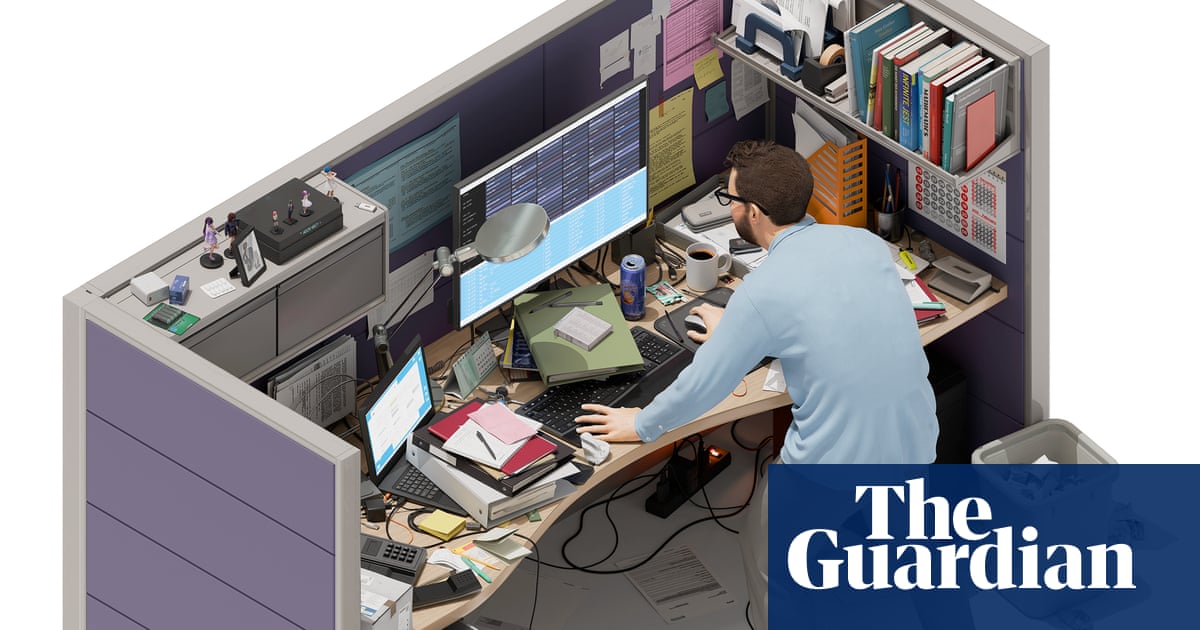
Not long after the terms “996” and “grindcore” entered the popular lexicon, people started telling me stories about what was happening at startups in San Francisco, ground zero for the artificial intelligence economy. There was the one about the founder who hadn’t taken a weekend off in more than six months. The woman who joked that she’d given up her social life to work at a prestigious AI company. Or the employees who had started taking their shoes off in the office because, well, if you were going to be there for at least 12 hours a day, six days a week, wouldn’t you rather be wearing slippers?
“If you go to a cafe on a Sunday, everyone is working,” says Sanju Lokuhitige, the co-founder of Mythril, a pre-seed-stage AI startup, who moved to San Francisco in November to be closer to the action. Lokuhitige says he works seven days a week, 12 hours a day, minus a few carefully selected social events each week where he can network with other people at startups. “Sometimes I’m coding the whole day,” he says. “I do not have work-life balance.”
Another startup employee, who came to San Francisco to work for an early-stage AI company, showed me dismal photos from his office: a two-bedroom apartment in the Dogpatch, a neighborhood popular with tech workers. His startup’s founders live and work in this apartment – from 9am until as late as 3am, breaking only to DoorDash meals or to sleep, and leaving the building only to take cigarette breaks. The employee (who asked not to use his name, since he still works for this company) described the situation as “horrendous”. “I’d heard about 996, but these guys don’t even do 996,” he says. “They’re working 16-hour days.”
Startups have never been particularly glamorous. When I started reporting on the industry a decade ago, people were cashing in on the new mobile app economy, and coders were chugging Soylent to stay at their desks longer. Startups then, too, were defined by hustle culture, high-octane energy and the pursuit of growth at all costs – ideas that, to some extent, have remained in the bloodstream of the industry.
But in the last year, as the magic dust of artificial intelligence has settled in San Francisco, the vibe among tech workers does seem different. The excitement about a new era in tech – and all the money that comes with it – is now tempered with anxieties about the industry, and the economy. Some workers are going all in on AI while also questioning whether all that AI is good for the world. Others are effectively training machines to do their jobs better than they can. And many of the same workers who are racing to build the future are now wondering if the future they’re building has a place for them in it.
The rest of us may be ambiently aware of these anxieties, but they are already tangible and keenly felt inside the tech industry. Even the biggest tech companies, once known for coddling employees with on-site massages and barber shops, have scaled back perks as they have escalated the expectations of workers. Mark Zuckerberg and Elon Musk have each been candid about their predictions that AI will replace some junior and mid-level engineers at their companies, and have respectively called for their workforces to be more “efficient” and “extremely hard core” as waves of layoffs set employees on-edge. Tech companies laid off about a quarter of a million workers around the world in 2025, according to a report published by RationalFX. In many of those layoffs, AI was cited as a main factor, even if the full reason for layoffs is often more complex.
“If you were a software engineer five years ago, you could kind of write your ticket,” says Mike Robbins, an executive coach who has worked with companies like Google, Microsoft, Salesforce and Airbnb. Now, the balance of power has shifted away from tech workers, many of whom are left feeling anxious about their work performance. “When companies become less scared about losing employees, then they can be a little more forthright in terms of what they want and be a little more demanding.”
Robbins, who wrote the book Bring Your Whole Self to Work, used to be asked to speak to companies and their leaders about topics like employee burnout, well-being and belonging – top priorities in the years during and shortly after the pandemic. “Quite frankly, we’ve stopped talking about all that,” he says. Now, company leaders want advice on topics like change, disruption and uncertainty in the workplace.
Those themes – change, disruption and uncertainty – are each part of the fuel that has driven tech workers to put in more hours, at a higher intensity. Investment in artificial intelligence companies reached record highs in 2025, yet workers are feeling scarcity in ways they haven’t before.
“It’s definitely something that’s on everyone’s mind,” says Kyle Finken, a software engineer at Mintlify, which makes an AI tool for developers. “I think a lot of people are concerned like, ‘Oh, am I going to have a job in three years?’”
Despite his fears, Finken, like many other startup employees I spoke to, feels energized by the “extraordinary innovation” happening in artificial intelligence and believes that there will still be plenty of jobs for software engineers in the future, even if those jobs look different from the pure coding roles of today. He and other tech workers characterized the current moment as a particularly creative and productive time in tech, where people are devoting extra hours to work not because their employers demand it but out of genuine interest in the new tools and capabilities. For example, Garry Tan, the head of the famous startup accelerator Y Combinator, recently bragged that he “stayed up 19 hours” playing around with Claude Code.
Even those who felt excited about the pace of change acknowledged that AI was rapidly augmenting their work, in ways that could have uncertain outcomes for the jobs of the future. “This is definitely not an era of complacency,” says Finken.
One reason for working so many hours is to keep up with tools and technology that are changing nearly every day. If you take the weekend off, you can miss a major development, which makes it harder to keep up with what competitors are doing. Another reason is to have something to show future employers, especially as more junior-level jobs are replaced by AI.
“No one hires junior developers any more,” says Lokuhitige, the Mythril co-founder. Landing a job now requires “doing something cool”, he says, like building a new product or solving a problem that gets recognized as useful by larger companies. Job postings for entry-level tech jobs have dropped by a third since 2022, according to Indeed’s Hiring Lab, while job postings requiring at least five years of experience have risen. If you’re not grinding at a startup, you’re missing the prerequisite to get hired in the future.
What this means for the rest of us
While economists are torn about whether AI will replace most jobs or just change them, they seem aligned in the idea that AI has already reshaped a great deal of entry-level work and will continue to do so. A paper published by Stanford researchers in November found “substantial declines in employment for early-career workers” in industries exposed to AI and suggested that areas where change is already occurring could be like a “canary in the coalmine” for the rest of the economy. The Anthropic CEO, Dario Amodei, has suggested AI could eliminate about half of all Entry-level jobs in white-collar industries within the next five years.
The head of the International Monetary Fund recently predicted that 60% of jobs in advanced economies will be eliminated or transformed by artificial intelligence, “like a tsunami hitting the labor market”. In San Francisco, you can already see the early signs, as Uber drivers compete with self-driving Waymos, and baristas are replaced by robotic coffee bars. Professional business services that support the tech industry have also been negatively affected by the layoffs. The pressure to grind in the tech world could be an early signal – a harbinger for what many other industries will feel soon.
Robbins, the executive coach, says that companies once looked to Silicon Valley as a model of how they should operate, down to emulating policies like unlimited vacation days or adopting perks like free lunch in the office.
“There was an idealization of tech and Silicon Valley for a long time across the business world. Some of that has changed,” he says. “Now, people aren’t asking me to tell them what’s going on in the Valley so that they can adopt it, the same way they were a decade ago.”
Rather than a model of how we should all work, the tech industry may be a premonition for the anxiety and attempts to compensate that are coming for all of us.