✨ Quick summary
This article by SEO expert Tom Demers breaks down the biggest SEO changes coming in 2026, focusing on how AI-driven search, GEO, and Google’s evolving SERP experience will impact visibility, traffic, and measurement.
Key takeaways
- AI Overviews and AI Mode will continue expanding in search results, reshaping how users discover information and reducing traditional click-throughs.
- GEO will grow, but traditional SEO will remain the primary source of high-intent traffic, making a balanced strategy essential.
- Expect more bad GEO advice and increased spam, which could harm SEO if followed without care.
- Google’s SERP UX will change significantly, affecting organic listings, ads, and attribution.
- Measuring SEO results will become harder, pushing marketers to focus on real outcomes like leads and revenue rather than visibility metrics.
There’s a lot brewing in SEO coming into 2026:
- Google is rolling out new AI tools and features either directly to search or in ways that could impact search.
- While Google’s share of search remains dominant, there appear to be more legitimate threats to that near-monopoly than there have been in years (ChatGPT, Perplexity, “GEO”).
- AI tools for performing SEO tasks are advancing quickly.
So, which trends are particularly important for business owners and marketers to keep an eye on coming into 2026? We’re breaking down the ones you need to know.
Contents
- AI Overview and AI Mode will continue creeping into SERPs
- GEO will surge (but traditional SEO still won’t go away)
- Terrible GEO advice will run rampant
- We’ll see big changes to the Google SERP UX
- Measuring SEO results will become even more difficult
- There will be more focus on the tactics that move the GEO needle
- Reddit spam, list spam, and parasite SEO will go mainstream
- Review ransom and negative GEO will increase
- AI content will need to be improved
2026 SEO trends to watch
These are the SEO trends we’re keeping an eye on.
1. AI Overview and AI Mode will continue creeping into SERPs
AI Overviews were a major factor in SEO traffic in both 2024 and 2025, and that’ll be the case again in 2026.
Google has shown no signs of slowing down the rollout of AI Overviews, and it’s likely that we’ll see significant growth in some combination of AI Overviews and AI Mode in Google search results.
For instance, in January of 2025:
- 312 of the top 1,000 “What is” queries triggered AI Overviews.
- Only one of the top 1,000 “Roofing company in” queries had an AI Overview (and it was for “how to start a roofing company in Texas”).
As of December 2025, those numbers were:
- 794 of the top 1,000 “What is” queries triggered AI Overviews.
- Only five of the top 1,000 “Roofing company in” queries had an AI Overview (and those that did were for things like “how to start a roofing company in Texas” or “largest roofing company in X”).
Here’s what I currently see for a local query looking for roofing companies near me in 2025:
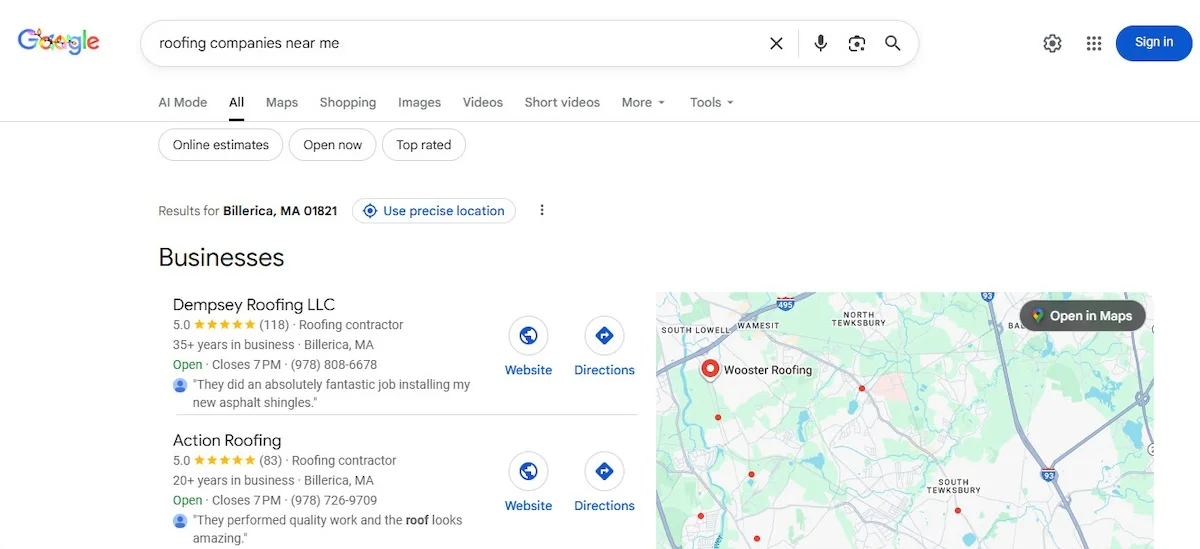
If you’re a local roofing company in this search result, your map listing and organic listing are still key (for now–and as long as your customers aren’t going right to ChatGPT).
But there are already examples of Google testing AI Overviews in place of map packs for certain queries in certain areas:
Starting to see search results where AI is replacing local packs 😱
This is not a better user experience. The 2nd business here actually has reviews, photos etc but they are not being pulled in because AI results are still pretty stupid. This result has:
1. AI results
2. LSAs… pic.twitter.com/54qgeZuTuQ— Joy Hawkins (@JoyanneHawkins) September 26, 2025
And Google has started testing allowing searchers to ask follow-up questions of an AI chatbot in search results as well (“ask anything”):
(1/2) Today we’re starting to test a new way to seamlessly go deeper in AI Mode directly from the Search results page on mobile, globally.
This brings us closer to our vision for Search: just ask whatever’s on your mind – no matter how long or complex – and find exactly what you… pic.twitter.com/mcCS7oT2FI
— Robby Stein (@rmstein) December 1, 2025
In terms of the immediate 2026 traffic impact, this may be the single most important trend for business owners and marketers to be aware of. A few things to keep in mind:
- There may be additional queries where you have to adjust your traffic expectations if AI Overviews take over.
- There may be opportunities to show up in AI Overviews or AI Mode that you’ll want to monitor and capitalize on when possible.
- You’ll want to understand how this traffic converts relative to Google Business Profile traffic, website traffic, and other channels like ads.
🔎 Need help understanding the modern rules for SEO? Download our free guide >> How to Do SEO Right—Right Now!
2. GEO will surge (but traditional SEO will remain alive and well)
Every transformative technology goes through surges and drops. The dot com boom and bust. For example, take a look at Bitcoin:

It would be naive to think that “GEO” and AI adoption will just go up and to the right without any dips or drawbacks.
It’s also important to keep in mind the relative scale of different platforms.
In August of 2024, ChatGPT reported it had 200 million weekly users. As of October 2025, the number was 800 million.
Incredible growth, but in 2024, Google already boasted:
“Six products with more than two billion monthly users, including three billion Android devices. Fifteen products have half a billion users.”
Studies have shown that sites generate 34x the search traffic from Google and traditional search engines that they get from chatbots (in other words: SEO traffic is ~34x GEO traffic).
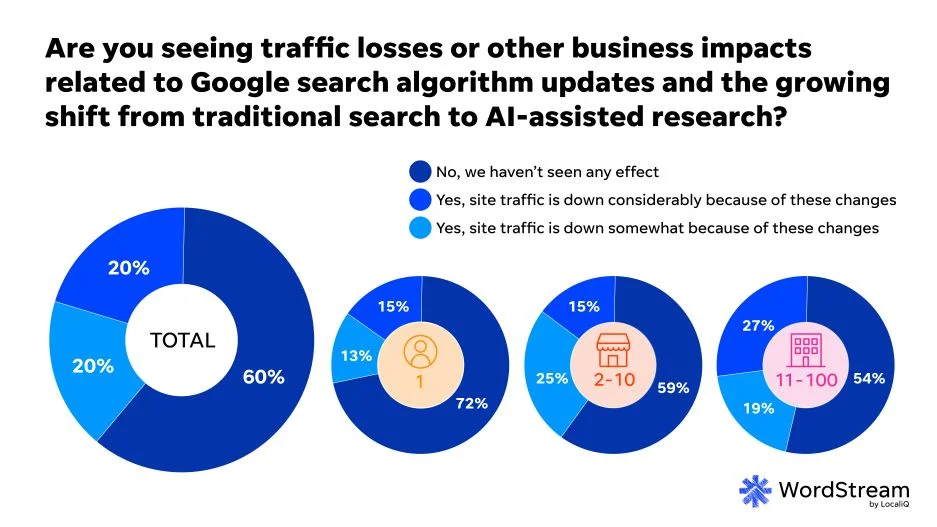
So while GEO traffic is growing and will be even more significant by the end of 2026, it’s much, much less than SEO traffic for now. In fact, WordStream’s Small Business Website Trends Report found that 60% of businesses hadn’t seen any impact to their website traffic as a result of AI-assisted search (yet).
In 2026, it’s likely that you will see GEO hype cycles and reactionary “sky is falling” doomsday predictions. A lot of GEO platforms are being built and backed by venture funds, which likely means:
- Those tools will get hyped up (often promising unrealistic traffic growth and opportunities) and invested in by marketing departments.
- Anyone not investing will be “slow-moving” and “behind.”
- Those marketing departments will realize the realities of the above data (that SEO is less dead than they thought, and GEO is less “here” than they thought) and become disillusioned with GEO traffic.
- GEO is dead/overblown/etc.
The reality is: 1) GEO is a very promising channel that will likely grow quickly in the coming months, 2) SEO is not going to go to zero and will continue to drive high-intent, profitable traffic, and 3) optimizing for both will have a lot of overlap.
What you can choose to do instead of overreacting to hot takes on LinkedIn is just follow the data. AI search traffic is going to grow over time (unevenly; some niches will see much more activity here than others), there will be opportunities to drive traffic, some tools will help with this, and many will give some useful data.
Pay attention to the real opportunity, and right-size your investment to the channel (regardless of which way the hype is blowing).
⬇️ Download our 2026 Small Business Website Trends Report to find out how businesses are planning and thinking about SEO and their web presence this year.
3. Terrible GEO advice will run rampant
Whenever a marketing channel becomes the “flavor of the week,” lots of bad advice about how best to leverage that channel inevitably follows. Right now, there’s a sprinkling of bad advice about how to get visibility and traffic from AI tools like ChatGPT, Perplexity, etc.
That bad advice is likely to grow significantly throughout 2026.

Most current GEO advice falls into two categories:
- A list of SEO best practices positioned as new, novel GEO best practices.
- A list of things that don’t actually impact GEO much, but that can be detrimental to a site’s SEO (where SEO is still driving 25-50x the traffic within that niche).
A lot of category 1 is relatively harmless, since it’s advice that helps your company’s SEO visibility and traffic, and will often be good advice for marketing generally.
The bigger threat, though, is category 2.
Some of the advice I’ve seen pushed, specifically, includes:
- Creating an “AI-friendly” copy of your site: This will have little to no impact on traffic from LLMs, and if not implemented properly, can cause a lot of SEO issues.
- Creating tons of highly specific “GEO pages:” These will often be seen as thin or low-value content by Google, you frequently won’t have actual evidence that these are frequently asked questions in LLMs (there is no “ChatGPT keyword tool” yet), and generating them will have relatively low impact on actual LLM visibility and traffic.
- Spam listicle placements: While showing up on lists relative to your business’s core category is a great way to improve visibility and traffic from LLMs, generating your own listicles on low-quality sites that LLMs aren’t using as sources without properly vetting those sites is a good way to get your site penalized in Google without actually improving your GEO position.
A lot of the things that “GEO experts” are pushing are both not going to move the needle for GEO and are detrimental to SEO.
4. We’ll see big changes to the Google SERP UX
Google is in a very interesting position coming into 2026:
- They are facing a lot of competition from OpenAI and other AI companies.
- They are still the dominant player in search, and many feel they have a massive advantage in the AI space generally as well (they have lots of data across a lot of platforms–search, Gmail, Google Drive, Android, YouTube, etc.).
- They have to balance building out AI tools, keeping search share, and making money for shareholders.
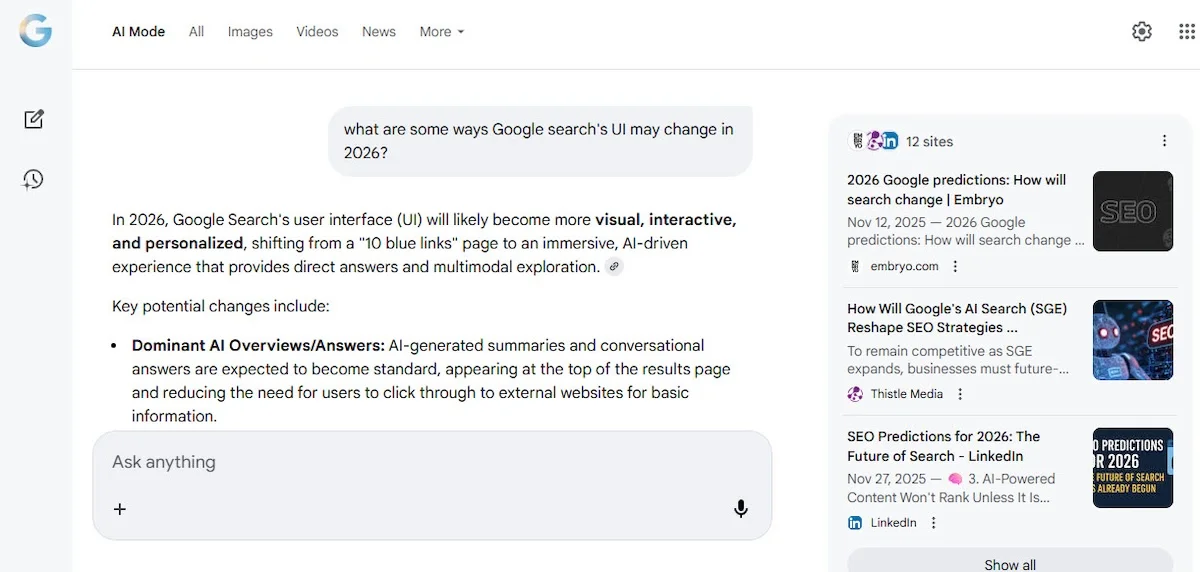
All of this will likely lead to a lot of changes to search results throughout 2026. Ask Anything is being integrated in various ways:
Another variation of the ‘Ask anything’ unit on desktop. This time featuring the coloured animation for the AI Mode text that has appeared in the past for other related features, along with the more descriptive title. https://t.co/o8vWrkcyAO pic.twitter.com/9NCWH4ZRDH
— SERP Alert ⚡️ (@SERPalerts) November 28, 2025
They’ve even tested “giving back” to publishers and site owners by adding more links in-line in AI Overviews:
Seeing more and more links in Google’s AI Overviews! – This one has 7 in-content links directly to the source material!!
This is amazing.
Big shoutout and thanks to @sundarpichai credit where it is due, this could keep the open web thriving for decades to come.
If @sama… pic.twitter.com/lcMh6E0nzg
— Joe Youngblood – SEO, Futurology, AI, Marketing (@YoungbloodJoe) November 25, 2025
And they’ve rolled out “Sponsored Results” that look just like organic listings that have led to accidental clicks.
Serving these various masters and working to integrate AI in a way that’s beneficial for users while increasing revenue and profits will likely mean a lot of changes to how search results are formatted in 2026.
This is incredibly important information in that it can help you:
- Understand why your ads may be clicked on more frequently.
- Understand why your traffic may rise or drop (if your listing is featured or de-emphasized by a specific SERP shake-up).
- Identify opportunities to show up in the search features that Google emphasizes in your search results.
5. Measuring SEO results will become even more difficult
A few specific things can complicate data analysis for companies focusing on SEO and GEO in 2026:
- Google limited the ability to see 100 results in SERPs, which hamstrung third-party SEO tools that had been tracking rankings.
- OpenAI was a customer of SERP API, which scrapes Google search results. As Google competes with other LLMs for market share, it’s possible that it may limit access to data generally to keep an informational edge over competitors like ChatGPT.
- Without an ad product (though there are rumors one may come in 2026), tools like ChatGPT don’t have an incentive to share prompt data the way Google shares search data for PPC advertisers. As a result, you have a lot of LLM tools guessing at which prompts you should be targeting and tracking, and guessing at prompt frequencies and true visibility.
- Those selling GEO services or tools have an incentive to exaggerate the impact of GEO and visibility in LLMs.
- Some data anomalies in tools like Google Search Console may be created by increased usage of third-party GEO tools.
It’s going to be especially important for businesses to focus on connecting KPIs (actual site visits, leads, and qualified leads and sales) to the proper channels without getting distracted or misled by inconsistent data around visibility metrics.
6. There will be more focus on the tactics that move the GEO needle
As more companies focus on GEO (even if there is somewhat of a reckoning at some point in 2026), the actual tactics that move the needle on GEO visibility will get more focus and investment, namely:
- Links, particularly on the right lists, pages, and sites.
- Mentions, again, particularly in the right places.
- “Off-site on-page SEO,” meaning the actual content and verbiage surrounding off-page links and mentions.
Much of this activity was already best-practice SEO activity, but as companies see how much this type of work moves the needle on GEO visibility, it’ll be more and more of a focus in 2026.
7. Reddit spam, list spam, and parasite SEO will go mainstream
First, people realize that a tactic or platform is valuable:
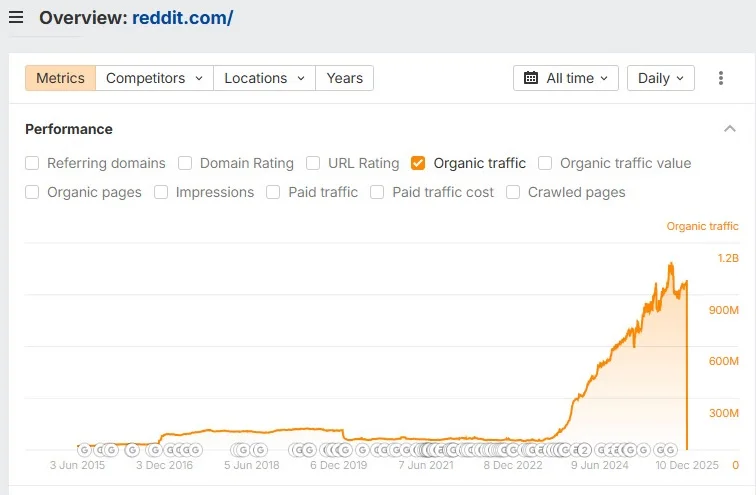
Even if the value wanes somewhat:
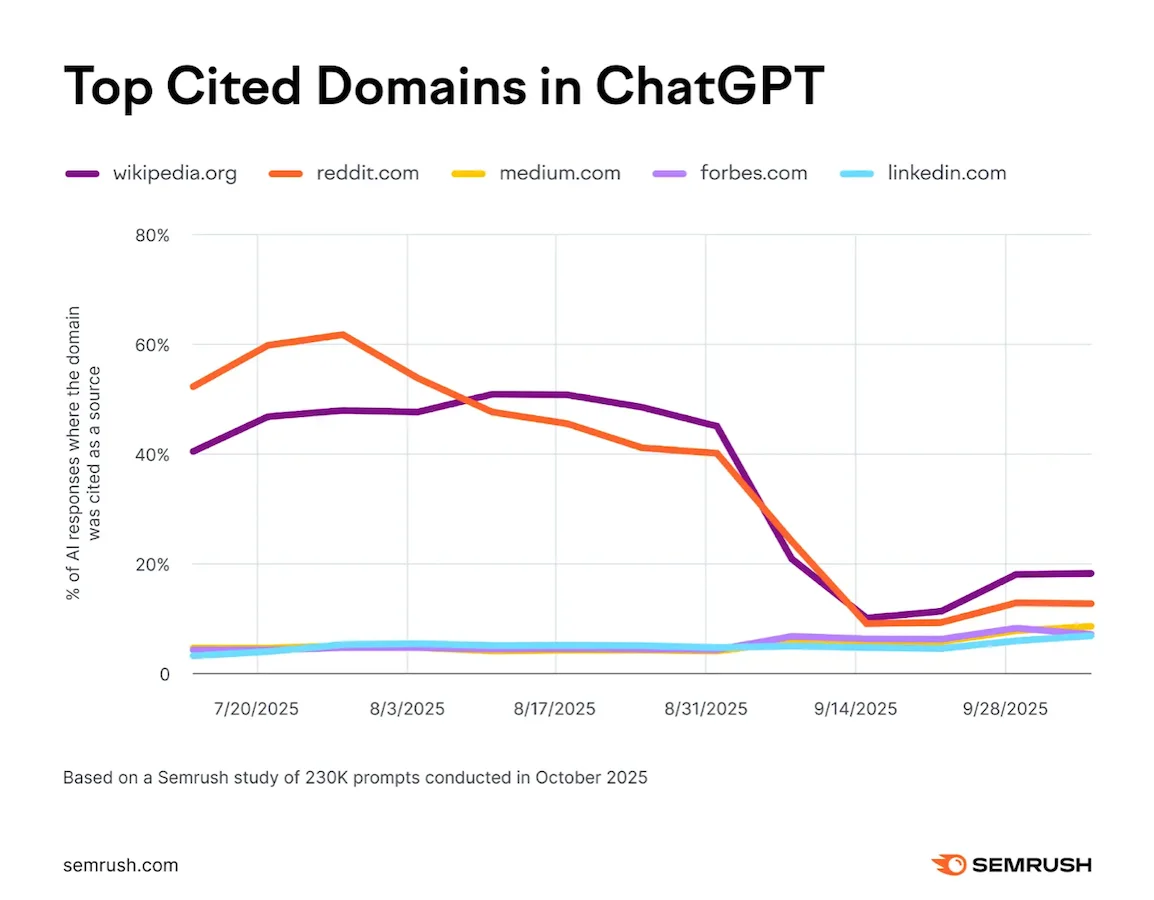
Source
Then, people leverage the tactic more, and the same tactic tends to get spammed more and more:
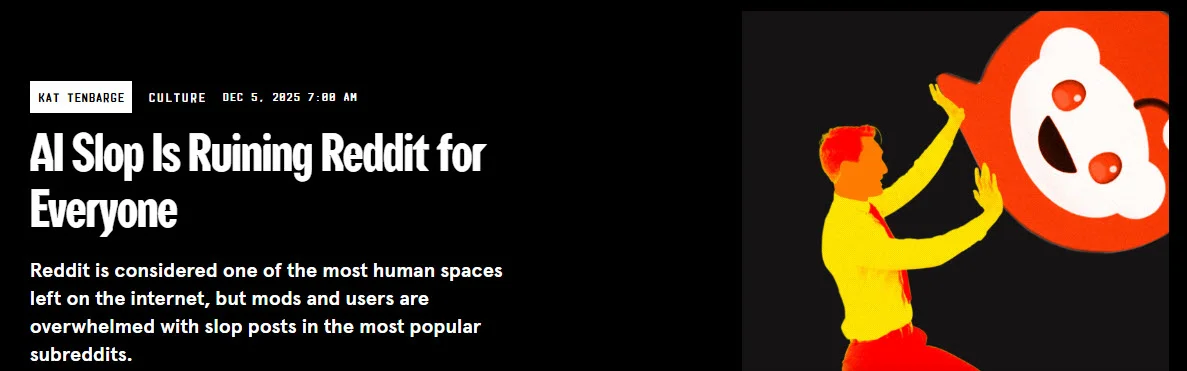
This is already happening on Reddit and on third-party authority sites, of course, but the more businesses recognize that mentions in these places move the needle (especially if the Reddit numbers swing back up), the more rampant spam will become as 2026 progresses.
8. Review ransom and negative GEO will increase
Negative SEO and review ransom aren’t new. As more users turn to LLMs for information and research, and platforms leverage review sources other than Google, some people will game these systems, too. For their own business’s benefit, but also for even more nefarious purposes.
When you do have someone reach out to you threatening to ruin your review rating, save any relevant evidence or information, and you can work on reporting the ransom/attacks through relevant channels.
9. AI content will need to be improved
A lot of the content being created for the web is now straight AI content, or “AI-assisted” in some way. And that includes the words, images, videos, etc.
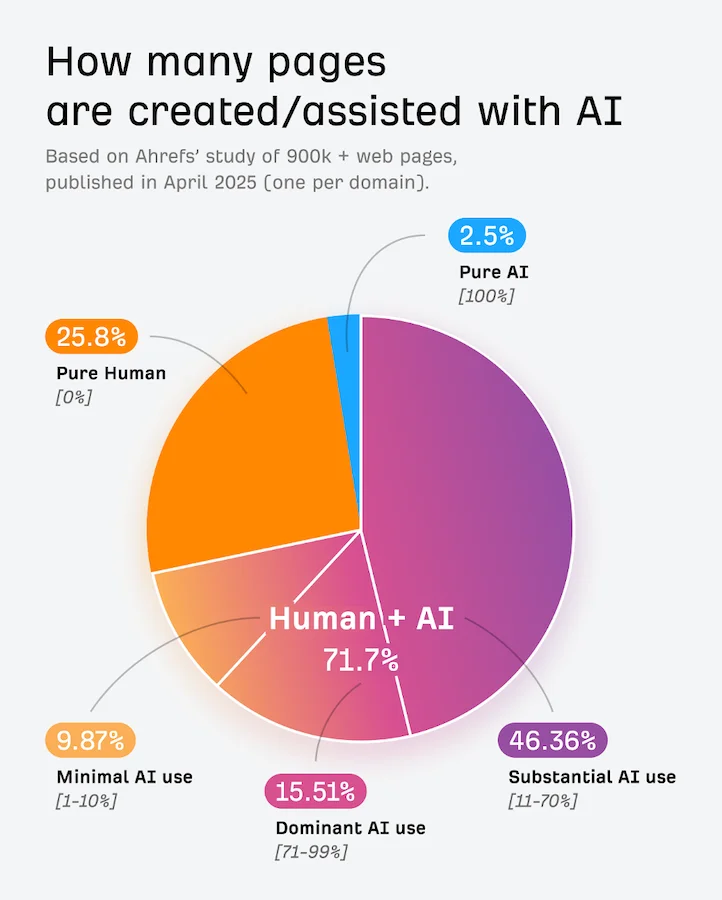
Source
There are a lot of tools to help create content with AI. They’re still quite limited, and there will be skills (like original storytelling) that they may never master, but lots of tasks that they’re currently being used for:
- Researching third-party data and stats.
- Writing hooks, titles, and offers.
- Creating generic copy to fill out programmatic pages and add some simple context around scaled data.
Late in 2025, new versions of tools like Nano Banana, Google Veo, Sora, and more were released. The AI arms race will push the major players to keep releasing updates and new toolsets, and an influx of VC money into AI tools won’t hurt the development of these capabilities either.
There are areas where these tools will improve and become better (particularly at scale) than humans (if they’re not already). This will mean a few things for businesses:
- Table stakes for content quality will be going up.
- The number of content assets filling what had been “content gaps” will go through the roof.
- The content types that produce GEO results will have tools tailored to creating them (and the content outputs will get better)–trends colliding.
What these 2026 SEO trends mean for you
The businesses and content creators who can simultaneously read the larger trends of where search is going and what works, while also finding ways to leverage new AI-powered tools, will be the most outsized winners in 2026.
Here are the 2026 SEO trends to keep an eye on:
- AI Overview and AI Mode will continue creeping into SERPs
- GEO will surge (but traditional SEO still won’t go away)
- Terrible GEO advice will run rampant
- We’ll see big changes to the Google SERP UX
- Measuring SEO results will become even more difficult
- There will be more focus on the tactics that move the GEO needle
- Reddit spam, list spam, and parasite SEO will go mainstream
- Review ransom and negative GEO will increase
- AI content will need to be improved
And remember, trends may come and go, but the SEO best practices that move the needle are forever (until Google and other search engines change them 🙃).