By using this site, you agree to the Privacy Policy and Terms of Use.
Accept
World of SoftwareWorld of SoftwareWorld of Software
  • News
  • Software
  • Mobile
  • Computing
  • Gaming
  • Videos
  • More
    • Gadget
    • Web Stories
    • Trending
    • Press Release
Search
  • Privacy
  • Terms
  • Advertise
  • Contact
Copyright © All Rights Reserved. World of Software.
Reading: WormHole Algorithm Outperforms BiBFS in Query Efficiency and Accuracy | HackerNoon
Share
Sign In
Notification Show More
Font ResizerAa
World of SoftwareWorld of Software
Font ResizerAa
  • Software
  • Mobile
  • Computing
  • Gadget
  • Gaming
  • Videos
Search
  • News
  • Software
  • Mobile
  • Computing
  • Gaming
  • Videos
  • More
    • Gadget
    • Web Stories
    • Trending
    • Press Release
Have an existing account? Sign In
Follow US
  • Privacy
  • Terms
  • Advertise
  • Contact
Copyright © All Rights Reserved. World of Software.
World of Software > Computing > WormHole Algorithm Outperforms BiBFS in Query Efficiency and Accuracy | HackerNoon
Computing

WormHole Algorithm Outperforms BiBFS in Query Efficiency and Accuracy | HackerNoon

News Room
Last updated: 2025/10/16 at 8:23 PM
News Room Published 16 October 2025
Share
WormHole Algorithm Outperforms BiBFS in Query Efficiency and Accuracy | HackerNoon
SHARE

Table of Links

Abstract and 1. Introduction

1.1 Our Contribution

1.2 Setting

1.3 The algorithm

  1. Related Work

  2. Algorithm

    3.1 The Structural Decomposition Phase

    3.2 The Routing Phase

    3.3 Variants of WormHole

  3. Theoretical Analysis

    4.1 Preliminaries

    4.2 Sublinearity of Inner Ring

    4.3 Approximation Error

    4.4 Query Complexity

  4. Experimental Results

    5.1 WormHole𝐸, WormHole𝐻 and BiBFS

    5.2 Comparison with index-based methods

    5.3 WormHole as a primitive: WormHole𝑀

References

5 EXPERIMENTAL RESULTS

In this section, we experimentally evaluate the performance of our algorithm. We look at several metrics to evaluate performance in different aspects. We compare with BiBFS, a traversal-based approach, and with the indexing algorithms PLL and MLL. We test several aspects, summarized next. Detailed results are provided in the rest of this section.

(1) Query cost: By query cost, we refer to the number of vertices queried by WormHole, consistent with our access model (see §1.2). We show that WormHole actually does remarkably well in terms of query cost, seeing a small fraction of the whole graph even for several thousands of shortest path inquiries. See Figures 2(b) and 5.

(2) Inquiry time: We demonstrate that WormHole𝐸 achieves consistent speedups over traditional BiBFS, even while using it as the sole primitive in the procedure. More complex methods such as PLL and MLL time out for the majority of large graphs. We also provide variants that achieve substantially higher speedups. Finally, in §5.3, we show how using the existing indexing-based state or the art methods on the core lets us achieve indexing-level inquiry times. See Figure 1.

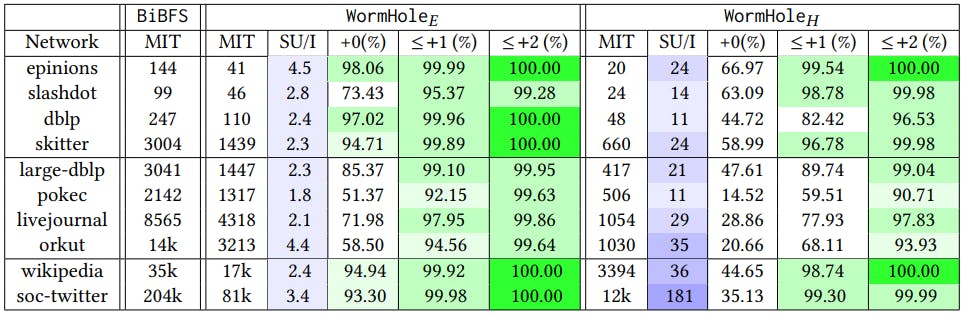
(3) Accuracy: We show that our estimated shortest paths are accurate up to an additive error 2 on 99% of the inquiries for the default version WormHole𝐸; a faster heuristic, WormHole𝐻 , shows lower accuracy, but still over 90% of inquiries satisfy this condition. See §5.1 and Table 3 for details.

(4) Setup: We look at the setup time and disk space with each associated method. Perhaps as expected, WormHole𝐸 beats the indexing based algorithms by a wide margin in terms of both space and time: see Figure 7. In §5.3 we further show that using these methods restricted to Cin results in a variant WormHole𝑀 with much lower setup cost ( Table 6).

Datasets. The experiments have been carried out on a series of datasets of varying sizes, as detailed in Table 2. The datasets have been taken either from the SNAP large networks database [36] or the KONECT project [34]. We organize the results into two broad sections: we first introduce two variants
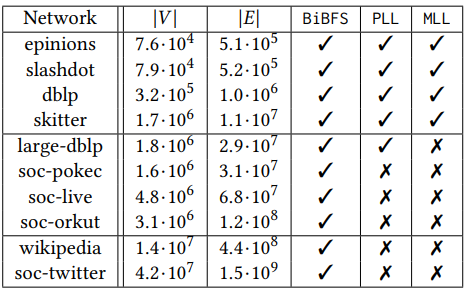
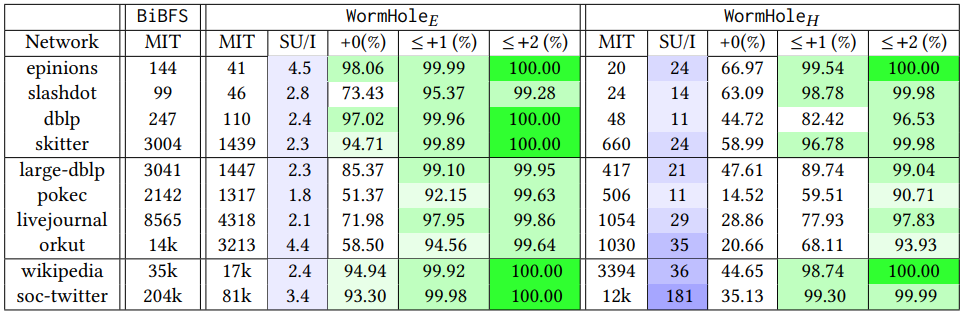
Table 2: Network datasets used for experimental evaluation with their corresponding sizes. We observe that BiBFS finishes on all the datasets, but the indexing based methods do not on the medium and large networks. We were able to set up MLL on large-dblp in reasonable time, but the subsequent shortest path inquiries were met with consistent segmentation faults that we were unable to debug.

Table 3: Summary of WormHole with the two cases: WormHole𝐸, with the exact shortest path through the inner ring, and WormHole𝐻 that picks only the shortest path between the highest degree vertices – refer to §5.1. We note the mean inquiry times per inquiry (MIT) in microseconds, and average speed up per inquiry (SU/I) compared to BiBFS for each method. We also note the percentiles of inquiries by absolute error: for WormHole𝐸, we get absolute error under 2 for over 99% of the inquiries. This drops for WormHole𝐻 , but it is still above 99% for six of the ten datasets, and over 90% in all of them. Accuracy numbers are highlighted in green, where darker is better. Similarly, we have a gradient of violet for speedups; darker is faster. For WormHole𝐸, speedup over BiBFS per inquiry on average is usually between 2× and 3×, but this increases to consistently between 20−30× in WormHole𝐻 , and reaches a max of 181× in our largest dataset, soc-twitter.

of our algorithm. We then compare it with BiBFS as well as indexing based methods – PLL and MLL. The latter two did not terminate in 12 hours for most of the graphs, while BiBFS completed on even our largest networks.

We classify the examined graphs into three different classes and use a fixed percentage as the ‘optimal’ inner ring size for graphs of comparable size (where the inner core size as % of the total size decreases for larger networks, an indication for the sublinearity of our approach). This takes into account the tradeoff between accuracy and the query/memory costs incurred by a larger inner ring. The classification is summarized in Table 1. For the experimental section, we default to these sizes unless mentioned otherwise.

Implementation details. We run our experiments on an AWS ec2 instance with 32 AMD EPYC™ 7R32 vCPUs and 64GB of RAM. The code is written in C++ and is available in the supplementary material as a zipped folder, with links to the datasets. The backbone of the graph algorithms is a subgraph counting library that uses compressed sparse representations [45].

:::info
Authors:

(1) Talya Eden, Bar-Ilan University ([email protected]);

(2) Omri Ben-Eliezer, MIT ([email protected]);

(3) C. Seshadhri, UC Santa Cruz ([email protected]).

:::


:::info
This paper is available on arxiv under CC BY 4.0 license.

:::

Sign Up For Daily Newsletter

Be keep up! Get the latest breaking news delivered straight to your inbox.
By signing up, you agree to our Terms of Use and acknowledge the data practices in our Privacy Policy. You may unsubscribe at any time.
Share This Article
Facebook Twitter Email Print
Share
What do you think?
Love0
Sad0
Happy0
Sleepy0
Angry0
Dead0
Wink0
Previous Article AT&T settles 7 million data breach lawsuit — here’s how you can claim your share up to ,500 AT&T settles $177 million data breach lawsuit — here’s how you can claim your share up to $7,500
Next Article Here’s How To Use Them Here’s How To Use Them
Leave a comment

Leave a Reply Cancel reply

Your email address will not be published. Required fields are marked *

Stay Connected

248.1k Like
69.1k Follow
134k Pin
54.3k Follow

Latest News

DDoS attack knocks France’s postal service La Poste offline during holiday peak –  News
DDoS attack knocks France’s postal service La Poste offline during holiday peak – News
News
Rodeo is an app for making plans with friends you already have
News
Robert Downey Jr. Rejected An Oscar-Winning Sci-Fi Movie After Iron Man – BGR
News
Polar Loop Review: Whoop has nothing to worry about
Gadget

You Might also Like

Washington state Commerce chief Joe Nguyen is leaving, reportedly to lead Seattle Metro Chamber
Computing

Washington state Commerce chief Joe Nguyen is leaving, reportedly to lead Seattle Metro Chamber

3 Min Read
Meet the Writer: Two-Time Founder Sam Bhattacharyya on Accidentally Finding Product-Market Fit | HackerNoon
Computing

Meet the Writer: Two-Time Founder Sam Bhattacharyya on Accidentally Finding Product-Market Fit | HackerNoon

16 Min Read
Coding Rust With Claude Code and Codex | HackerNoon
Computing

Coding Rust With Claude Code and Codex | HackerNoon

15 Min Read
The HackerNoon Newsletter: The Most Dangerous Person on Your Team is Dave (And He Just Quit) (12/26/2025) | HackerNoon
Computing

The HackerNoon Newsletter: The Most Dangerous Person on Your Team is Dave (And He Just Quit) (12/26/2025) | HackerNoon

3 Min Read
//

World of Software is your one-stop website for the latest tech news and updates, follow us now to get the news that matters to you.

Quick Link

  • Privacy Policy
  • Terms of use
  • Advertise
  • Contact

Topics

  • Computing
  • Software
  • Press Release
  • Trending

Sign Up for Our Newsletter

Subscribe to our newsletter to get our newest articles instantly!

World of SoftwareWorld of Software
Follow US
Copyright © All Rights Reserved. World of Software.
Welcome Back!

Sign in to your account

Lost your password?