If China’s demographic crisis is not reversed, if the world’s factories shrink and nothing stops the bleeding, its decline will drag and have effects throughout the world: from cost increases in consumer goods (telephones, footwear, electric vehicles) to inflationary pressures due to lower manufacturing efficiency. As an example, a “button”: thousands of kilometers from China, an entire population is already suffering from the lack of babies in Beijing.
In Ireland, no one imagined a situation like this.
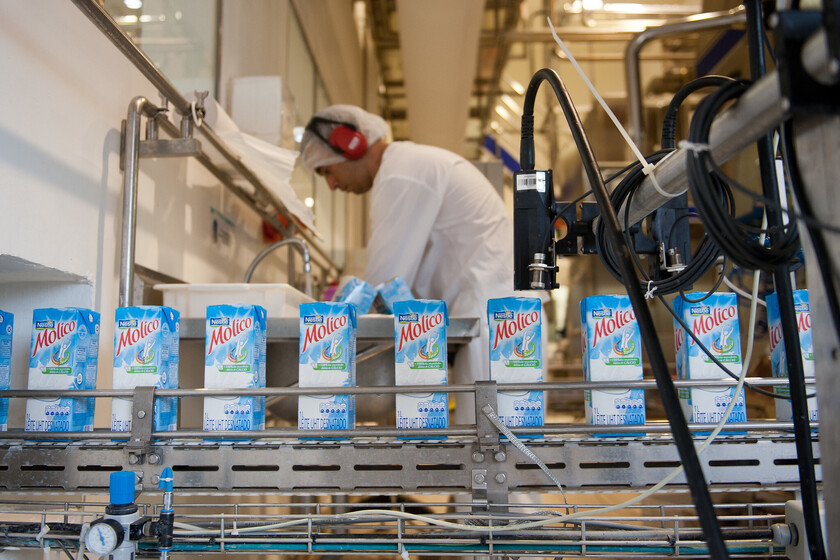
Industrial mirage. For years, the small Irish town of Askeaton, County Limerick, found its redemption in a factory that produced gold dust. It wasn’t a metaphor. Nestlé’s production lines produced infant milk for the Chinese market, a product so profitable that some workers nicknamed it “the white cocaine” of the town.
Overnight, that business transformed a town forgotten by modernization into a prosperous enclave, where credit flowed easily and employment was synonymous with stability. But when the Swiss managers arrived two years ago with the announcement of the closure, disbelief took over everyone. Nobody could conceive that such a modern plant, the result of a million-dollar investment, would simply be closed.
Rely on China. Nestlé attributed the decision to a macroeconomic reason: the plummeting birth rate in China. The number of births had fallen from 18 million in 2016 to just nine million in 2023, and demand for foreign infant formula was sinking. However, the New York Times reported that among the 1,100 inhabitants of Askeaton the official version was not convincing. There were those who suspected that the multinational was simply responding to a Chinese demand: to move production to Asian territory itself.
The argument made sense. For years, Nestlé had closed markets in Europe and the Middle East to concentrate exclusively on China. “We put all our eggs in the same basket,” Oliver Scanlon, one of the veterans of the place, remembers to the newspaper. And although the business experienced its golden age with that turn, everyone understood too late what it meant: China was not only buying the product, it was also learning how to manufacture it.
Silent learning. The workers recount how every year Chinese auditors arrived, curious to the extreme, writing down every technical detail of the industrial process. Sometimes they even visited neighboring farms, taking an interest in dairy production methods. “They came to learn,” said rancher Tim Hanley. “They can produce everything, and their goal is self-sufficiency.”
Ultimately, what happened at Askeaton was the consequence of a repeated pattern: the initial enthusiasm for the Chinese market ended with the transfer of knowledge and the relocation of production. In November 2023, just a month after announcing the Irish closure, Nestlé obtained authorization to open a twin plant in Suzhou, eastern China. While justifying the closure due to the drop in birth rates, the company proclaimed that the Chinese market “continued to be the largest in the world by the absolute number of newborns.”
Jobless. The Times recalled that the closure of the plant has left a visible scar. The machines stopped last month and, unless someone purchases the facilities for the 22 million euros at which Nestlé has valued them, the doors will close permanently in March. Layoffs, severance packages and outplacement programs have not compensated for the sense of loss.
The factory was the invisible engine that made local businesses run, from Seán Moran’s hardware store to the credit union, which for years granted loans with only a payroll as collateral. “It was a good salary and the town prospered,” admits Patrick Ranahan, head of the entity. “But we knew it could disappear from one day to the next.”

From globalization to dependency. The Askeaton case is an example of the vulnerability of local economies in the era of globalization. The sudden success, sustained by Chinese demand, masked the fragility of a model based on a single customer and a single market. What began as a story of international cooperation ended up being technology transfer disguised as prosperity.
In the process, China not only bought the product, but also the knowledge, and when it was ready to replicate it, it simply cut ties. For Askeaton, the “crown jewel” has become a symbol of a bitter lesson: in global commerce, the shine of success can fade as quickly as the foam on the powdered milk that fed them for half a century.
Image | Nestle
In WorldOfSoftware | The great paradox of China’s demographic crisis: its origin is due to a policy that worked too well
In WorldOfSoftware | China knows that its population is going to collapse but it already has a long-term plan to solve it. Of course, thanks to AI