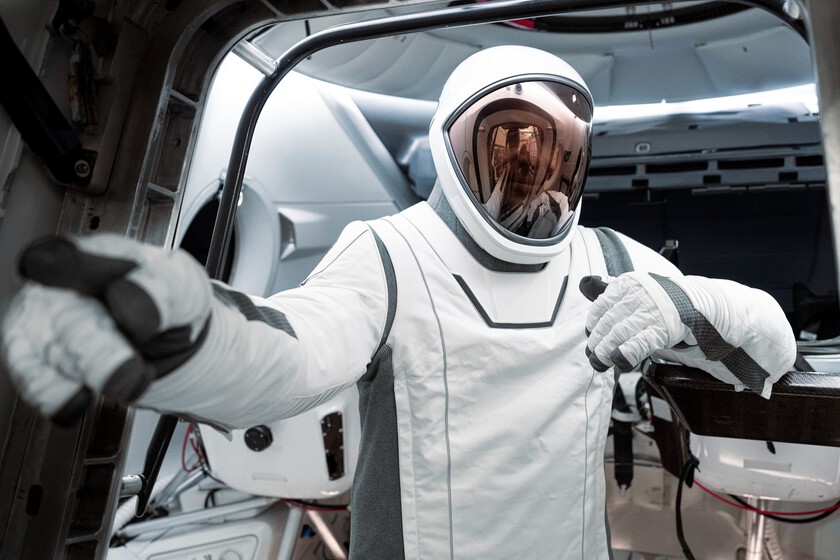
2025 has been a lost year for NASA. No rockets have exploded, no spacecraft have crashed, but political instability, lack of leadership and budget wars have decimated the morale and operational capacity of the US space agency. The most absurd thing of all? The self-inflicted harm has had the opposite effect of what the US government sought.
Nobody at the wheel. It all began on January 20, 2025, when Biden-era administrator Bill Nelson resigned as head of NASA. Janet Petro, director of the Kennedy Space Center, took over as acting administrator. In his six-month term he dedicated himself to complying with Trump’s divisive policies, starting with eliminating the space agency’s Diversity and Inclusion office.
Donald Trump had nominated the young billionaire Jared Isaacman, who flew into space twice with SpaceX, for the permanent position of administrator. Isaacman, who was seen as a business accelerationist, made it through his confirmation hearing in April 2025. Everything seemed done.
However, on May 31, shortly before Trump traded insults with Elon Musk, the White House abruptly withdrew his nomination. The official reason, published by Trump himself in Truth Social, was Isaacman’s “prior associations,” particularly his donations to Democratic candidates.
La era Duffy. NASA was left adrift. On July 9, Trump named his Secretary of Transportation, Sean Duffy, as acting administrator. Duffy, a former congressman with no aerospace experience, kept his Cabinet post while leading NASA, and is said to have maneuvered to integrate the historic space agency under the Department of Transportation.
But Sean Duffy’s stellar moment occurred on October 20, when he set the goal of returning to the Moon while Donald Trump was president. In order to get astronauts to the lunar surface before China does so for the first time in 2030, Duffy reopened the HLS contract that NASA had awarded to SpaceX. Other companies such as Blue Origin and Lockheed Martin will compete with SpaceX’s Starship to transport astronauts from lunar orbit to the surface of the Moon in the first manned lunar landing since the Apollo era.
Life takes a thousand turns. In a twist that well illustrates NASA’s lost year, and despite Duffy’s efforts to show off to his president, on November 4, Trump reappointed Jared Isaacman as administrator. The timing coincides with an improvement in Elon Musk’s relationship with Donald Trump, suggesting that donations to Democrats did not have as much to do with Isaacman’s truncated career as the Elon-Trump feud did.
But even as NASA’s power vacuum nears its end, the agency faces even worse problems. The White House budgets for 2026 included a 24.3% cut to the space agency’s overall funding, including a 47% cut to the science budget.
The lack of approval of the budgets has also had, ironically, a catastrophic impact for the agency: 15,000 NASA employees (85% of the workforce) were suspended without pay due to the government’s “shutdown.” The shutdown has delayed all kinds of developments, including the lunar program and the Mars sample recovery mission, in which NASA is in direct competition with China.
Meanwhile, China. NASA’s comings and goings have allowed the Chinese space agency to close the gap. After becoming the first country in the world to bring back samples from the far side of the Moon with the Chang’e-6 mission, China is on track to become the first nation to bring back samples from Mars with the Tianwen-3 mission.
The great irony is that, with NASA’s lost year, it is also beginning to be very feasible that a Chinese astronaut will set foot on the Moon before the next American moon landing occurs, which the White House wanted to avoid with its scientific budget cuts and its improvised leadership changes. The “sorpasso” is no longer a distant prediction. US inaction in 2025 has helped put China on that trajectory.
Imagen | Polaris, SpaceX
In WorldOfSoftware | Obsessed with beating China, NASA has just done the unthinkable with its Artemis II lunar mission: advance it