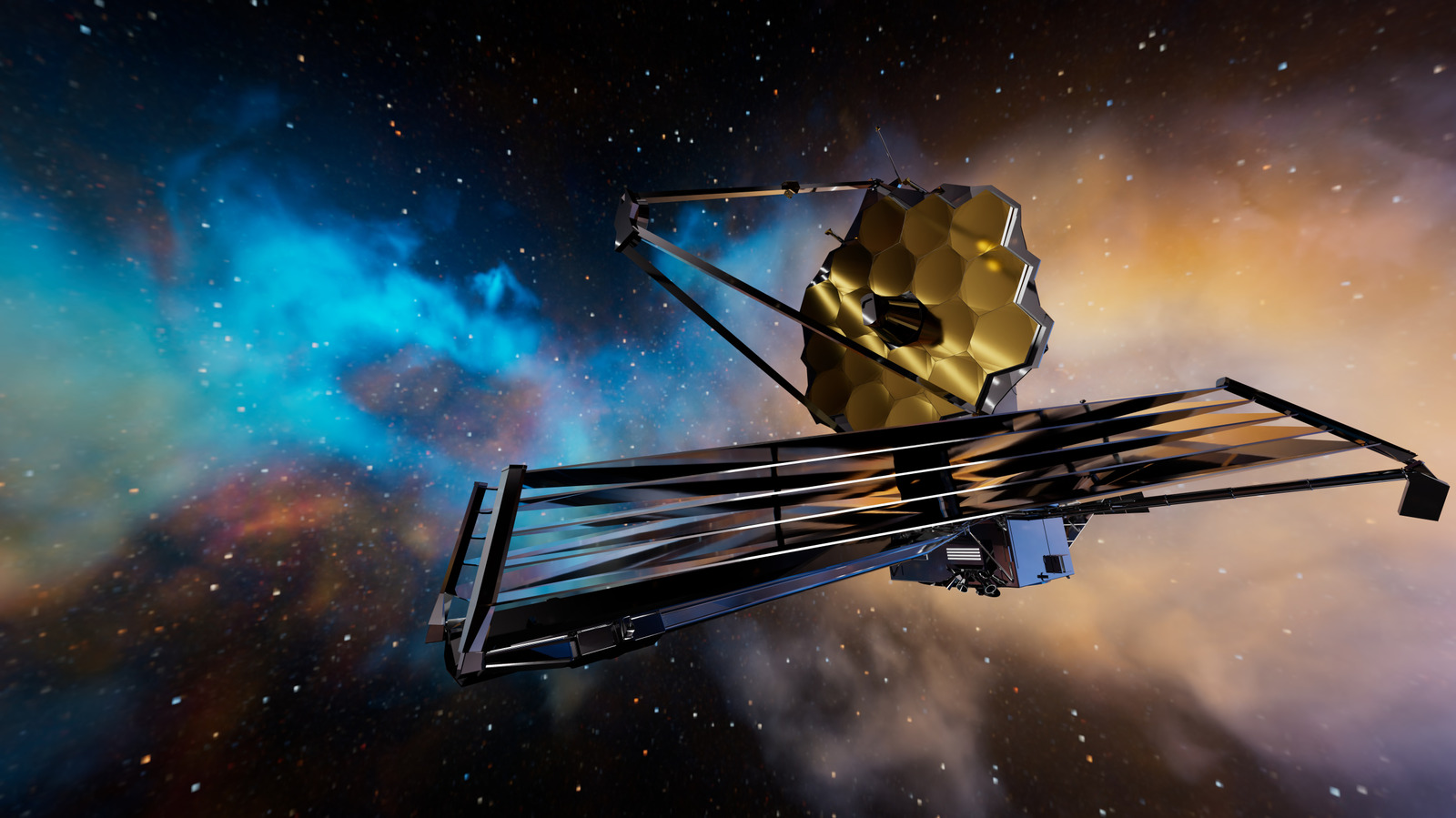
When NASA launched its $10 billion James Webb Space Telescope in 2021, scientists hailed the mission as the greatest achievement of its kind in over three decades. Soon, however, scientists noticed a major problem with the world’s most finely tuned camera: its pictures were blurry. To solve this issue, a pair of Australian researchers developed an artificial intelligence program dubbed AMIGO (Aperture Masking Interferometry Generative Observations) to address resolution issues in Webb’s most powerful telescope cameras.
The development underlines how the extreme distances of satellites like the James Webb Space Telescope can complicate maintenance and repairs. Located a million miles from Earth, the telescope cannot be as easily repaired as its predecessor, the Hubble Space Telescope. For reference, when NASA launched Hubble in 1990, lens alignment issues necessitated a special mission from the Space Shuttle Endeavour to install new optics. With JWST, however, manual adjustments are impossible. AMIGO is a nifty workaround for researchers to adjust how JWST interprets and processes data, rather than traversing the solar system to adjust the lenses themselves. It does so by restoring the camera’s aperture masking interferometer (AMI), a thin piece of metal dotted with holes that allows researchers to gauge whether the camera is experiencing optical misalignments based on the light it filters.
JWST is capable of photographing the universe’s oldest galaxies, and it’s changing the way scientists look at the universe. In fewer than five years, the telescope has captured galaxies born over 13.5 billion years ago, unearthed what some believe to be stars powered by dark matter, discovered supermassive blackholes, and even rewritten how scientists view the earliest stages of the universe. With the adjustments offered by AMIGO, the James Webb Space Telescope may open a window into mankind’s oldest questions.
Fixing the world’s most expensive telescope
To understand how AMIGO solved the world’s most expensive photography issue, you must first understand how the James Webb Space Telescope works. Essentially, Webb uses a series of mirrors to reflect infrared light into the telescopes’ image recording instruments. The size of these mirrors, the largest of which weighs over 1,500 pounds and stands 21 feet across, allows Webb to capture high-resolution images from extremely dim and distant galaxies. During this process, Webb experienced a common issue with infrared cameras called the electronic effect, in which the image’s brightest pixels leaked into their darker counterparts, thus blurring the image. According to researchers, the issue was ten times greater than originally expected, making it difficult to study distant planets that appeared fainter than their stars.
To correct this issue, the researchers built the AMIGO system to fix Webb’s electronic distortions by teaching it to replicate the telescope’s optics and electronics. In doing so, the program learned to correct instances where electric charges crept into neighboring pixels, allowing the team to restore the AMI’s performance to previously unreached heights. As one researcher connected to the project said in a press release, “Instead of sending astronauts to bolt on new parts, they managed to fix things with code.” According to researchers, the AMIGO program has helped the telescope take photographs of planets farther than ever before, allowing researchers to isolate dimmer space objects and produce sharper images at higher resolutions.
AMIGO in action
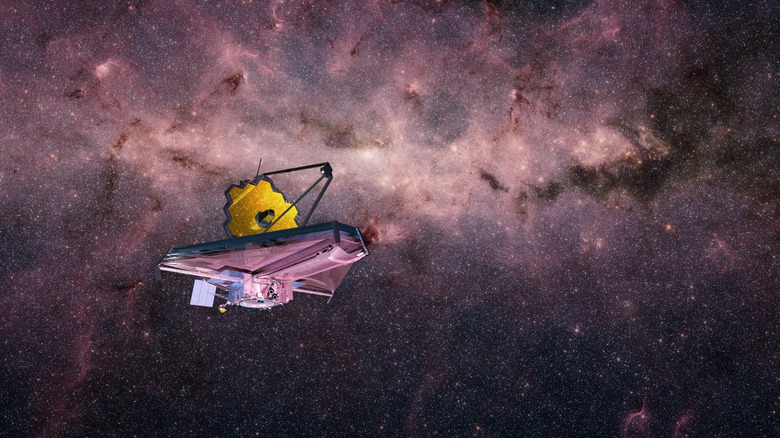
In the immediate wake of AMIGO’s rollout, researchers at the University of Sydney have produced two groundbreaking papers that exhibit the JWST’s newfound capabilities. In the first, led by Ph.D. student Louis Desdoigts, researchers used the AMIGO system to correct the telescope’s electronic distortions when observing distant star systems. In the study, the Webb telescope captured images of an exoplanet and a brown dwarf roughly 133 light-years away. Before the corrections, scientists knew of these distant objects but couldn’t capture visual evidence due to the light from their nearby star, HD 206893. After the corrections, however, both objects appeared in the scientist’s map of the distant star system. As exhibited by the study, the telescope’s new AMI functionalities will allow scientists to search for unknown planets at previously unthinkable resolutions.
AMIGO has also allowed Webb to produce sharper images, taking breathtaking snapshots of black holes, fiery moons, and distant, dusty stellar winds. In a second study, researchers revisited some of the telescope’s most difficult targets, pushing the limits of its capabilities. In the study, the telescope used AMIGO to capture dust billowing around a pair of distant stars, jet streams spouting from black holes, and Jupiter’s most active lunar volcanoes on Io.
Although the AMIGO system is in its developmental stages, researchers are confident that it may open up a new era of space science for the James Webb Space Telescope and its successor, NASA’s Nancy Grace Roman Space Telescope. Set to be launched in May 2027, the observatory will possess a field view 100 times larger than Hubble’s, giving scientists visual access to approximately a billion galaxies as they investigate dark energy and matter, distant exoplanets, and infrared astrophysics. That is, if President Trump’s budget cuts don’t kill the project before it gets off the ground.