At the end of November, in Harbin, the image is repeated every winter, with a scale that has not stopped growing in recent editions: cranes, machinery and workers begin to raise structures on a surface that weeks later will become walls, towers and slides made of ice. According to official data, construction is advancing this year thanks to the ice stored during the previous season and preserved for more than ten months. This material allows work to begin even before the river freezes completely again, with the aim of preparing an area that this winter will have 1.2 million square meters.
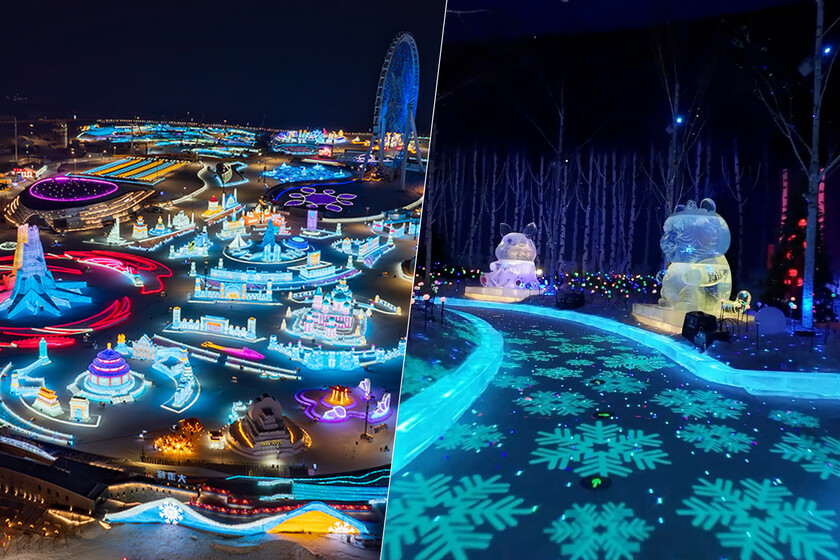
Harbin Ice-Snow World has grown from a local celebration to a seasonal theme park that rises again every winter. It functions as an enclosure with defined entrances, circulation areas, walkable structures and spaces to stay for hours, especially when it gets dark and the lighting changes the perception of the place. It is not just a setting for photographs, but a park designed to be walked, used and visited for a few weeks, while weather conditions allow it.
When ice stops being landscape and becomes infrastructure
Upon entering the venue, the experience is more similar to that of a theme park than a temporary exhibition. You can walk between buildings, climb platforms, slide down ramps or access areas prepared for snow activities. The architectural elements are not presented as immobile pieces, but as part of the route. For this edition, those responsible have announced spaces for ice fishing, cross-country skiing and collective snow gamesas well as an additional stage that will complement the cultural activities of the already usual Dream Stage. The proposal does not focus solely on showing structures, but on facilitating their use within a planned and temporary environment.
Before erecting ice structures, Harbin already celebrated winter through local practices. The hand-carved ice lanterns began to be used in the city in the middle of the last century and gave rise to the first Harbin Ice and Snow Festival, held on January 5, 1985, according to official pages. The jump to the current format came in 1999, when Harbin Ice-Snow World was created as an independent venue, with specific access and design. Since then, the evolution has been constant: more surface area, greater volume of materials, presence of machinery and planned construction processes.
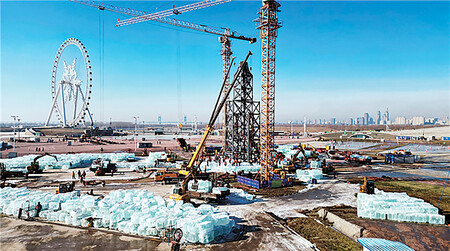
The park, under construction in November 2025
Harbin has turned winter into a source of economic activity. According to data released by Xinhua, the city received 90.36 million visitors during the last season, with estimated income of 137.22 billion yuan (almost 17 million euros), an increase of 16.6% compared to the previous year. Ice-Snow World does not explain these figures on its own, but it acts as one of the main focuses of attraction and as an element that concentrates tourist services, accommodation, restaurants and transportation during the weeks in which it remains open. The construction mobilizes technical profiles, operators and specialists in structure and lighting, while the opening requires personnel for visitor service, security, maintenance and tourist support. Many of these roles are temporary, but require prior coordination and planning.
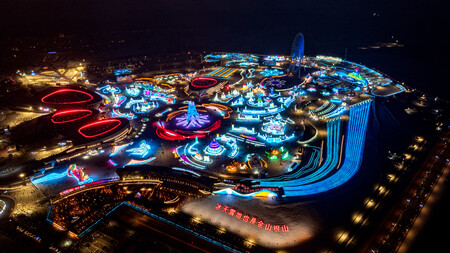
When comparing Harbin to other large winter events, such as the Sapporo Snow Festival in Japan or the Quebec Winter Carnival in Canada, the difference is not just in size, but in structure. Sapporo distributes its sculptures in various urban spaces and Quebec combines culture, parades and outdoor activities, but neither of them functions as a theme park concentrated in a single venue, as occurs in Harbin. Harbin uses hundreds of thousands of cubic meters of ice and snow, according to official data, and builds walkable structures that are part of the route and not just the landscape. It is not so much a festival as a temporary recreational facility.
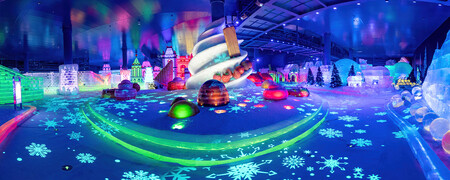
Harbin Ice-Snow World has been integrated into the city’s tourism calendar as a seasonal facility. It is built every year, it opens for a few weeks and It is dismantled when temperatures no longer guarantee stability. This temporary nature does not prevent its planning: the prior storage of ice, the mobilization of workers and the associated services indicate that it is an organized activity and not simply a one-time event.
The park functions as a generator of temporary employment, concentrates the winter tourism offer and channels activities that are subsequently complemented by the interior ice and snow enclosure, designed to operate all year round as an extension of the exterior park. There is no pretension of permanence, but of repetition adjusted to the climatic conditions. This repetition has allowed the consolidation of technical, logistical and tourist processes linked to winter as a seasonal economic resource.
Images | The Harbin International Ice and Snow festival | Harbin Government
In WorldOfSoftware | Someone wants to build a 144 meter high skyscraper in the middle of the port of Malaga. The reason: luxury tourism