Megastructures have a what-do-I-know-what-do-I-know-what makes us love them. It makes perfect sense: they are colossal works that humanity has been doing for millennia and in which we increasingly use more and more sophisticated machinery. There is also a certain sense of competition, and if a few months ago Europe boasted of the longest railway tunnel in the world, today we have to talk about an even more difficult one: one twice as long and underwater.
It is the Bohai Strait Railway Tunnel. And it will be in China, of course.
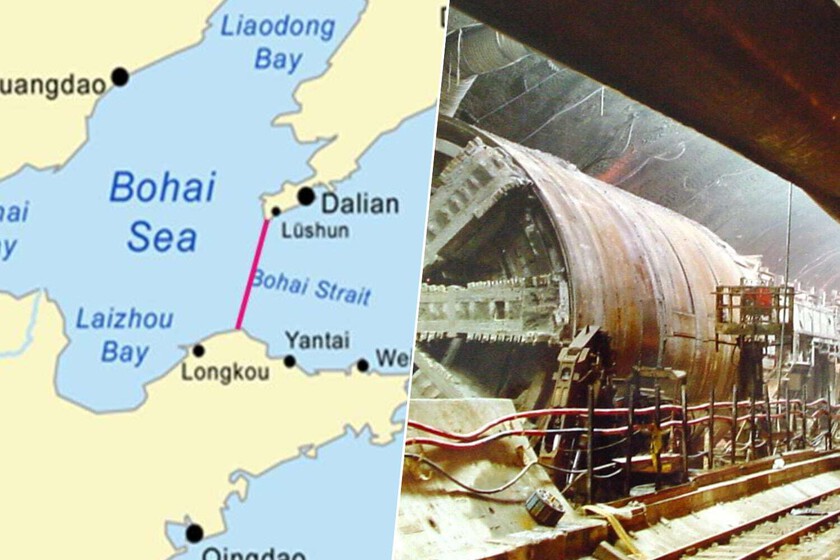
Dalian-Yantai. To the sides of Beijing are the provinces of Liaoning and Shandong. The first has 44 million inhabitants. The second, 101 million. They are two important nerve centers in China, but there is a problem: they are separated by the Bohai Sea and the only way to get from one to the other is by ferry that takes about eight hours or by going around the bay on a 1,500 kilometer trip.
Given the importance that the area was gaining, in 1992 the idea of a connection across the strait arose that would link the cities of Dalian and Yantai. Although China has accustomed us to mega constructions in record time, in this case the logistics were complicated and it was in 2012 when a research group was established under the supervision of the Chinese Academy of Engineering to see if it was viable and, in 2019, they began to talk seriously about the project.
Specs. Having ruled out a structure that combined bridges, islands and tunnels – such as the Hong Kong Zhuhai-Macao – those in charge of the project agreed that the best solution would be a single railway tunnel whose characteristics are… colossal:
- 125 kilometers in total, 90 of them underwater.
- Designed for trains traveling at a speed of 220 km/h.
- Built 80 meters below the seabed.
- Two main tunnels of 10 meters in diameter.
The most important thing: of the eight hours by ferry or more than ten by car, the journey would take about 40 minutes. It is a considerable reduction in time that will help not only transport people, but also what is most interesting in the region: goods and commerce.
Train>car. The Price of the tunnel has varied over the years. The estimate a decade ago was 200 billion yuan, about 30 billion euros. Currently, it is closer to 300 billion yuan, about 40 billion euros. Everything to unite two of the most powerful regions in China in terms of trade and more than the colossal Three Gorges Dam.
It is estimated that it would take about ten years to recover the public-private investment in the infrastructure, and the reason why the tunnel has been planned as a railway tunnel instead of a mixed one (cars plus trains) is for safety reasons. The Bohai tunnel will be more than twice as long as the Channel Tunnel, so creating such a long underwater tunnel suitable for cars would be extremely expensive and complex as it would require adequate ventilation. Furthermore, in the event of an accident, emergency response would be more difficult.
What there will be are shuttle trains that will allow both cars and trucks to be loaded. This is something that is already being explored in other parts of the world and, recently, we have seen it raised in the American transcontinental.

Challenges. Now, it’s not going to be easy. The topography of the bay bottom varies between areas of just 10 meters to others that reach almost 90 meters deep. In addition, there are active faults in the area and it is a region with high seismic activity. In fact, it is close to the Tan-Lu fault, one of the most active in China, which implies a thorough study to adapt the structure to possible earthquakes.
Ecology. On the other hand, the ecosystem. Apart from being a sensitive area in terms of earthquakes, the tunnel would pass through ecologically sensitive areas. It is the habitat of the spotted seal, protected in China, and also includes migration routes for both fish and birds.
You have to wait seated. And if we speak in the future it is because the works have not started. At the moment, it is a project, but important steps have been taken in recent months. At the beginning of 2024, the Bohai Tunnel was included in several national strategic documents, and in May this year it was incorporated into the Modern Comprehensive Transportation System Development Plan of the 14th Five-Year Plan.
In these 30 years, steps have been taken studying the feasibility of the project and exploratory drilling, and more recently more and more voices have emerged that mention the need to promote this Bohai corridor. When will the works begin? It is not known, but 2026-2030 is considered the window of opportunity for this.
Either way, if it ends up happening, Bohai will not only be – by far – the longest underwater railway tunnel in the world: it will also be one of the largest tunnels, overall.
IMumegenes | Walk, Ekem
In WorldOfSoftware | China has built the highest bridge in the world and has done what it must: turn it into a show