Table of Links
- I. Abstract and Introduction
- II. Related Work
- III. Modeling of Mobile Channels
- IV. Channel Discretization
- V. Channel Interpolation and Extrapolation
- VI. Numerical Evaluations
- VII. Conclusions, Appendix, and References
III. MODELING OF MOBILE CHANNELS
A. The Doppler Effect
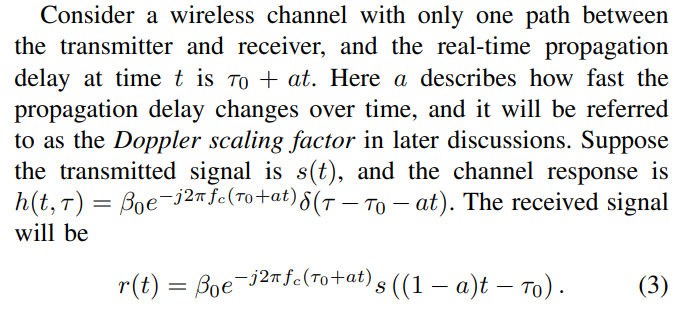
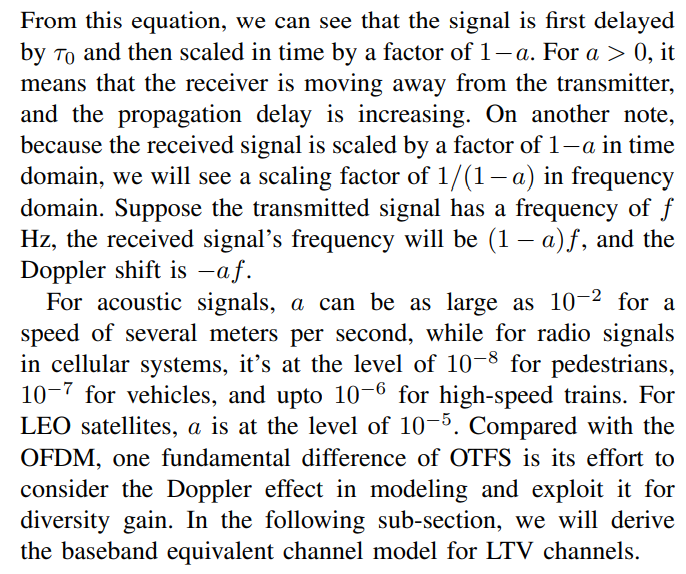
B. Approximate Baseband Equivalent Channel Model
Consider the channel model in (1), and the received signal in (2) can be explicitly written as

For a short period of time, we have τl(t) ≈ τl , leading to an LTI model. OFDM works very well in such cases.
With OFDM, we can very elegantly remove ISI through Fourier transform at low complexity, but there is a price for that. Note that τl(t)’s are assumed to be constant in one data frame, which means the frame cannot be very long. Taking the LTE as an example, one sub-frame lasts for only 1 ms. In 5G NR (Release 17), a slot lasts for 15.625 µs to 1 ms, with a sub-carrier spacing of 960 kHz to 15 kHz, respectively. During each frame/slot, we must use a certain amount of resources for channel estimation, which is part of the overhead we need to pay for doubly-dispersive channels. For high-dynamic scenarios, we need to reduce the frame length, but the amount of resources required for channel estimation in each frame is fixed. As a result, the spectral efficiency will decrease. Intuitively, we need to estimate channel more frequently in wireless channels with higher dynamics, because the channel varies faster. To a certain point, the channel response varies so fast, and it will change before we get a chance to estimate it. Reliable communications will thus become impossible. In extreme cases, the channel is not time-invariant in even one OFDM symbol, and the channel variation will manifest itself through ICI and error floor [11].
To solve this problem, note that the LTI channel model is obtained by taking the 0-th order Taylor expansion of the realtime propagation delays, and it cannot capture the time-variant characteristics of the mobile channels. What if we take the first-order Taylor expansion? By doing so, the modeling error will accumulate slower over time and the approximate channel model will stay accurate for a much longer period of time, i.e., the geometric coherence time [19], [20]. Thus, channel estimation frequency can be reduced accordingly. Motivated by this idea, we take the propagation delay’s first-order Taylor approximation as

where al is the Doppler scaling factor of the l-th path.
Consider the approximation in (5), and the received signal in (4) can be approximated by
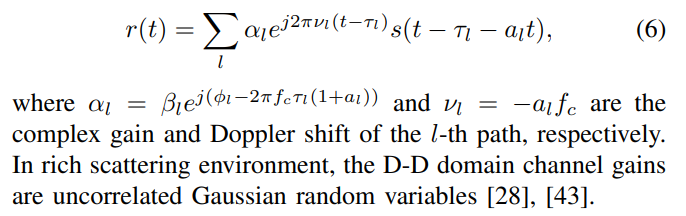
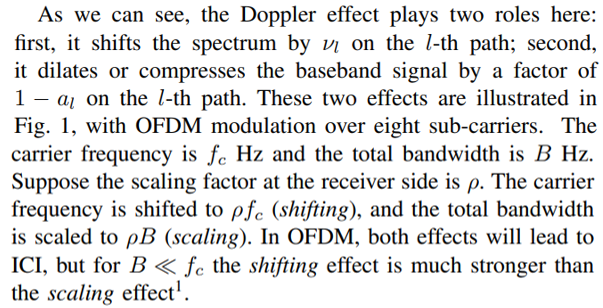
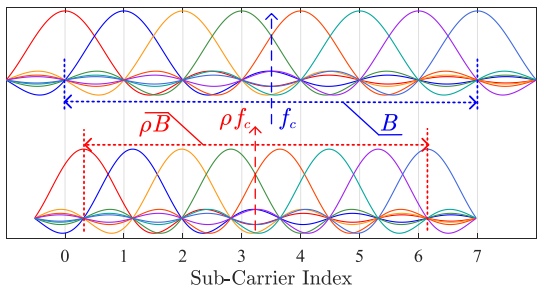
With the first-order expansion, the baseband channel is

Until now we have been talking about the channel model in the time-delay domain. However, the D-D domain channel model is almost exclusively employed in OTFS-related work. It seems that the above model is very much like the DD domain channel model by considering propagation delay and Doppler shift (i.e., propagation delay changes over time linearly). However, we will see in the following sub-section that they are fundamentally different.
C. D-D Domain Channel Model
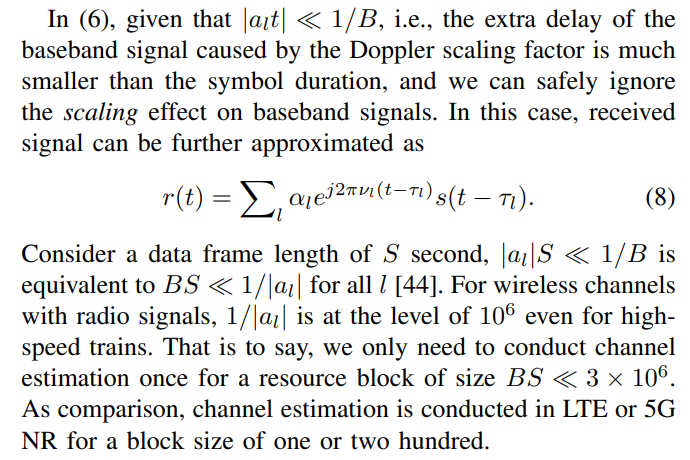
If we define the D-D domain channel response as

equation (8) can be rewritten as

Equation (10) is what we commonly see in literature on OTFS. From the above discussions, we can see that the D-D domain channel model is actually the approximation of the first-order Taylor expansion of the mobile channels, by ignoring the scaling effect on baseband signals. Therefore, the D-D domain model is more accurate then the LTI channel model (0-th order), but less accurate than the first-order one in (7).
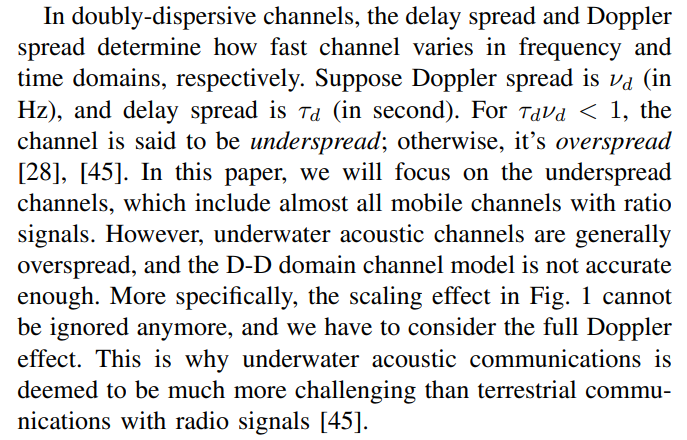
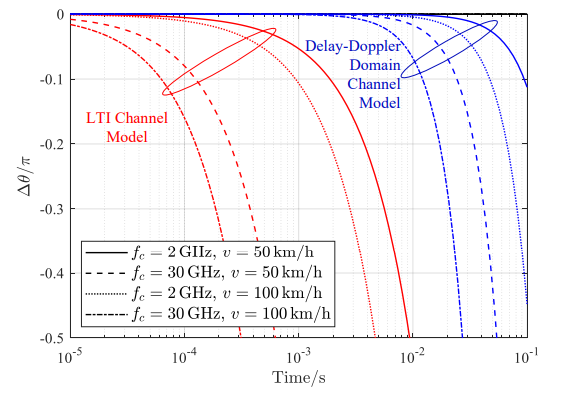
In Fig. 2, the channel variations over time are presented for different carrier frequencies and device speeds. The x-axis is time, while the y-axis is the phase change of the complex channel gain. As we have explained, the LTI channel model used in OFDM is the 0-th order Taylor approximation of the accurate one, while the D-D domain channel model is very close to the first-order approximation. Therefore, we can expect the D-D domain channel model to be more accurate. Or equivalently, we can expect this model to stay accurate for a longer period of time.
:::info
Authors:
(1) Zijun Gong, Member, IEEE;
(2) Fan Jiang, Member, IEEE;
(3) Yuhui Song, Student Member, IEEE;
(4) Cheng Li, Senior Member, IEEE;
(5) Xiaofeng Tao, Senior Member, IEEE.
:::
:::info
This paper is available on arxiv under CC BY-NC-ND 4.0 license.
:::
[1] Note that B ≪ fc alone does not justify the neglect of the scaling effect.