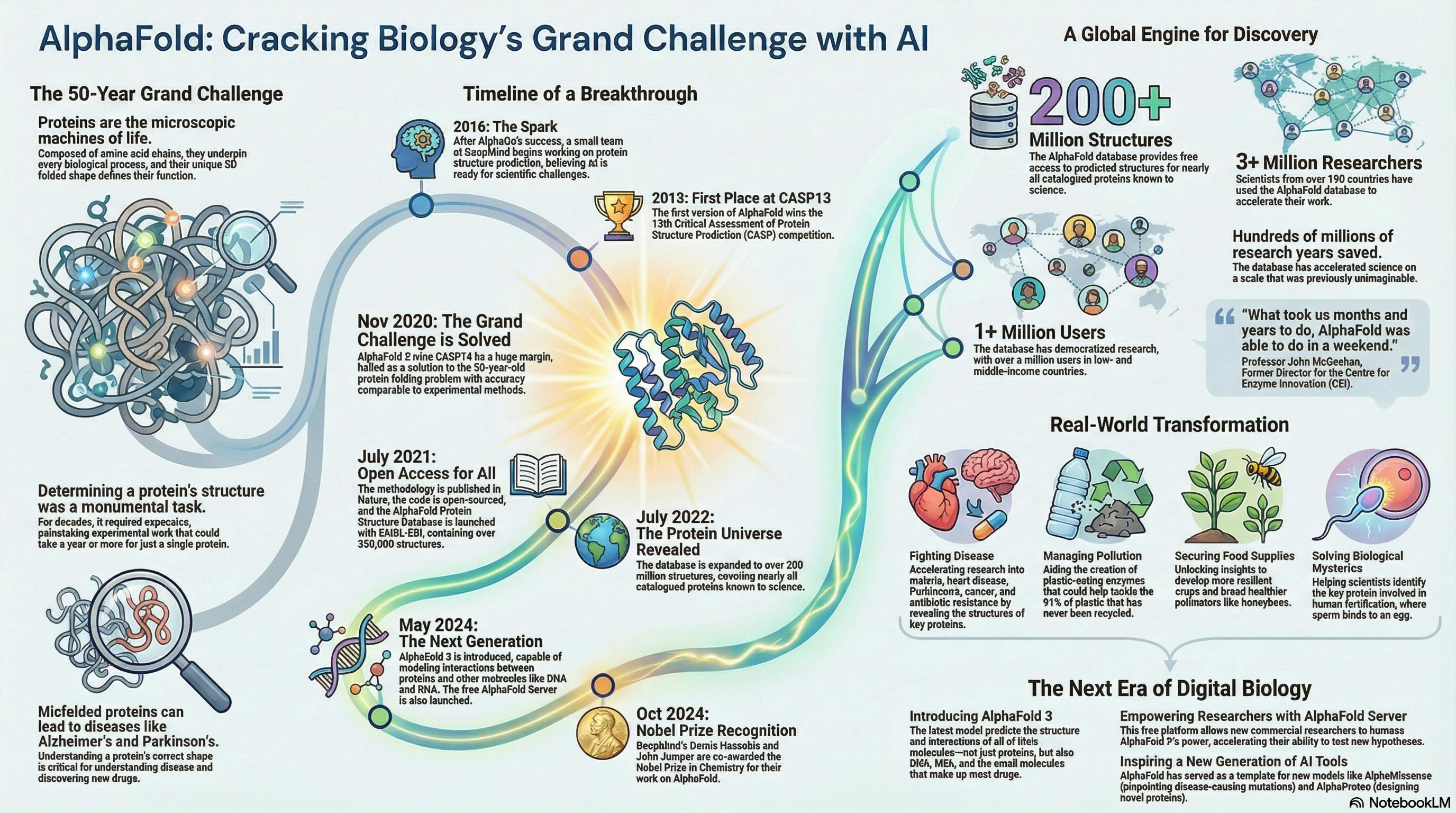
Inside every living cell is a universe of microscopic machinery. These machines, called proteins, are the engines of life, driving every process from fighting infections to carrying oxygen through our blood. Their function is dictated by their intricate 3D shape, and for half a century, the “protein-folding problem,” aka predicting that shape from a sequence of amino acids, stood as one of biology’s grandest challenges. Cracking it was critical for understanding disease and discovering new medicines.
In 2020, this 50-year-old problem was solved. An AI system from Google DeepMind called AlphaFold learned how to predict a protein’s structure with an accuracy comparable to years of painstaking experimental work. The breakthrough was so profound that in 2024, its creators, Demis Hassabis and John Jumper, were co-awarded the Nobel Prize in Chemistry alongside David Baker for his work on computational protein design.
But the true impact of AlphaFold goes far beyond the initial headlines and awards. Since its release, the tool has become a global engine for discovery, producing surprising and transformative results that are quietly reshaping the world of science. Here are six of the most impactful takeaways from this revolutionary AI.
1. So Accurate, It Looked Like a Heist
When the first large batch of AlphaFold’s predictions was made freely available, the results were so precise that parts of the scientific community reacted with sheer disbelief. Some researchers, who had spent their entire careers working to determine the structure of a single protein, were shocked to see an AI generate the same answer in a flash.
Nobel laureate John Jumper, a lead scientist behind AlphaFold, recalled the initial reaction from scientists who expected to find flaws but instead found their own unpublished work perfectly replicated.
I saw this comment from someone on Twitter saying, “How did they get a copy of my structure?” How did they get– how did DeepMind do this thing that I had done and not yet published? They couldn’t believe that this was literally a machine doing years of painstaking work, like this, all at once, kind of a flash.
This reaction underscores the magnitude of the breakthrough. It wasn’t just an incremental improvement; it was a quantum leap. The AI had solved the problem with an accuracy that rivaled the gold standard of experimental work, turning a multi-year endeavor into a matter of minutes.
2. It’s Solving Problems Its Creators Never Dreamed Of
While the team behind AlphaFold was primarily focused on human health, the tool’s fundamental power has been embraced by scientists in a vast range of unexpected fields. By providing a universal key to understanding protein structures, AlphaFold is helping solve problems its designers never anticipated.
- Bee Conservation: In Europe, scientists used AlphaFold to understand the structure of Vitellogenin, a key immunity protein in honeybees. These insights are now guiding conservation efforts for endangered bee populations and helping develop AI-assisted breeding programs to create healthier, more resilient pollinators.
- Human Fertility: Two independent research groups were trying to pinpoint the exact mechanism of fertilization. Knowing the proteins on an egg, they used AlphaFold to screen all 2,000 proteins found on the surface of sperm to see which one would bind. Both groups identified the same crucial protein, a discovery that opens new avenues for understanding and potentially treating infertility.
These examples highlight the power of creating a foundational scientific tool. By solving one core problem, AlphaFold has empowered thousands of researchers to ask and answer new questions in nearly every field of biology.
3. A Tool for Everyone, Not Just Elite Labs
Perhaps one of AlphaFold’s most profound impacts is its role in democratizing a highly specialized and expensive area of science. The AlphaFold Protein Structure Database is freely available to anyone in the world, and it has already been used by over 3 million researchers in more than 190 countries.
This open access is leveling the playing field. Crucially, over 1 million of these users are in low- and middle-income countries, granting access to a level of computational biology that was once the exclusive domain of elite, well-funded institutions. By dramatically lowering the cost and barrier to entry, AlphaFold is empowering a new generation of scientists globally.
4. Empowering the Next Generation of Scientists
The story of Turkish undergraduate students Alper and Taner Karagöl is a testament to this shift. With no prior formal training, they taught themselves structural biology during the pandemic using online AlphaFold tutorials. They have since published 15 research papers, proving that brilliant ideas are no longer constrained by geography or institutional prestige.
This isn’t just about access; it’s about diversifying the scientific mind. When groundbreaking tools are available to everyone, solutions can come from anywhere, unconstrained by the traditional structures of institutional science.
5. An Unimaginable Acceleration of Discovery
The sheer scale and speed of AlphaFold’s contribution are staggering. Previously, determining a single protein structure could take a PhD student years and cost hundreds of thousands of dollars. Today, the AlphaFold database contains over 200 million predicted structures, covering nearly all catalogued proteins known to science. This massive repository has potentially saved “hundreds of millions of years in research time.”
Professor John McGeehan, Former Director for the Centre for Enzyme Innovation, put the acceleration into perspective:
What took us months and years to do, AlphaFold was able to do in a weekend. This incredible speed doesn’t just save time; it fundamentally changes how science is done. Researchers can now redirect their time and resources away from determining structures and toward solving society’s biggest challenges, from tackling antimicrobial resistance to improving crop resilience.
6. From a Still Photo to the Movie of Life
The original AlphaFold focused on individual proteins, but biology is a dynamic dance of interactions. The next evolution, AlphaFold 3, is designed to model this entire performance. A simple analogy makes the leap clear: think of the original AlphaFold as creating a perfect, high-resolution photograph of every single worker in a factory. It was revolutionary. AlphaFold 3, however, creates a full-motion video of how every worker interacts with every other worker, every machine (DNA/RNA), and every raw material (ligands) to get the job done.
This is the leap from static blueprints to dynamic simulations. By modeling the full dance of molecular interactions, AlphaFold 3 moves biology from the wet lab to the computer, allowing scientists to run complex biological experiments digitally before ever picking up a pipette. This ushers in an era of “digital biology” and is poised to transform drug discovery. To accelerate this new wave, the AlphaFold Server now gives non-commercial researchers free access to these powerful capabilities to test their own hypotheses.
Conclusion: A New Era of Discovery
AlphaFold is far more than a solution to a single, 50-year-old problem. Its real legacy is in providing a template for how AI can serve as a powerful tool to accelerate all of science. By turning a complex, time-consuming task into a rapid, accessible, and computational one, it has unlocked new possibilities across countless fields, empowered a global community of researchers, and changed our fundamental understanding of life itself.
AlphaFold provides a new blueprint for scientific discovery. The question is no longer if AI will help solve our grandest challenges, but which one we will point it at next.
- Apple Podcast: HERE
- Spotify: HERE