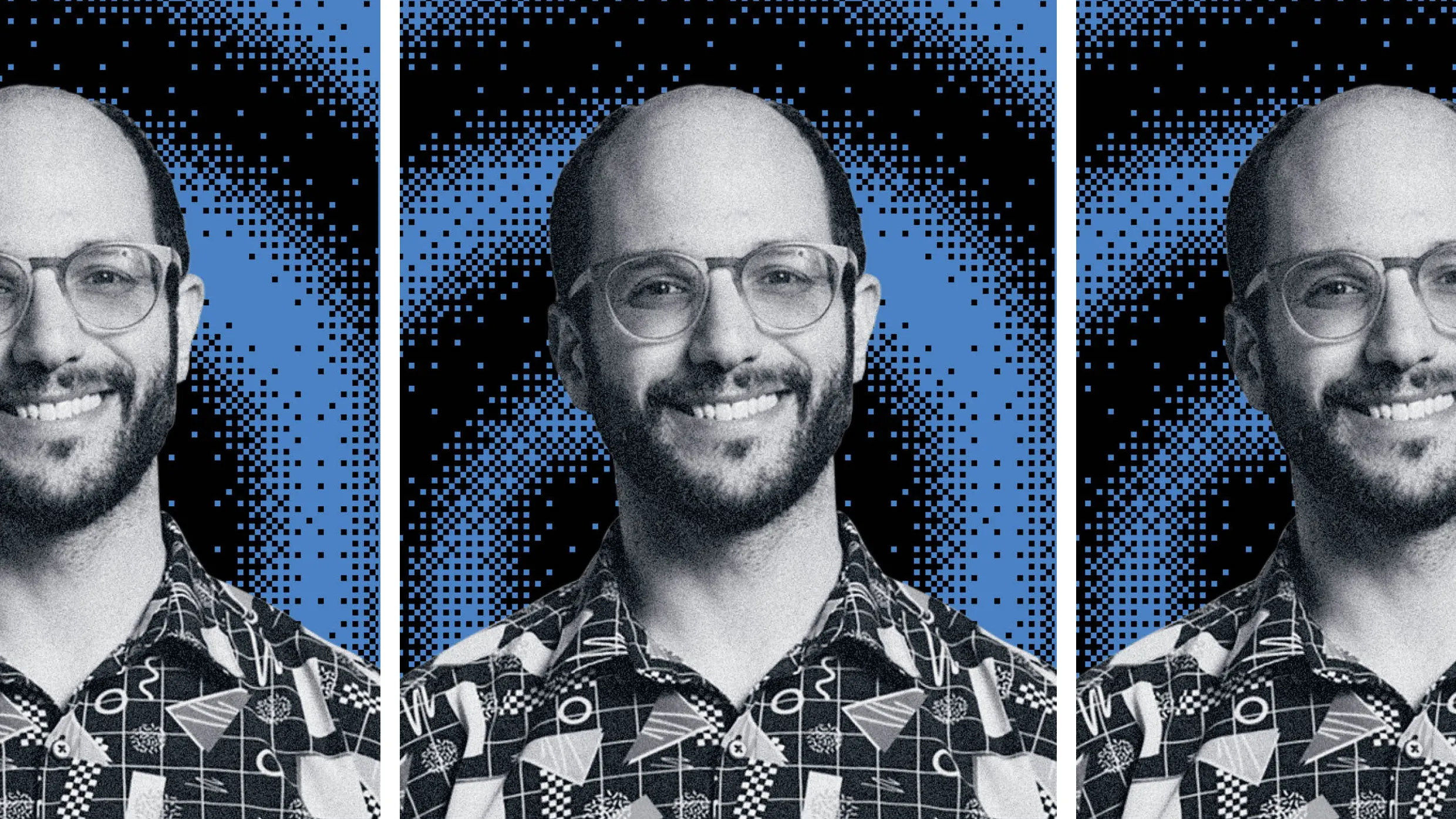
Over the past decade, Figma has transformed how people within companies collaborate to turn software ideas into polished products. Now the company itself is being transformed by AI. The technology is beginning to show its potential to take on much of the detail work that has required human attention in design, coding, and other domains. But the end game involves far more than typing chatbot-style prompts and waiting for the results.
I spoke with Figma’s head of AI, David Kossnick—one of Fast Company’s AI 20 honorees for 2025—about what the company has accomplished so far and where he’s trying to steer it. “We’re still in chapter one, maybe the start of chapter two,” he told me.
This Q&A is part of Fast Company’s AI 20 for 2025, our roundup spotlighting 20 of AI’s most innovative technologists, entrepreneurs, corporate leaders, and creative thinkers. It has been edited for length and clarity.
Talk a little bit about what your work at Figma encompasses and how you came to have this job.
Anything that has AI in it, I and my team touch in some way. It’s everything from traditional AI tools like search, which we’ve rebuilt using multimodal embeddings, to some of our newer, AI-forward workflows. Figma Make is an example of that.
As to how I came to get this job, I’ll give you a short version. I knew a lot of the Figma team for a long time. The chief product officer, Yuhki (Yamashita), and I went to college together. He was at my wedding.
I did a startup of my own, and one of our board members was John Lilly, who was also on the board of Figma. I actually met (Figma cofounder/CEO) Dylan (Field) when there was, like, a 20-person Figma team, because we were building a game engine, and Figma is basically a game engine, with all sorts of custom renderings. (Lilly) was like, “You guys should compare notes.”
So I’ve known the team for a long time, and it’s a product I’ve used a lot. And then, about a year and a half ago, when I joined, I’d been working on AI at Coda, which was then acquired by Grammarly.
As a big Figma user, I also felt like there was just such a huge opportunity for Figma, and it had barely gotten started. So I was thinking about what’s next and sharing it with Yuhki: “There’s a lot you guys could do.” He was like, “I know, we just don’t have the right team here yet. You wanna come?” I was like, “That sounds amazing.”
Is there a particular Figma philosophy about AI and how to put it into this experience that’s been around for a while, and which people choose to use because they like it, in most cases?
There’s been a couple of learnings, both from our own team and from working with customers. A lot of our biggest customers are technology companies themselves. Many are integrating AI themselves. And so we’ve learned through them—what’s working and what they’re trying.
There have been two industry trends, and we’ve done both here. One is trying to find existing workflows that you can add AI to, to save users time, to delight them, to give them new capabilities. And also building totally new experiences that have AI as the core of the workflow.
Interestingly, we’ve actually done some market research and surveys of users and other companies. People understand and value the new AI for workflows even more. I think that’s counterintuitive. You think you have such big products, and adding efficiencies to them is very viable. And it is. But often, AI is a little more invisible there. Kt’s embedded in a workflow that you’re used to, and so the thing that is foreground in your mind is the workflow itself.
That’s good. We don’t want to get in people’s way. Figma Design’s canvas is kind of like the Google homepage or Facebook news feed, where a single pixel of friction literally slows down millions of people every day. Which makes for interesting challenges. How do you introduce things so they don’t bother people?
But on the flip side, there’s a lot of new workflows and new tools. People—especially our type of customers—are always experimenting. And so they’re very open to trying a totally different approach.
Historically, Figma has been this thing that human beings use to collaborate with other human beings to create stuff from scratch, and often very carefully considered stuff. What’s the experience like of integrating tools that take some of that heavy lifting off their shoulders?
I think it’s super exciting. It feels and looks different for different user types. So as an example, we actually just finished up a $100,000 hackathon, our first ever, for Figma Make. It was totally inspiring seeing all the range of things people have made.
There were students. There were people who never learned to code. There were designers who code a lot, and it’s just helping them do it faster. There were hobbyists. For a lot of those user types, a very common theme was, “Wow, I just couldn’t have done this before.”
The other way it feels is as a kind of thought partner to experts. I feel this myself as a (product manager) when I chat with Figma Make or ChatGPT. I have a problem. I have a solution in mind. And actually, there are some other solutions I hadn’t thought about, because I was so focused on this one solution. It can help you pull back and see a wider solution space, and explore a few other threads in a very cheap way before you go too deep.
It’s like Doctor Strangewhere he has this magic crystal that lets him look into all the different possible futures. Expert users are always running simulations in their heads. “What if I move this button over here? How’s the user behavior going to change? What does that mean for the next part of the experience?” We’re finding that these types of AI tools make that loop so much faster, where it’s like, “I’m just going to try exploring a bunch. I’m going to literally make them, but make them 10 times as quickly, and play out all those different end states.”
How far is Figma down the continuum from having no AI to AI being everywhere and doing everything AI could possibly do?
It’s an interesting question. There’s AI today and AI in the future. If all research was frozen, there would probably still be five years of new product experiences that the industry could build from current models. But the pace of model improvement is still really high as well.
For us, I’d say we’re still in chapter one, maybe the start of chapter two. And chapter one was, “We’re going to do a bunch of basic features, get our feet wet, save time in your workflows.” Chapter two is, “We’re doing some new AI-first experiences.” Figma Make, that whole category of prompt-to-app, is very, very new.
As the models get better and faster and cheaper, what other new workflows are going to become available? Today, things like autocomplete, as an example, are hard to make fast, and hard to make cheap, and hard to make high quality. And, you know, we’re still using many interfaces in the industry that feel like typing at a terminal from the ’60s. That’s not the final interface. That’s not the final workflow. I think the interfaces are going to become more visual, more exploratory.
It’s part of why I’m so excited about Figma and why I came here. As AI gets better, what you want the experience of working with an AI to feel like is going to be more and more similar to what you want the experience of working with a human to feel like. You’re going to want to brainstorm with the AI before it goes off and thinks for 10 hours and then builds something. You’re going to want to work through the big trade-offs. You’re going to want your teammates in there too, not just the AI.
I think that’ll be a super exciting place, where things like code become implementation details that AIs are more and more capable of driving, with humans reviewing.
The final deadline for Fast Company’s World Changing Ideas Awards is Friday, December 12, at 11:59 pm PT. Apply today.