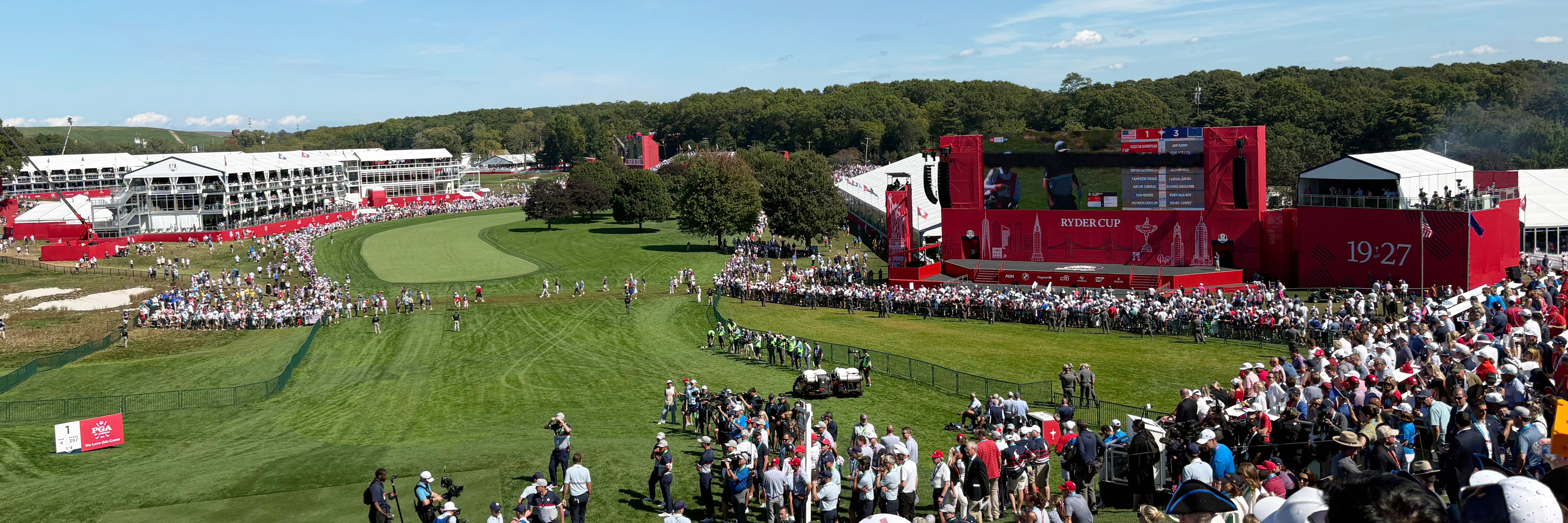
The sporting calendar is full of big events, but some end up being unforgettable. And this year’s Ryder cup golf tournament at Bethpage Black golf course in New York was one of them, not just for what happened on the course, but also off it.
As the action and drama on and off the golf course unfolded, underneath it all was an element that kept everything running: the performance of the network on which the event’s management relied. In networking, that is very much job done.
And this job was something more complex than ever before. It involved supporting multi-faceted demands from all stakeholders involved the event, spanning retail, commercial, operations, security, safety and broadcast.
First contested in 1927 at the Worcester country club in the US, and named after its founder Samuel Ryder, The Ryder Cup has become one of the world’s leading sporting events. Every two years, 24 of the best players from Europe and the US go head-to-head in match play golf. It is set to celebrate its centenary in Country Limerick in Ireland.
For this year’s competition, the sporting and organisational bar was set higher than ever, and getting things right depended on what the organisers described as a connected intelligence platform that had the flexibility to ingest, unify and analyse tournament data from a variety of sources to gain real-time insights and intelligence. These sources included crowd locations, drink and merchandise point of sale devices, ticket scans, weather information, the location of golf carts, historical footage of past Ryder Cup events, site plans and operational manuals.
From these sources, the event organisers wanted to achieve a defined series of outcomes including real-time operational management and decision-making; operational intelligence to inform future event planning to optimise revenue, costs and guest experiences; enhanced tools and resource to assist event staff; realise immediate value; and utilisation of tournament content.
But the bottom line was that to gain these outcomes, the Ryder Cup team needed a scalable, reliable and reusable data infrastructure. To achieve this, the Bethpage Black event’s underlying communications infrastructure was based on technology from HPE.
A history of connectivity
The two parties first began working in 2018 and the relationship accelerated in 2023 for the Rome edition of the Ryder Cup, when HPE provided greatly expanded coverage, alongside enhanced fan and staff experiences, based on an integrated private 5G and Wi-Fi network. The infrastructure combined the private 5G technology of Athonet, which was at the time recently acquired by HPE and HPE Aruba Networking’s Wi-Fi technology.
For 2023, the basic job was to support “the most digitally engaging” Ryder Cup, with network innovation designed to deliver enhanced fan experiences. That meant not only addressing spectators’ demands for constant connectivity, but also providing a personalised, immersive experience driven by rich content. Fans were able to use the network in Rome to navigate around the course virtually, jump the queues for merchandise and food, and track player locations. Similarly, operations staff were able to monitor fan behaviour, assign more staff during peak periods, and provide fan activations whenever and wherever needed.
Wi-Fi 6/6E networks provided the mainstay of the connectivity required for thousands of fans congregating in popular areas, while private 5G was the base for wide-area coverage to more remote parts of the golf course, as well as a secure private network dedicated to critical operations staff.
In reality, the course presented unique connectivity challenges, not only to the organisers, but to players and fans alike. It covered 370 acres of archaeologically protected countryside, meaning HPE could not route all of the course to run fibre optic ducting. Furthermore, the fixed cables attracted the very unwanted attention of fibre-hungry rats running around the site, meaning integrated Wi-Fi and private 5G network wireless options were imperative.
Despite still having to deal with some unwelcome creatures around the course, at least there were none of the four-legged variety at Bethpage Black. But there were plenty of people to deal with – the network had to cope with the demands of around 250,000 spectators plus staff over the weekend, making the job equivalent to servicing the connectivity needs of a small city.
Building blocks of modern IT
For James Roberston, HPE vice-president and CTO of industrial strategy, and CTO of media, entertainment, hospitality and sports, what was delivered in 2025 was probably one of the largest, temporary networks in the world and reflective of what HPE describes as the “essential building blocks” for modern IT: AI, hybrid cloud and networking. Any idea of a reliable, never mind elevated, experience could not have been considered without the use of AI.
“It takes these three key building blocks to make it work, to be able to gather the data right – whether it be IoT telemetry, network telemetry or other environmental telemetry – to bring it together and to process it with AI,” said Robertson. “It’s all data. And we have to make sure that we’re collecting, curating and collating the data in the most appropriate way based on the event. One of the things that we’re really proud of is how we’ve gone about this before the Ryder Cup this time around.”
In terms of basic core networking capabilities, the network comprised 170 CX switches out on the course in different locations, 650 Wi-Fi 6E access points (APs), 25 user experience insight sensors, a three-node private 5G network, 67 AI-enabled cameras and the HPE Aruba Networking Central management system.
It takes these three key building blocks to make it work, to be able to gather the data right, to bring it together and to process it with AI James Roberston, HPE
There was also a HPE private cloud AI colocated with the network core in an air-cooled trailer on site, with multiple telemetry date generated via APIs. These gave notice of weather alerts, along with ticket scans, merchandising orchestration, food and beverage sales, and staff cart locations, as well as guest counting and queue management in real time. It also supported video search and statistics for the hundreds of accredited media at the event.
Yet Robertson feels that in such deployments as the Ryder Cup, simply building a network is table stakes: “We know how to do it. [We had] 1,500 acres of a golf course that we covered from end to end, edge to edge with coverage for Wi-Fi. [But also] we said if networking is table stakes, how do we go to that next level? What can we do to elevate the experience even more?”
The user experience sensors were said to be of particular importance, he added, saying: “Think of [them] as being a synthetic user where you can programme different tests, different things that you want to [observe such as] whether it’s accessing a website or whether it’s basic network, up, down, can I get a DHCP address, can I do something on a website? Am I getting the right response from the website?
“So, these synthetic users sitting around the course are basically giving us a view of what the people walking around the course are seeing in real time, but we’re doing it from a telemetry standpoint. We’re gathering that data, which is fed into the equation about how the infrastructure is behaving, even at the far flung reaches of the ninth hole all the way back.”
Key to reaching these far-flung places was a three-node private 5G network using the CBRS spectrum as deployed in the US. Used for operational comms and for backhaul, it was used in New York to plug last-minute coverage gaps – for example, a pop-up business that needed a mobile payment processing system.
Real-time insights
Yet even for such advanced tech, there was a large human element to the sensors and their positioning. HPE engineers positioned the user experience sensors at human height – as they were supposed to take in data from the same perspective as people, they were set at a height that an average human would be when performing typical tasks to give a better indication of the health of the infrastructure than if it was embedded in the AP hardware.
And similarly in running tests on the network heath, HPE examined “normal” behaviour, such as how well people could access social media sites to post and stream content. It addressed questions such whether the network seeing latency changes going to those sites, and how much load there was on specific APs when people moved en masse across the course to a location where golf was taking place.
This was done, noted Roberston, precisely to give the HPE on-site engineers an early warning system to ascertain how reliably the network was functioning. The key, again, was the telemetry data enabling understanding of the infrastructure.
HPE built for the Ryder Cup team a real-time operational intelligence dashboard that could only track essential items during operations, such as flow, wait times, sales and weather, along with monitoring live data feeds from HPE networks, including video streams. It could, for example, give indications of crowd surges near pavilions due to weather events, and increases in merchandise as well as food and beverage sales. As these peaks aligned with heavier network usage in area, the organisers could align extra staff, increase merchandising, scale F&B and increase bandwidth to accommodate users.
Michael Cole, CTO of the European Tour group and Ryder Cup Europe, revealed that the HPE operational intelligence platform could prepare, unify and feed ingested data into advanced analytics tools – such as computer vision crowd analytics and an AI assistant – to provide the required real-time insights.
For Cole, a core deliverable from the investment in the HPE network, and AI in particular, was to realise immediate value from AI use cases, gaining knowledge on network utilisation, bandwidth thresholds and the ability to maximise network performance insights.
For example, spectator behaviour analysis offered entry and exit counting, dwell times, queue duration and people counting. An enterprise data platform enabled sharing of the content and analytics environment for all stakeholders, including secure data access from the network ecosystem.
A video search assistant – using an engine built on Nvidia blueprint, running on HPE Private Cloud Al – allowed users to seek out any Ryder Cup video instantly, searching by player, hole number, or moment. It had an Al tool that found highlights by searching and summarising Ryder Cup footage using natural language processing. Historical footage was indexed and searchable via Al interface.
Crucially, the AI use cases included networking alerting and workflows, showing network utilisation and bandwidth thresholds, enabling network performance insights to be maximised. An essential element of the HPE setup was to use agentic AI capabilities to diagnose problems before they occurred.
“[We needed to see network traffic] data in advance, sorting [a problem] before it happened and basically being in the mindset that – if something really goes wrong – we just swap it out. You don’t have time to diagnose and fix it. We just swap it out and keep going,” said Robertson.
The layout of the network infrastructure
The network fibre backhaul feeding into the trailers housing the network control centre exemplified perfectly the essence of managing an outdoor event of this scale. The fibre cables were run around the course under specially reinforced ducting that could take the weight of fully laden tractors and golf carts, and of the thousands of people walking by. Near the end of the cable run by the control centres, the most practical route was to hang then from the branches of trees and over pathways.
Within the air-cooled trailers that were used to monitor performance were the engineers. A trailer housed two server racks side by side, with cables cross-connected into the core switch, the aggregation switches and the uplink to the internet. In the lower half of the racks sat the PC AI system, the GPU worker node and cluster node.
On a practical note, the server room needed massive cooling through big air conditioners thanks mainly to the air conditioners working for the GPU-based PC AI system. The engineers stated they had never put such a PC AI server in a trailer before, adding that they would try not to do so next time due to the noise of the fans.
The HPE engineers described their network insight dashboard as a next-generation control centre, basically allowing them to “find a needle in a haystack”. Traditionally, network management indicated when systems were up or down, but the setup at Bethpage Black could advise where and when things were starting to go wrong or perform in a way that was not offering a good customer experience. In the past, the system used red or green signals to indicate the state of the network; the more fluid and flexible system now displays added colours for the various stages of network issues.
An engineer said: “I’ve got 719 devices total, between APs, switches and wireless gateways. I can look for clients and I can look for alerts. But my key points are all brought up here, where I can see things like overall usage, how the network is operating and what the health insights are.
“From an insight perspective, we’re taking information from the data lake that all this feeds into. We’re using the network as a big sensor to collect telemetry and feed it back, and then we’ll run it through machine learning engines or AI processes to go back and look for things. This helps us figure out things like, [how to locate something] in a large, deployed network, and how many switches do we have? And keeping track of things like, what firmware am I on?
“If I want to enable 6 GHz communications on Wi-Fi, I have to use new technology. I have to use things like WPA 3, but not all my clients support that yet. The insight [function] looks at all the client devices that are connecting to the network, not just my network, but any network that is serviced by HPE, to find what the client capabilities are. [It helps me find] the tipping point on an SSID where I go, ‘I have enough critical mass for the types of devices, the types of applications that they’re using, that it makes sense to go to WPA 3’. So, that gives me additional insight to help where I might go.”
Another essential point in the operation was that the system was used to track events such as a Syslog or a logger using the network as a sensor. It was able to show, for example, how long it took an iPhone running the latest version of iOS to connect to the network. If there was an AP offline, was it a systemic problem? Was it a power issue? How many times did the AP fail in a given time period? The AI was able to give specific information to say where problems were, the devices that it was on, the specific ports it was located, and suggest an action to remediate or troubleshoot.
HPE is looking forward to advancing this capability in the future by use of agentic AI reasoning agents that can correlate all network data and see how many people have been affected by a DHCP server and see if an issue was client specific, for example. The goal is that such actions will become self-healing over time.
On the subject of 6 GHz communications on Wi-Fi, Roberston added that another key issue to deal with was the frequency coordination of the many wireless technologies in use, including TV and broadcast equipment, as well as for IT and networking – in particular, the private 5G setup.
“A lot of cameras now use 6 GHz, so we had to work with the camera operators and camera owners and manufacturers to understand what part of that spectrum they were using so we [could] reserve it and make sure that it didn’t conflict,” he said. “That’s frequency coordination: it’s imperative at an event like this because you’ve got everything from two-way radios going on, to communication with TV. The last thing you want is one of those mission critical signals to go down.”
And, in reality, they did not fail. While all was going wild around the course, nobody mentioned the network in the post-event analysis. For example, how many people sent TikTok clips of Rory McIlroy being berated? All the networking elements passed off without noticeable incidents reported. The golf shots got hit, presidents danced, spectators spectated – and the network ran as required.
Job done – and now onwards to Limerick in 2027.
Sign Up For Daily Newsletter
Be keep up! Get the latest breaking news delivered straight to your inbox.
By signing up, you agree to our Terms of Use and acknowledge the data practices in our Privacy Policy. You may unsubscribe at any time.