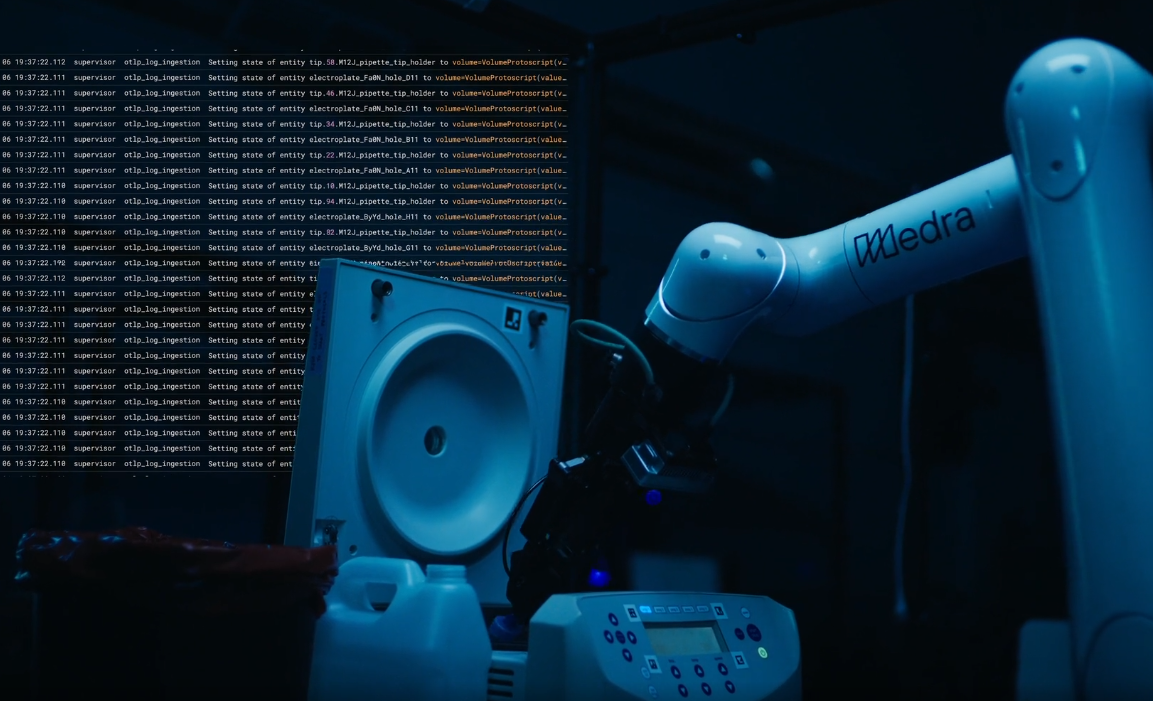
Medra, an artificial intelligence startup focused on drug discovery, has raised $52 million in early-stage funding to try to integrate powerful large language models with physical systems that can perform real-world lab experiments and truly automate science.
The Series A round, announced today, was led by Human Capital, along with participation from existing investors such as Lux Capital, Neo and NFDG, plus new backers including Catalio Capital Management, Menlo Ventures, Fusion Fund and others.
The startup has ambitions to build what it calls “the first physical AI scientist” and enable AI models to do more than just create theories by testing its hypotheses in real lab experiments. It’s simultaneously focused on developing models that specialize in drug discovery and reasoning to design various experiments, and general-purpose robots that can carry them out with full autonomy.
Medra said its Physical AI system can run end-to-end experiments completely autonomously without any human input. It does this by interfacing with standard laboratory tools and instruments. Its companion system is known as Scientific AI, which designs the experiments and interprets the results so it can refine its theories and hopefully, create entirely new drugs.
While its systems are still under development, they’ve already been put to use by some of the world’s top biopharmaceutical companies, including Addition Therapeutics, Genentech Inc. and Cultivarium Inc.
The startup wants to fulfill the promise of AI-powered drug discovery, which has lots of potential but has not yet accelerated the creation of new medicines in a meaningful way. The problem is that existing implementations tend to focus on only one aspect of drug development: Either they’re focused on industrial automation but reliant on human researchers to do the actual theory, or they automate scientific research but require human scientists to implement their theories in the real world. As a result, it still takes around 10 to 15 years to bring a new drug to the market, with average costs exceeding $2 billion.
Medra founder and Chief Executive Michelle Lee said in a blog post that the pharmaceutical industry typically runs millions of experiments every year, but most of the data it generates cannot be reused or fed back into AI development cycles. “To accelerate drug development, we need to link predictions directly to automated execution and feed the results back into the model,” she explained. “This continuous loop enables drug discovery companies to run far more experiments, iterate faster, and advance therapies with a higher probability of success.”
With the money from today’s round, Medra will grow its team, refine its Physical AI and Scientific AI systems and, most important, build its own fully automated laboratory, with a scheduled launch for next year.
Human Capital Founder Armaan Ali said he’s backing Medra because it’s trying to create an entirely new category in drug research and development. “We believe science can continuously learn and scale to create groundbreaking therapeutics with a higher chance of clinical success,” he added.
Image: Medra
Support our mission to keep content open and free by engaging with theCUBE community. Join theCUBE’s Alumni Trust Network, where technology leaders connect, share intelligence and create opportunities.
- 15M+ viewers of theCUBE videos, powering conversations across AI, cloud, cybersecurity and more
- 11.4k+ theCUBE alumni — Connect with more than 11,400 tech and business leaders shaping the future through a unique trusted-based network.
About News Media
Founded by tech visionaries John Furrier and Dave Vellante, News Media has built a dynamic ecosystem of industry-leading digital media brands that reach 15+ million elite tech professionals. Our new proprietary theCUBE AI Video Cloud is breaking ground in audience interaction, leveraging theCUBEai.com neural network to help technology companies make data-driven decisions and stay at the forefront of industry conversations.