Transcript
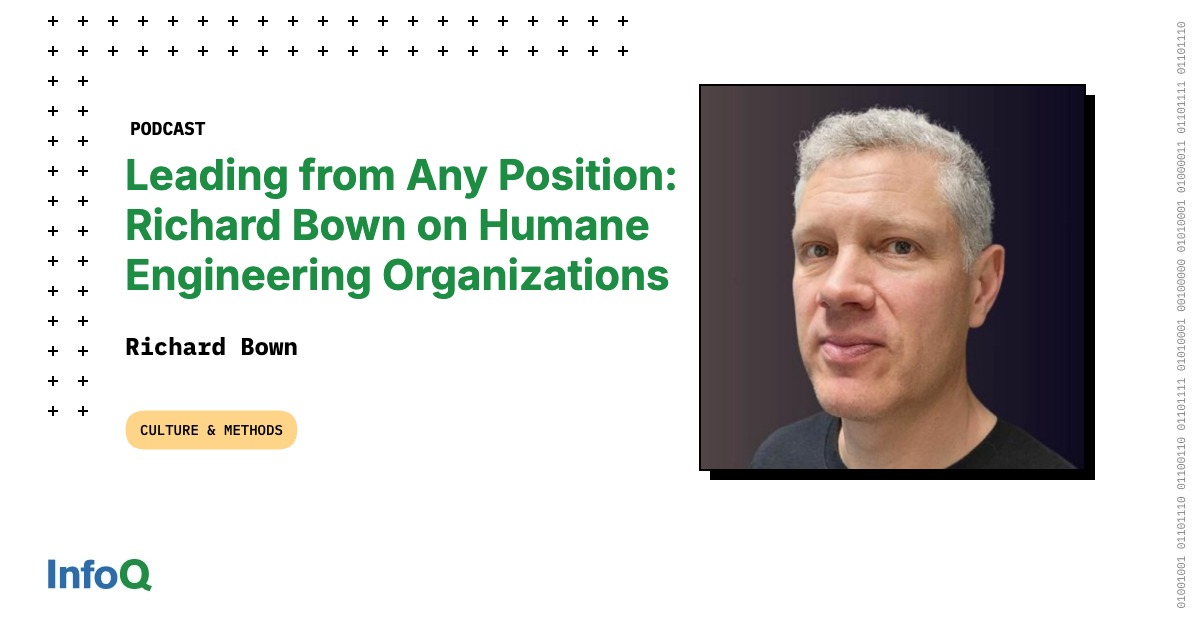
Shane Hastie: Good day, Folks. This is Shane Hastie for the InfoQ Engineering Culture Podcast. Today, I’m sitting down with Richard Bown. Richard, nice to meet you.
Richard Bown: Shane, thanks for having me on. It’s really nice to be here.
Shane Hastie: My normal starting point with these conversations is who’s Richard?
Introductions [01:18]
Richard Bown: Who is Richard? Yes, good question. So, I’m a software engineer, have been for the last 30 years. I’ve worked in a variety of roles in telecoms and finance and lots and lots of different companies. Over the years, I gradually grew to become a team lead, a tech lead, eventually a head of engineering. And now I’m back as an IC working as a DevOps engineer.
Shane Hastie: That’s an interesting pathway. And let’s dig into that a little bit, if we may. So, you went through up into a management role and then back… is it back or is it sideways or is it just a shift into the individual contributor DevOps engineer? What happened there?
Transition from Management to IC Role [02:01]
Richard Bown: For a long time, I felt that I needed to progress. And because I’ve been an external, I also preferred to be an external contractor for a lot of the jobs because I had a quite short attention span. I tended to hop around quite a lot and fix a problem, move on to the next problem, and I really enjoyed that. As you grow up the ladder or ascend the ladder, that doesn’t work so well. You need to have a bit of stickability. You need to be able to stay in a job and show that you can do that and grow into a leader role, right? These are the things that we’re taught or that’s the thing that maybe I assumed. We got to a point where I was able to do that and find a role eventually.
And I put it on this pedestal that it would be great to be there. And I’d love to, in some ways, having experienced many managers over my career to that point, be able to do things a bit differently or a bit better maybe. Or I don’t know, just try my hand at it and try to do that role. I went into it very excitedly, but completely unprepared. And in the years after that, I realized that there’s a book called What Got You Here Won’t Get You There. I should have read that book. I should have read plenty of other books or probably talked to some people before I’d taken that role on. So, eventually I realized, okay, maybe that wasn’t the right path for me.
But I guess I changed into a sense that leadership wasn’t about necessarily leading an organization or being a manager. You can also lead from where you are. And I think that’s the decision I came to and I feel very comfortable leading from where I am right now.
Shane Hastie: There’s a couple of things that come up to me for that. One is you’ve had self-awareness to recognize that a management type role wasn’t something that inspired you. Let’s delve into that if we can first. That’s hard to do.
Self-Awareness in Career Decisions [03:46]
Richard Bown: In some ways, yes. But I guess it depends on your personality type. It depends what you’re looking for from a job, from a role, I guess. One of the things that frustrated me around the role that I was asked to do was that there was just so much administration basically that I was so far away from the work and I thought I could help the work better by going up the ladder. Maybe it was down to the organization, maybe it was down to just the place that I landed.
However, my inability to deal with the more subtle interpersonal parts of that, or not deal with it in a way that I could do it constructively, I found that very hard. Whereas coming back to a team where I felt very comfortable mentoring, leading, coaching, doing the things you should do as a leader, not even feel that you ought to do, but just come naturally, right? Those inspired me, I guess, to be able to say, “Well, this is also leading”. Some of the work that I’d done with the team topologies guys as well over the last few years has been very informative for that, because that book really tied a lot of stuff together for me. And one of the subtitles of that book is around building humane engineering organizations, of course, right?
So, that really stuck with me and I wanted to be able to do that, to be able to build humane engineering organizations and do that as a contributor.
Shane Hastie: So, stepping into that contributor with that experience from management, and you make the point about leadership in the context of that individual contributor role, what does leadership look like in there? What are the things that you’re doing that embody leadership at that level?
Influencing Without Formal Authority [05:27]
Richard Bown: The way I see it these days is it’s being a proper inverted commas “leader”, a manager, a senior person in an organization, but you have more time to consider the implications of your actions. And also, you can work at a much smaller level. So, I feel it’s very similar in lots of ways. So, you can view what’s going on around you and you can comment on it. First, that’s a starter. You can internally comment. You can say, “Well, there’s a decision happening here or there’s a code change happening there or there’s an infra, whatever. Things are moving around here. And how do I feel about that? Do I like it? Do I not like it? What do my team members feel? What do my colleagues feel about this too?”
And then how can we make sure that we don’t make mistakes as we go forward, as we build this stuff, as we bring people into the team, as we change our architecture, or every single decision that you see around you, everything you come into contact with, you can do it with a leadership hat on, absolutely. And you can influence that as well. So, if you work in an organization where it’s a respectful organization where you do feel that you can speak your mind and open your heart to other members in that organization, you can speak freely basically, then it should be a blame-free way that you can influence every decision that’s made in some ways. And sometimes, you don’t need to.
Sometimes you can just stand there and see what happens. You might mention something to someone and say, “Well, do you feel this is the right way that we should be going about things?” But then you can watch that stuff happen and maybe react to it from your position wherever it may be. So, from that perspective, you have to take the ego, I think, out of the way that you feel about the decisions that are being made. And if you can detach yourself a little bit from that and not feel too emotionally involved with everything that’s going on around you, you can be a very effective leader from wherever you are.
Shane Hastie: What does a humane software development environment look like, feel like, act like?
The Challenge of Finding Humane Organisations [07:22]
Richard Bown: Honestly, I don’t know. And if I do find one, I’ll let you know because I haven’t experienced one yet, truly. I think a lot of interest over the last few years around sociotechnical architectures, a lot of interest in Conway’s law, of course, the way that the organizational makeup affects the architecture that you end up with, a lot of psychologists are talking now about it as well. Obviously, Daniel Pink’s book Drive, the talk about motivation, team sizing, Dunbar’s number, all of these great topics that come up in team topologies, of course.
These are all great, and it gives us more understanding, more knowledge about how organizations work and how software or systems more likely are built with those systems of people. But having said that, we are still scratching the surface, I think, of what it means to make a humane engineering organization because ultimately we don’t run on air, we run on cash and we need customers to be able to buy the things that we create. And that means we have to build stuff and we have to get it up into the cloud or wherever we’re hosting it and sell it, and it needs to be there 24/7. So, there’s always the thin end of the wedge when it comes to the people, to the humans, right?
No matter how great your organization and how well-intentioned and how many brown bag sessions you have or team outings or corporate fundraisers, all these things are great to bring people closer together. However, it’s just papering over the cracks from my perspective. I’ve not met one yet. I like to think there are brilliant organizations out there. And obviously, I’ve worked for some great organizations in my time. However, when you’re talking about truly humane, I still think we’ve got quite a long way to go, and that’s probably the nature of the business that we’re in.
Shane Hastie: So, how do we as engineering professionals nudge our organizations in that direction what we want to see?
Nudging Organizations Toward Humanity [09:21]
Richard Bown: Yes, that’s a good question. It is absolutely possible. I think if there are some touchstones, like one thing I find myself looking at quite regularly is the front page of any organization I work on that, their webpage and say, “What are our values”, right? So, you look at the values that the organization upholds, then you can use those in your day-to-day. Not a lot of people tend to do that, right? We get distracted by things that are happening around us and we tend to react rather than actually think about it. And respect typically figures quite heavily in lots of companies’ values. Look at those and see how can I embody those on a day-to-day basis and call people out as well.
I think it’s important to, if you’re not feeling comfortable or if someone else is not feeling comfortable, then I’d be an ally and be able to stand alongside people and make them feel that they’re not alone if they’re struggling with something or other. Again, this is tricky, right? These are very subtle things, especially in the workplace. The boundaries between home life and work life are usually quite rigid, but they’re also difficult to define or detect maybe between people. So, it’s tricky depending again on your culture, where you’re from, and also your company’s culture and how that works. All of these things can be quite subtle.
So, from my perspective, yeah, you can try and embody what you feel is correct and embody the points that the company tries to bring across on a day-to-day basis, and then that’s all you can do and you can just do your best.
Shane Hastie: Part of the reason that we got together is you wrote a book. You wrote a novel, in fact, called Human Software: A Life in I.T. I wouldn’t quite call it a thriller, but it’s got some pretty intriguing moments and all about building data centers. Without giving away too much, what brought you to the idea of writing a novel about that?
The Novel: Human Software: A Life in I.T. [11:23]
Richard Bown: It’s not a small undertaking, so I don’t know quite where it came from, but I think it was inspired by so many of those great books that I was reading. So, when I stepped away from the manager role, I started doing some reading, I started doing some writing as well. Actually, the writing was terrible, but the writing informed the reading in some ways. So, I started reading books and one of those books was The Phoenix Project, which I hadn’t read until that point a few years ago, and I was blown away by it completely. I thought, “This is brilliant”. Being able to read a novel, a story around DevOps, around what we do day-to-day, our infrastructure, and our challenges, and it was great. I loved that.
Then I read Team Typologies, and I really enjoyed that, and I saw the humane aspects there, things we’ve discussed. And I wanted to represent that because I felt that despite all of the great things that we’ve learned over the last 20 to 30 years in software engineering, when I go to my day job, I still have very similar feelings, very similar things to deal with on a daily basis. I don’t feel things that have improved really that much. And still, the human is the part in the machine, which is still working away, trying to make things happen, right? So, I wanted to represent that a lot more depth, I guess, than those books that went before. So, I did want to have a real human contact.
I wanted to have people with families and understand what it meant to work 24/7, 365 sometimes in these teams that are supporting these systems. What it’s like to have a family who is growing and have their own requirements, what it’s like to have a partner who’s out of work and maybe suffered burnout as an IT manager and with a home and work overlap and you can’t seem to escape from it. So, I wanted to represent that claustrophobia in some ways, but also create a hopeful novel as well. And I hope there is a part of it.
That’s the intention behind it to be able to discuss all of the things that we do, but also come out with it despite the trappings of data centers and AI and all that kind of stuff and a story with an evil boss, it’s supposed to be a bit of fun. And at the end of the day, I hope it delivers a hopeful message that we can get better at this stuff if we concentrate on it.
Shane Hastie: Well, I certainly enjoyed the read and you took us on that emotional journey most definitely. And I’m not going to give away any of the story of the book, so to speak. I would encourage our listeners to maybe think about reading it if they’re inspired to look at stuff in that way. Again, if I can come underneath the book and get into some of the important team sociotechnical messages that you were conveying in there, you made the point of real people in real circumstances facing real challenges, dramatized, of course, but still you catch our attention with these. What else was in there? What else was under the covers for you when you were doing that?
Themes of Ambition and Career Lifecycle [14:18]
Richard Bown: I think it’s a lot around ambition as well, around how we look at it. And again, this is probably harking back to my journey. When you start out in your career full of fire, full of excitement as I was, and ready to get your teeth stuck into every technical project that’s going compared to as you get to your middle of your career, when you have responsibilities, when life gets real, and maybe your work takes a backseat, but then your ambition is still there to be someone, be someone different, to be able to grow in your role or in a different role, or even when you’ve got to a situation where you have burnt out perhaps, and you want to come back into the working life.
Organizational Vanity Projects [14:55]
So, all of those life cycle parts of how we work were very important to me. And also the organization, how the organization sees that. Is there such thing as an organization or is it just people wanting to get things accomplished and how do they do that with their own ambitions? I’ve for one have seen in many companies, where projects have just sprung up because an SVP or an EVP has to do something to show their bosses by the end of the year or the next year. And that will mean that potentially hundreds, maybe even thousands of people will be employed for a year, two years on a project, which is essentially a vanity project and sometimes goes nowhere.
And as an engineer working in many global companies over many years, I’ve seen that happen many times. Sometimes, these projects stick and they stay. Sometimes they just disappear into the ether and all that cost is written off. That feels hurtful sometimes when you’re an engineer working on projects for many years, but this is a recurring pattern. So, there’s also a bit of calling out of that. If you are in that a role and you are thinking about running a project along those lines or a large project of any kind, then ask yourself question, who am I doing this for?
Is it just for me to look good or is it for us to actually as an organization go somewhere further and actually bring ourselves closer together through delivering a great project, right? So, many themes, I could go on for a long time.
Shane Hastie: You also touch in the book on some of the bigger themes, the climate change, the questions and challenges around the advances in technology and AI. And some of the, just because we can doesn’t mean we should. Tell us more.
Climate Change and AI Considerations [16:37]
Richard Bown: Yes, indeed. I’m on the fence with AI, I think, really. I see a lot of my peers, obviously I think we all see a lot of our peers getting very excited about it and a lot of our peers are very unexcited about it, and some people haven’t even touched it or looked at it. And that’s the one perspective I can’t really understand. I think if you work in software, if you work in technology right now, you can’t avoid AI. You have to look at it in some way and maybe form an opinion about it. It would behoove you to do that, I would say, if you haven’t already. Around the question of what does it cost our planet, right? That does come up in the book. It’s more about our local communities.
How do we deal with our local communities when potentially they are at the whim of large companies? What does that mean? What does that impact look like from an ecological perspective as well, the power requirements? But also from a work perspective, what does that mean for our jobs? I use Copilot and I find it useful in some ways, but also I don’t use it that much if I want to get something done in a quick amount of time. And I work in infra, I work in DevOps. I’m not writing a lot of code. I’m writing mainly YAML and stuff. But despite that, I find it’s not really quite there yet. So, it’s important for us to understand what it can do for us, but is the cost right now worth it?
And what are we going to see in a few years time, I guess? In some ways, I feel personally that it’s a little bit too late really to worry about where things are going. Things have already gone. AI’s happening and it’s happened and we are using it day to day and increasingly so. It’s interesting to find out what that looks like and where it means. In the book, I do touch on what that could mean and I can imagine we’ll probably be seeing some stories and we have seen some stories like that in the news already around what that could mean for us.
Shane Hastie: Think about the InfoQ audience. A lot of them moving into leadership positions, some into management, some more into that leadership at the practitioner level. What’s the message you’ve got for those folks?
Advice for Emerging Leaders [18:47]
Richard Bown: I think the important thing is to, for me, from my journey is to arm yourself with some knowledge, for sure. Listening to this podcast is a great start, I would say, if that’s not too obvious a plug, but there’s some great knowledge here. Reading some books, some of the books that we’ve talked about today are really good starting points for understanding how engineering works in organizations and how leadership can look like as well. And also talking to the leaders, ones that you respect, ones that have helped you perhaps in the past. I’ve been very lucky to have some brilliant leaders, some brilliant managers in the past, and they have really inspired me, I think, and they continue to do so.
In fact, there’s so much in the book around little quotes and nods to people who have inspired me over those years. And those connections you really understand. I think you personally, I understood them as soon as they happened to me wherever I was in my journey from starting out as a graduate engineer to wherever I ended up. Those connections are usually pretty immediate and you understand the value of them straight away. So, think of those people, reach out to them and say, “How would you see me as a leader and how would you think I should best approach it?” That was the advice I wish I’d given myself before I’d gone into this management role.
Shane Hastie: Richard, really interesting conversation. So, great coot for though here. If people want to continue the conversation, where can they find you?
Richard Bown: So, I’m on LinkedIn where I write quite regularly, particularly around the book at the moment.
Shane Hastie: Richard, thanks so much for taking the time to talk to us today.
Richard Bown: Thank you, Shane. Been a pleasure.
Mentioned:
.
From this page you also have access to our recorded show notes. They all have clickable links that will take you directly to that part of the audio.