The sign outside Tom Hermes’s farmyard in Perkins Township in Ohio, a short drive south of the shores of Lake Erie, proudly claims that his family have farmed the land here since 1900. Today, he raises 130 head of cattle and grows corn, wheat, grass and soybeans on 1,200 acres of land.
For his family, his animals and wider business, water is life.
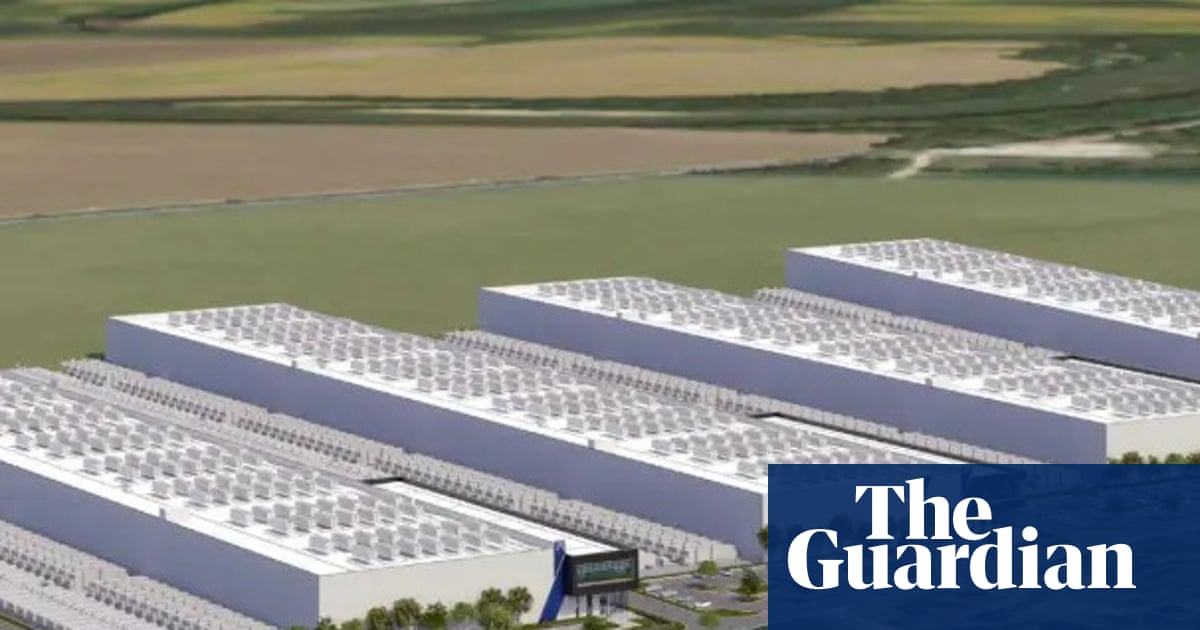
So when, in May 2024, the Texas-based Aligned Data Centers broke ground on its NEO-01, four-building, 200,000 sq ft data center on a brownfield site that abuts farmland that Hermes rents, he was concerned.
“We have city water here. That’s going to reduce the pressure if they are sucking all the water,” he says of the data center.
“They’re not good, I know that.”
Two years ago, the company said it would invest about $202m on a “hyperscale” data center that would employ 18 people and dozens more in the construction process. Although the company claims it uses a closed-loop, air-cooled system for cooling its computers that can reduce the need for water, artificial intelligence, machine-learning and other high power-demand processes do rely on water as a cooling agent.
All the while, a 10-minute drive north, the shoreline of Lake Erie hasn’t been this low in years.
Water levels across all five Great Lakes have begun to drop in recent months as part of a long-term fall. Since 2019, the Great Lakes have seen water-level decreases of two to four feet. While experts say this is a natural decrease given the record highs the lakes have experienced since 2020, it’s happening at a time when a huge new consumer of water has appeared on the horizon: data centers.
The source of the largest single deposit of freshwater on the planet, the Great Lakes, in particular Lake Erie, are already struggling with the fallout of drought and warmer water temperatures that, at this time of year, fuel major lake-effect snowstorms, and greater than normal levels of evaporation due to the absence of ice cover.
With major cities such as Chicago, Toronto, Detroit and Pittsburgh all within a few hundred miles of each other, small, under-resourced communities around the Great Lakes have become hugely attractive for data-center companies.
In Mount Pleasant, Wisconsin, Microsoft is building what it calls the “world’s most-powerful AI data center” that is set to open early next year and expected to use up to 8.4bn gallons of municipal water from the city of Racine every year. Racine gets its water from Lake Michigan. Similar stories are playing out in Hobart, Indiana, where AWS is planning to build a data center two miles from Lake Michigan’s shoreline, and in Port Washington, Wisconsin.
In Benton Harbor, Michigan, locals are concerned that a proposed $3bn data center would contribute to environmental pollution and traffic.
Forty miles west of Aligned’s under-construction data center in Ohio, in Woodville Township, hundreds of people showed up to a public meeting last October to voice concern about another proposed data center project in their rural community.
“The Great Lakes region, especially in states such as Illinois and Ohio, [is] among the most data-center dense states in the region. In addition to the high volumes of water used on site for cooling, our recent research found that even more water may be consumed to generate electricity to power data centers’ energy needs,” says Kirsten James, senior program director for water at Ceres, a nonprofit headquartered in Boston.
“These impacts can conflict with communities’ water-resource planning efforts.”
The Great Lakes Compact, a 2005 accord signed by the governors of eight US states and two Canadian provinces, means that Great Lakes Water must only be used within the regional basin.
Research by Purdue University found that data centers on average consume about 300,000 gallons of water a day. Water used by data centers is warmed significantly and for those that do not use a closed loop system, that heated effluent water, just 20% of the initial amount, is often discharged back into local wastewater systems or the environment, with potentially serious consequences for flora, fauna and human consumers. Even closed-loop systems that reuse the same water repeatedly need millions of gallons of water.
While many new data centers are drawing water from local municipalities that, in turn, get their water from groundwater, much of that supply comes from the Great Lakes watersheds.
Some communities are fighting back. Last month, residents of Fife Lake, Michigan, were overjoyed after hearing a plan for a data center in their town of 471 residents would be scrapped due to local opposition.
Similar stories of successful opposition have played out in Indiana and elsewhere.
But the data centers are fighting back.
Private firms representing data center companies have often successfully sued community authorities, accusing them of illegally excluding certain types of developments, making small towns powerless in the battle to keep out giant water-guzzling corporations.
In Michigan’s Saline Township, a community of about 400 people outside Ann Arbor, OpenAI and Oracle used a representative company to successfully sue the local authority to overcome opposition and build a massive facility that would use 1.4 gigawatts of electricity – roughly the equivalent of powering 1.4 million homes.
The Detroit Free Press editorial board assailed the move, calling it a “a fait accompli, hammered into this tiny Washtenaw county community over the objections of residents, the elected board that represents them, and Michigan’s attorney general, absent expert or outside testimony save a cursory public hearing held over Microsoft Teams”.
Data companies and their backers, however, say their presence is a net gain for Great Lakes communities by providing jobs and investment over the course of years.
Aligned has paid hundreds of thousands of dollars to Perkins Township, the local school system and a career center. In return, it gets a 15-year tax exemption from local authorities. A representative declined to respond to questions from the Guardian asking how much water it intends to use at the data center and from where it originates.
Local municipalities that support these facilities claim that the data centers will increase tax revenue and help rebuild ageing infrastructure such as water delivery systems that, in some places, are in significant need of upgrading. Calls, emails and messages left with Erie county commissioners asking if local authorities plan to supply the Perkins Township data center with water were not responded to.
Some Perkins Township residents say a number of local companies have been hired during the construction phase, bringing work to the area.
But many argue those investments are not worth the long-term price the community may pay.
Amanda Voegle, who works at a heating business now directly facing the data center, is concerned about water and many other issues.
“A couple of years ago, there was a water pollution issue at the site. I’m very concerned. Is this [water] going back into the lake?”
Two years ago, the construction site upon which the data center is being built was found to be the source of contamination of a river that flows into Lake Erie, with the remediation company responsible cited by the Ohio EPA for unauthorized discharges into state waters.
“I don’t understand why they built it so close to the street, because it’s an eyesore,” says Voegle.
She says there have been other unusual incidents at her workplace recently, including power surges.
“I don’t know if it’s related [to the data center]. It’s probably almost weekly that we lose power and have to fully reboot everything. There was a couple of things we actually had to replace because [the power surge] fried it.”