For most of the internet age, the relationship between brands and search engines was straightforward: you create useful content, Google sends you visitors, and, eventually, a respectable portion of those visitors become customers.
That agreement is no longer in place.
With the introduction of AI Overviews, Google no longer waits for users to click. It generates instant answers in the results page by paraphrasing multiple sources. Your content fuels the answer, but your website gets none of the traffic it deserves.
So how can you measure success in this new reality? We’re outlining the current challenges, how to address them, and what tools to use to measure performance outside of website traffic.
Contents
Why less traffic isn’t the end of the world
AI Overviews are heavily impacting search traffic. Just look at the data:
- 65% of AI answers contain no direct links back to the sources.
- Clicks on informational queries have dropped 18-30% across industries.
- Zero-click searches now account for more than 60% of all Google queries and continue to rise.
At first glance, the picture looks grim. Sessions are down, dashboards are looking bad, and leadership begins to question whether SEO is worth the investment at all.
However, the story is more nuanced than that. The traffic that is vanishing is mostly low-value: top-of-funnel searches for quick definitions, generic comparisons, and simple answers. Those visitors were rarely the ones who converted. The clicks that matter (from ready-to-buy people actively evaluating solutions) remain far less affected.
AI Overviews show for relatively straightforward and basic queries much more often than for queries with purchase intent.
The real challenge goes beyond tweaking your SEO strategy. The focus now shifts towards redefining what success means. Click-through rates and session counts no longer tell the full story. The true measure is whether your brand is being seen, remembered, and trusted, even when users never visit your site. That visibility builds awareness, shapes perception, and drives demand.
🔎 Get updated tips for your SEO strategy with our free guide >> How to Do SEO Right—Right Now!
The answer: Measuring AI brand impact
The rise of AI Overviews has made zero-click the default, which means the question is no longer “Did they click?” It is:
- “Did they see us?”
- “Did they remember us?”
- “Did it influence what they did next?”
Visibility and recall are now as important as traffic, and in many cases even more valuable. Appearing inside an AI Overview puts your brand in front of thousands of searchers, even if you never receive the visit.
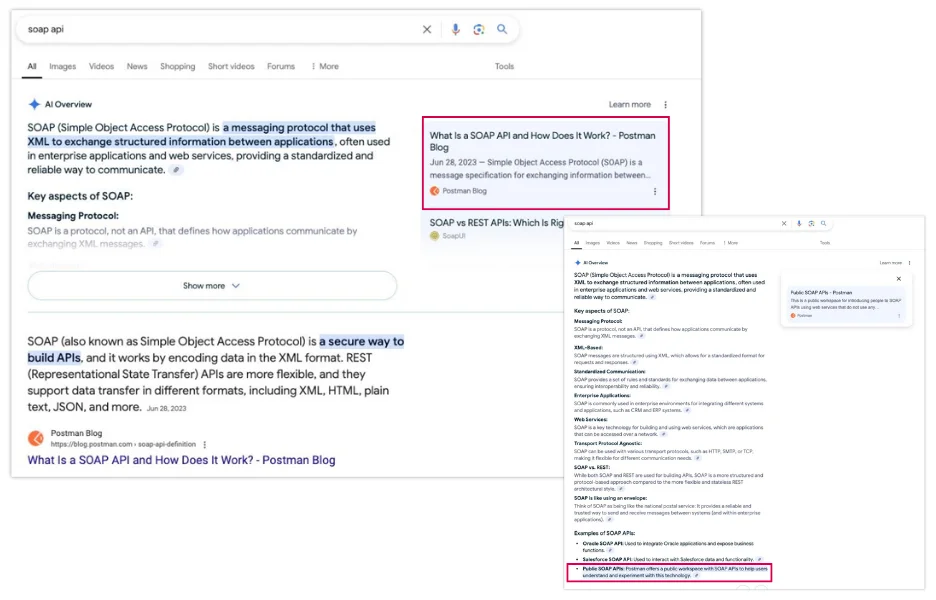
The clicks that are disappearing are mostly low-intent searches, such as “what is content marketing” or “best free invoice template.” These visitors were always difficult to monetize.
The clicks that remain, like “best B2B content agency pricing” or “WordPress CRM integration,” tend to have clear buying intent. They are also the kinds of queries AI struggles to summarize effectively.
The challenge for marketers is proving that this invisible exposure translates into real-world outcomes. That requires reframing SEO success away from raw traffic and toward brand lift.
Core challenges when measuring brand impact in AI-driven search
Marketers face three major obstacles when trying to measure brand impact in AI-driven search:
- Mentions without attribution. AI often paraphrases your content without linking back. Your insights shape the answer, but you receive no AI referral traffic.
- Misrepresentation of messaging. AI can strip away what makes you unique. A sustainability-first apparel company can be flattened into “t-shirts at mid-range pricing.” A SaaS that prides itself on support can be reduced to “task management software.”
- Analytics blind spots. Google Analytics, Google Search Console, and Ahrefs were built for clicks and rankings. None of them can show you when your brand appears inside an AI Overview.
The result is frustrating: your visibility is real, but invisible in reporting. Without a new measurement framework, you cannot prove value to leadership.
New metrics for measuring AI-era brand impact
Here are the metrics to pay attention to so you can prove success despite less website traffic.
1. Impressions and SERP visibility
When clicks fall away, impressions become the lifeline that tells you whether your brand is still in the game. Every impression is a signal that you are being surfaced, that your voice is part of the conversation, even if the user does not make it to your site. Think of it as digital eye contact. You may not get a handshake, but you are still noticed.
For too long, impressions were treated as a vanity metric. They sat buried in dashboards, overshadowed by traffic and conversions. That is no longer the case. With AI Overviews now in full swing, impressions are the closest thing to proof that your content still has reach. They show you how often Google trusts your material enough to pull it into the results, even if the user finds their answer before clicking through.
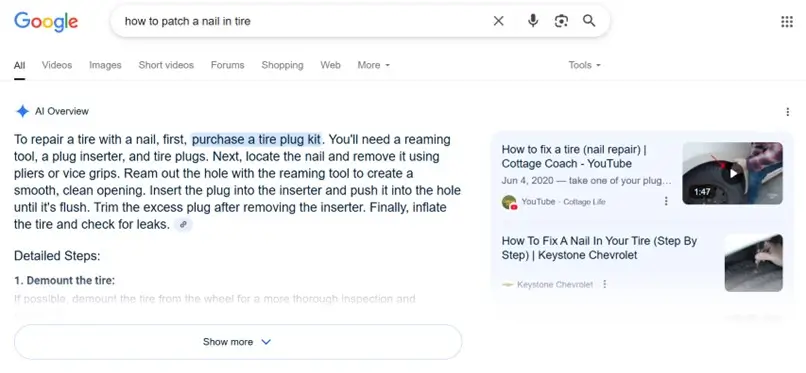
The mistake most teams make is panicking when clicks decline, assuming the content has failed. In reality, the story is often the opposite. Impressions might be growing, meaning more people are encountering your brand name, your perspective, or your ideas, even if they stop short of your site. That visibility plants seeds. It builds familiarity. And when the time comes for a decision, the brand they remember will be the one they saw again and again.
The challenge is shifting the mindset inside your company. Leadership is used to judging SEO by traffic alone. It is your job to show them that impressions are not scraps of wasted exposure. They are the new reach metric. They tell you whether you still have a seat at the table when the answers are being given.
How to measure it
- Open Google Search Console → Performance → Search Results.
- Track total impressions for priority queries.
- Segment into branded (your name, product) and non-branded queries.
- Export to Looker Studio or another BI tool and chart impressions against clicks to highlight the gap.
⭐️ What are the biggest challenges businesses face when it comes to SEO? We asked over 300 SMBs. Get the results >> The Big Small Business Website & SEO Trends Report
2. Branded search volume
If impressions are about being seen, branded search volume is about being remembered. When people take the extra step of searching for your company or your product by name, it means that something you did upstream left an imprint. In the AI era, that imprint is often the exposure you received inside an AI Overview.
This is why branded queries are one of the clearest signals of impact. They are a direct measure of awareness. You cannot fake them. Nobody types your name into Google unless they have heard of you, remembered you, and felt curious enough to want more. If impressions are the spark, branded search is the smoke that tells you the fire is catching.

Too many marketers focus on non-branded keywords because they seem broader and more “scalable.” But in a world where AI systems summarize generic information instantly, non-branded clicks are the first to vanish. Branded searches, on the other hand, are defensible. They prove your visibility is creating familiarity and recall that competitors cannot take away.
When branded demand rises, it is a sign that your visibility is not just empty exposure. It is bending the curve of recognition in your favor. This is the kind of metric executives understand instinctively.
How to measure it
- In Google Search Console, filter queries containing your company, product, or domain name.
- Cross-check branded query trends with Google Trends and Ahrefs or Semrush for validation.
- Establish a baseline, then report changes month over month to show whether branded demand is growing alongside impressions.
3. Direct traffic and assisted conversions
Not every customer journey is immediate or traceable. Many people see your brand in an AI Overview and walk away satisfied with the quick answer. But later, when the problem resurfaces or the stakes are higher, they type your URL directly into the browser or return through another channel. Those visits may not show up in the same session, yet they are part of the influence AI visibility creates.
This is where direct traffic and assisted conversions matter. Direct visits often look like they came out of nowhere, but in reality, they are the product of repeated exposure and familiarity. Someone saw you in search, remembered your name, and came back when it counted. Assisted conversions tell the same story: organic impressions lighting the spark that another channel later closes.
The danger is measuring only last-click performance. If you focus on the final step, you erase the real contribution of search visibility. SEO has always been a top-of-funnel channel, and in the AI era, its role as a memory-builder is even more important. Visibility creates awareness, awareness creates preference, and preference converts when the time is right.
For leadership, this is the hardest part to grasp. They want clean attribution lines. But reality is messier. Your job is to connect the dots and explain that many of those “mystery” direct signups started with an invisible encounter in an AI Overview.
How to measure it
- In GA4 → Reports → Acquisition → Traffic Acquisition, monitor Direct traffic alongside Organic.
- In GA4 → Advertising → Attribution → Conversion Paths, analyze how often organic impressions assist conversions closed by Direct or Paid.
- Use custom exploration reports to map the typical lag between first exposure and final conversion.
4. Share of voice in AI responses
Traditional SEO was about share of voice in the search results. You judged your position by how often you ranked compared with competitors. That scoreboard still matters, but a new one is emerging: share of voice inside AI responses.
Now the key question is simple: when people ask AI tools like Google’s AI Overviews, Perplexity, or ChatGPT, does your brand show up in the answer? The more consistently you are mentioned, the more mindshare you build in your market.
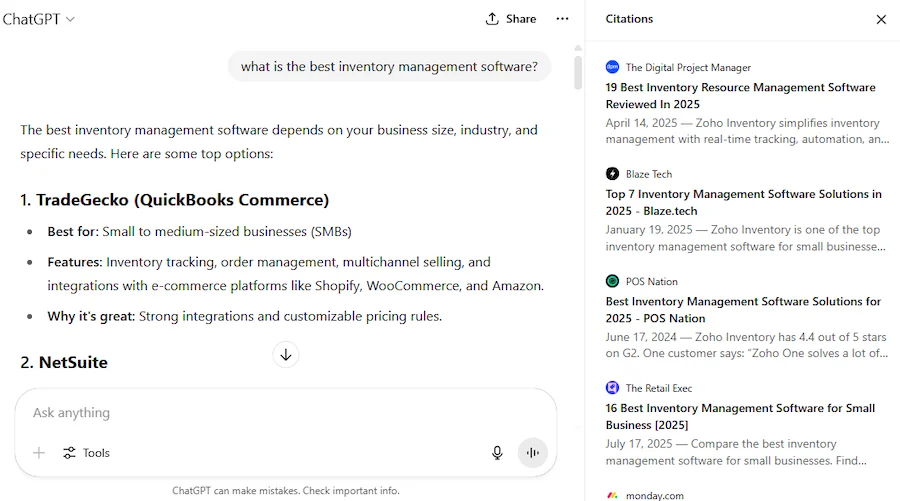
This is no longer about chasing one top ranking. It is about becoming part of the default knowledge base that AI systems rely on. As content strategist Oskar Duberg explains: “Brand mentions across diverse platforms create a network effect for AI visibility. When AI sees your brand referenced in multiple authoritative contexts, it is more likely to include you in responses, even without direct links.”
That is the new competition. Success is not just measured by where you rank, but by how often AI repeats and remembers your brand. Tracking your share of voice in AI responses shows whether you are still shaping the conversation or being left out entirely.
How to measure it
- Build a prompt map: 20–50 core questions prospects would ask.
- Run them monthly in Google AI Overviews, Perplexity, and ChatGPT (with browsing enabled).
- Record which brands are surfaced and calculate your share relative to competitors.
- Use tools like Perplexity Labs, ContentLab AI, or Keyword.com AI Visibility Tracker to automate monitoring at scale.
5. Sentiment and accuracy of representation
Visibility without accuracy is not a win. In fact, it can damage your brand. When AI mentions you but flattens or misrepresents your differentiators, the exposure works against you.
Consider what has already happened to publishers. The Guardian reported that some news outlets lost up to 80% of their clickthroughs once their stories were summarized by Google’s AI Overview. Authoritas estimated those sites could lose 79% of traffic for queries where their links were pushed below the fold. The information was still surfaced, but stripped of context and branding. What readers saw was a diluted version of the original.
This risk applies to every industry. If you are a sustainability-first apparel brand and AI reduces you to “mid-range t-shirts,” you lose the very essence of what makes you different. If you are a SaaS company known for world-class support and AI files you under “task management software,” you blend into the crowd.
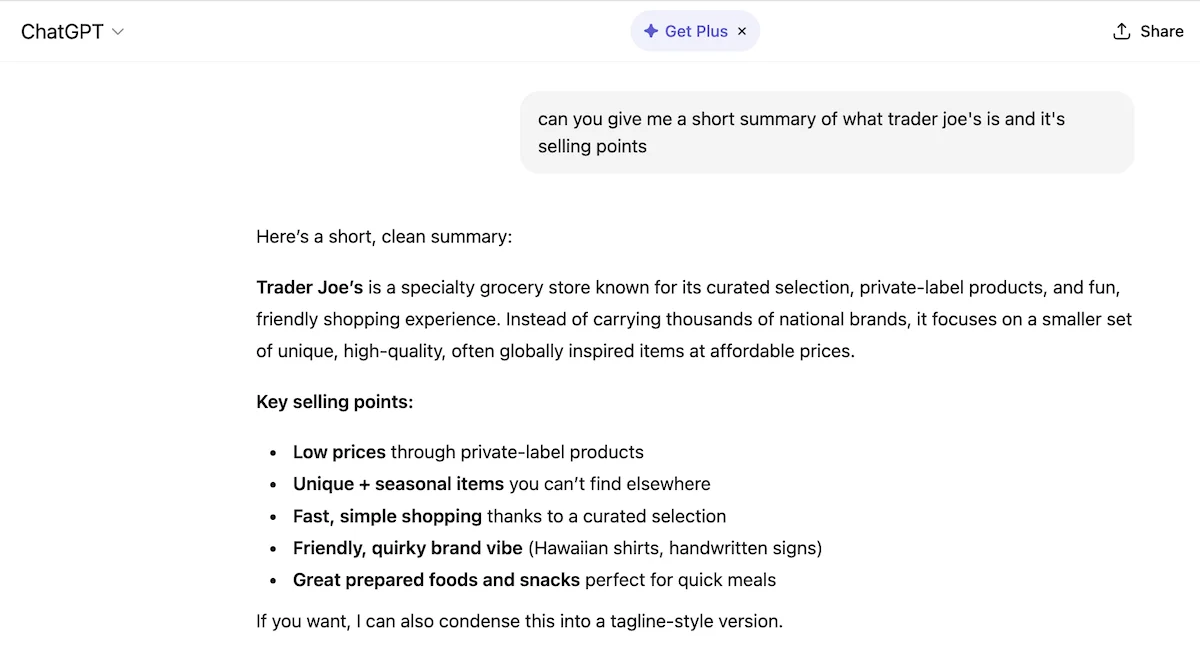
That is why auditing how AI portrays your brand is critical. You cannot assume your unique value will survive the summarization process. You need to surface it clearly, reinforce it structurally, and monitor whether AI repeats it correctly. The battle is no longer just about visibility, but about being represented with accuracy.
How to measure it
- Use your prompt map to run monthly brand audits across AI platforms.
- Document whether your brand is presented accurately, partially, or misrepresented.
- Track accuracy scores over time, and tie improvements to content restructuring or schema updates.
- Create an internal log so leadership sees whether AI reflects the brand correctly.
6. Post-exposure engagement signals
AI visibility does not always result in a click, but it often sparks action somewhere else. A prospect might follow you on LinkedIn. They might sign up for your newsletter. They might start a free trial days later, after remembering your name.
These are what we can call post-exposure signals. They are the ripple effects of visibility. They show up as sudden spikes in social growth, unusual bursts of email subscriptions, or direct trial activations that seem disconnected from your SEO campaigns. In reality, they are often the downstream result of AI-driven impressions.
The common mistake is treating social or email engagement as separate from search. In truth, they are increasingly connected. Zero-click exposure plants seeds in the minds of searchers. Other channels capture the growth once those seeds begin to sprout.
For marketers, the key is to watch for the patterns. Tie engagement spikes back to impression surges in Google Search Console. Add post-exposure signals to your reporting dashboard so leadership sees them as part of SEO’s contribution, not as random noise.
This is how you reframe the conversation. Not all value shows up as a click. Sometimes it shows up as a follow, a sign-up, or a trial. And those outcomes may be even more meaningful than a one-time visit.
How to measure it
- Track social follower growth, email signups, and trial activations over time.
- Use Google Search Console to identify impression spikes and correlate them with engagement bursts.
- Apply UTM tags on campaigns and forms to connect engagement sources with prior search exposure.
- Add these post-exposure metrics to your SEO dashboard as brand lift signals.
Tools that help you track AI mentions
Your new stack should include the following tools:
- Perplexity Labs helps you monitor when and how your brand is cited in Perplexity results. Since Perplexity is one of the few AI engines that consistently shows attribution, it gives you an early look at how your content is being pulled into generative responses.
- ContentLab AI and Profound specialize in tracking whether your brand appears inside Google’s AI Overviews. These tools allow you to map your presence across a wide range of queries, essentially building the AI-era equivalent of rank tracking.
- BrandMentions and Mention have expanded their monitoring to capture brand visibility in AI systems as well as across web and social platforms, giving you a cross-channel view of how your name is spreading.
- Google Search Console (GSC) and GA4 remain the foundation. They tell you whether impressions are rising, whether branded searches are increasing, and whether direct visits and assisted conversions are following the exposure.
Individually, these tools give you partial visibility. Together, they provide a 360-degree view of how your brand lives inside this new environment—whether it is being surfaced, recognized, and remembered.
Reporting framework: Tying it all together
AI Overviews are not a passing experiment. They are fast becoming the default way people consume search results. That means the KPIs that define SEO success will change.
Expect to measure:
- AI share of voice: The percentage of answers where your brand appears compared with competitors.
- Citation presence: How often AI systems actually credit you as the source.
- Brand recall lift: Measured through surveys, social listening, or controlled ad campaigns to see if exposure leads to recognition.
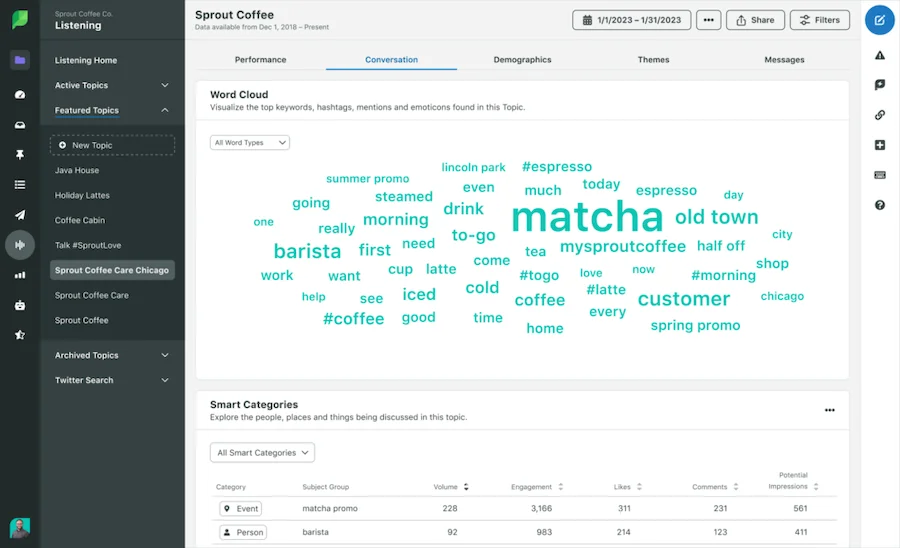
Example of a social listening word cloud on Sprout Social.
The companies that begin tracking these signals now will be the ones best positioned to prove value later. Early movers will not just defend their budgets—they will have a competitive advantage in shaping how the market sees them.
Redefining the impact of less website traffic
Traffic is no longer the definitive measure of SEO. The ground has shifted, and the winners will be the ones who prove that visibility, recall, and influence matter just as much as visits.
The challenge for marketers is to stop reporting on numbers that no longer tell the story and start reporting on the metrics that do. Impressions. Branded demand. Share of voice. Accuracy of representation. Assisted conversions. These are the new building blocks of impact.
Four steps to start today:
- Build an AI prompt map to test where you appear.
- Track impressions and branded searches every month.
- Use GA4 attribution to connect exposure to conversions.
- Audit how AI systems represent your brand.
You cannot force AI to send the click. What you can do is ensure your brand is seen, remembered, and trusted when the answers are given. That visibility is what drives awareness, shapes perception, and creates demand.