The year of 2025 was dizzying for Elon Musk. The tech titan began the year holding court with Donald Trump in Washington DC. As the months ticked by, one public appearance after another baffled the US and the world. Musk appeared to give a Nazi salute at Trump’s inauguration, staunchly championed a 19-year-old staffer nicknamed “Big Balls,” denied reports of being a drug addict while advising the president, and showed up at a White House press conference with a black eye – all in the first half of the year alone.
“Elon’s attitude is you have to get it done fast. If you’re an incrementalist, you just won’t get your rocket to the moon,” Susie Wiles, Trump’s chief of staff, told Vanity Fair in an expansive interview earlier this month. “And so with that attitude, you’re going to break some china.”
Musk saw huge, multibillion-dollar wins and equally large losses in business this year. In his dealings with federal agencies, he was able to secure new enormous government contracts and expand SpaceX’s operations. With Tesla, he was approved for a pay package that could make him the world’s first trillionaire even as the company’s global sales plunged. At the same time, Musk and his businesses were the target of protests, lawsuits and an exodus of high-level executives. He ended the year with a fortune worth some $600bn.
In the background, his turbulent personal life continued to provide surprises. Rightwing influencer Ashley St Clair sued Musk in February for custody of their five-month-old baby, revealing that Musk had fathered a 13th publicly documented child, for a total of now 14 children. As Musk made regular attacks in posts on X against transgender people, his estranged daughter Vivian Wilson, who is trans, was featured in New York magazine and modeled at New York fashion week. And the New York Times published a lengthy investigation into Musk’s father, Errol Musk, who was accused of child sex abuse.
The relationship that dominated Musk’s public life, however, was his friendship and falling out with Trump. On the day of his inauguration, Trump empowered Musk to gut government agencies, which the tech billionaire did with zeal and abandon. But by June, Musk and Trump had broken up. Their bromance burned hot and fast. On one of his final days as a special government employee, Musk lashed out at the president on his social media platform, X, saying: “Time to drop the really big bomb: @realDonaldTrump is in the Epstein files.” The post has since been deleted.
Though the drama surrounding Musk was frequently absurd and unpredictable, it was also consequential. This was a year when the richest person in the world obtained new levels of wealth and power that few in history have ever approached, one that demonstrated the depth of his global influence as he sought to advance his rightwing agenda and grow his tech empire.
While Musk had stayed away from Washington DC after the Epstein post, the billionaire was invited back in November for a White House dinner in honor of Saudi crown prince Mohammed bin Salman. By the end of the year, Trump and Musk seemed to have made amends. When asked by Fox Business this month if Musk was back in his circle of friends, Trump suggested the two could have a future together again.
“Well, I really don’t know,” Trump said. “I mean, I like Elon a lot.”
Musk expressed more regret than the president over the course the year had taken. When his former aide Katie Miller asked whether he would lead the unofficial “department of government efficiency” (Doge) again, knowing what he knows now, he responded: “Instead of doing Doge, I would have worked on my companies. And they wouldn’t have been burning the cars.”
Musk goes to Washington
After becoming a Republican mega-donor and campaigning for Trump during the 2024 election, Musk began the year on a high as he prepared to enter the administration as the de facto leader of Doge. He immediately set a tone of chaos and outrage that would persist for the length of his time in the White House.
During Trump’s internationally televised inauguration event in January, Musk issued what many people interpreted as back-to-back fascist-syle salutes as he concluded a speech. Rights groups condemned the gesture while Musk attempted to dismiss the criticism as “dirty tricks” from legacy media. The reaction was so intense and negative that some Tesla owners sold their cars in response to Musk’s gestures.
Musk spurred further condemnation from Jewish groups after appearing virtually at a rally for Germany’s far-right AfD party. The Tesla CEO told the crowd via livestream that Germans should not focus on “past guilt” and “move beyond that” in an apparent reference to Nazi Germany.
As Musk started his work with Doge, the controversies and backlash against his politics grew. The newly formed bureau operated first as a loose collection of appointed staffers and then subsumed the US Digital Service. It rapidly moved to gut federal agencies and conduct mass layoffs across the government even as ethics watchdogs launched lawsuits accusing Musk’s group of violating privacy and transparency laws, some of which continue today. Musk personally bragged about feeding the United States Agency for International Development (USAID), the world’s largest single provider of humanitarian aid, “into the woodchipper”. The cuts would cause the abrupt cancellation of aid programs worldwide, disrupt HIV/Aids treatment for millions and result in children starving to death in a hunger crisis that experts agree was needless.
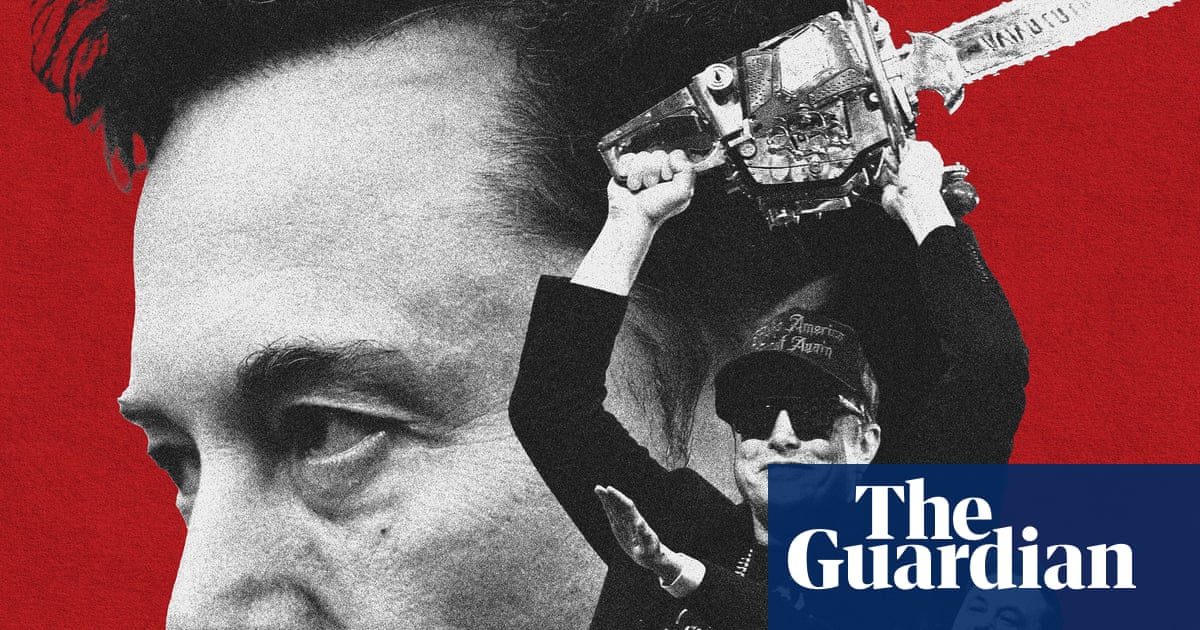
At the annual Conservative Political Action Conference in February, Musk appeared to relish his new role as the Trump administration’s demolition man. He brandished a chainsaw on stage and told the audience “I am become meme!” as he waved it about in sunglasses and a gold chain. In March, he once again began to pour more money into Republican causes by holding rallies and handing out $1m checks to support a conservative judge in Wisconsin’s supreme court race.
The pushback against Musk’s political blitz soon began to frustrate his ambitions, however. Judges that ruled Doge’s activities illegal or issued temporary injunctions infuriated Musk, who called for the widespread impeachment of any “activist judges” who opposed his agenda. His preferred candidate in the Wisconsin supreme court race lost by a significant margin, a sign to some in Washington that Musk’s presence had potentially become politically toxic.
Musk left his role in the White House in May amid disputes around his pick for who would head Nasa and clashes over Trump’s One Big Beautiful Bill Act. Upon his exit, he signalled that his time with politics had come to a close, claiming he would reduce his campaign finance contributions in the future and return to his businesses. Yet he quickly put himself back in the spotlight with his public battle with Trump on social media and vowed he would start a third political party called the “America party,” a promise that has yet to come to meaningful fruition.
Musk’s political leanings continued to drift rightward, allying himself via near-constant posts on X interacting with far-right activists such as Tommy Robinson and telling Joe Rogan that “it should be OK to have white pride”. He led an online grievance campaign in early October against the Anti-Defamation League, the country’s most prominent Jewish advocacy group, claiming that it “hates Christians” and suggesting that their documenting of extremism encouraged murder. Although no longer in the administration, his extreme conservative takes on immigration, race and politics have persisted as prominent features of his public identity.
Musk’s constellation of businesses
The year in Musk’s businesses offered the billionaire even larger truckloads of money than before, despite facing intense controversy and competition.
Unlike other tech moguls, who typically helm one company at a time, Musk sits astride several corporations. He controls the rocket company SpaceX and the tunneling and brain implant companies, Boring Inc and Neuralink, respectively. Musk also runs the social media company X, which he bought for a second time this year via his artificial intelligence company xAI. Then there’s Tesla, his electric car company.
Of all his enterprises, Tesla especially courted attention this year, as people enraged by Musk’s work with Doge focused their attention on the carmaker’s showrooms. Across the country, protesters marched at ongoing “Tesla Takedown” events. One sign at a San Francisco protest in March read: “Burn your swastikar before it burns you.” Dozens of Tesla cars and charging stations nationwide were set on fire as one-off vandals protested the billionaire.
Though Trump and Musk hosted what amounted to a Tesla sales event on the lawn of the White House in March, Tesla saw its sales slump worldwide.
By June, Musk had announced the rollout of its self-driving robotaxis in Austin. Within the first week, bystanders had recorded videos of the cars having difficulty turning left or picking which side of the road to drive on, which attracted the attention of regulators. These robotaxis, which were required to operate with a human safety driver up until earlier this month, have encountered only a handful of documented safety incidents since then.
Lawsuits against Tesla also piled up throughout the year. In August, a Florida jury awarded more than $200m to victims of a deadly crash involving its Autopilot technology in August. And in California, two separate lawsuits were filed in October over three teenagers who were killed when a Cybertruck caught on fire and locked them inside. The National Highway Traffic Safety Administration also opened several investigations into the carmaker over safety issues.
While Tesla’s plunge in profits continued throughout the year, that didn’t stop the company’s shareholders from approving a pay package for Musk – the largest corporate payout in history – that could catapult him to the status of the world’s first trillionaire.
Tesla’s year finished with a blow from California’s department of motor vehicles. The agency said the car company had misled consumers and exaggerated the capabilities of its Autopilot technology. If Tesla doesn’t “remedy the situation” within 90 days, the DMV said earlier in December, the company will be banned from selling cars in the state, its biggest US market.
With SpaceX, Musk was able to curry favor with the federal government. Not only did his Starlink satellites continue to dominate the Earth’s atmosphere – the SpaceX subsidiary operates the vast majority of all satellites in orbit – but the Federal Aviation Administration and the air force gave SpaceX the go-ahead to increase rocket launches in Florida, Texas and California. This came despite the company’s massive Starship, a 400ft machine that Musk hopes to one day fly to Mars, repeatedly blowing up and showering shrapnel across the Caribbean. One such explosion prompted legal action from Mexico, which said the debris harmed thousands of endangered sea turtle hatchlings.
Musk also consolidated his social media and artificial intelligence companies this year. In March, he announced that xAI had acquired X in an all-stock transaction that he said valued X at $33bn. Both companies are privately held.
xAI makes the Grok chatbot, which is integrated into X. The chatbot had countless meltdowns in the second year since its release. It pushed conspiracy theories about “white genocide”, claimed Trump won the 2020 election and spewed numerous antisemitic claims, once referring to itself as “MechaHitler”. Nevertheless, Musk was able to seal a $200m contract from the Department of Defense to integrate Grok into federal government tools.
Meanwhile, Musk’s xAI datacenters in Memphis, Tennessee, were accused of polluting historically Black neighborhoods. The company had moved in dozens of portable methane gas generators to power the facilities, initially without permits, which brought several protests and a pending lawsuit from the NAACP.
Neuralink, which operates in relative secrecy compared with Musk’s other businesses, accelerated the tests of its brain chips in 2025. The company says its product allows a person limited control of a computer via their thoughts. After announcing its first successful implantation in 2024, the company announced in September that it had completed the procedure in 12 patients.
Throughout the year, top executives fled the uproar involved in managing Musk’s companies. Linda Yaccarino departed as X’s CEO, as did its advertising chief. xAI lost its co-founder, chief financial officer and lead lawyer. Likewise, Tesla saw several executive exits, including the vice-president of North American sales, the director of the battery team, the head of the “Optimus” robot project and several leaders of the company’s various car divisions.
A year of personal feuds
Musk, whose life is frequently animated by grievances and breakups, had a banner year for high-profile fights, even by his own standards. Longstanding feuds reignited while his close relationship with Trump imploded in full public view, all as he posted a steady stream of attacks against immigrants, the trans community, the media, Wikipedia and a host of other targets on X, where he boasts 230 million followers.
Musk began the year by accusing the government of South Africa, his birth country, of anti-white racism when he sought approval for his Starlink internet provider to operate in the country. It was part of a series of spats Musk would have with governments abroad and world leaders, including declaring that the UK prime minister, Keir Starmer, was “complicit in the rape of Britain” in one of his anti-immigration tirades.
As Musk picked fights internationally, he also became a combative presence during his time within the Trump administration. Tensions with other administration officials resulted in reports of tense meetings in the Oval Office and a loud, near-physical yelling match between him and treasury secretary Scott Bessent in the halls of the White House. Transportation secretary Sean Duffy became another adversary in a clash over the future of Nasa, with Musk calling him “Sean Dummy” on X amid a string of other insults.
Even Musk and Trump’s formerly close friendship soured, as the president pushed his One Big Beautiful Bill Act that removed tax credits for electric vehicles and threatened to harm Tesla’s already flagging sales. Musk lashed out at Trump on Twitter in June, saying that the bill’s addition to the deficit would destroy the work Doge had done. The deterioration in their relationship culminated in Musk accusing the president of having ties to convicted sex offender Jeffrey Epstein. Trump, in turn, insinuated he could cancel Musk’s government contracts and said his most prominent financial backer had “lost his mind”.
The messy, public breakup between Musk and Trump marked the end of the Tesla CEO’s time as self-described “first buddy” to the president. Although the two have entered a period of rapprochement in recent months, Musk is far from the constant presence at Trump’s side that he was on the campaign trail.
Musk’s pivot back to his tech empire allowed him to refocus on other grudges, including against Sam Altman, his former OpenAI business partner turned rival. Musk added to his series of lawsuits against Altman’s AI company with a case in August that alleged Apple and OpenAI were engaging in anticompetitive conduct, an accusation that OpenAI described as part of Musk’s “pattern of harassment” against the firm. The two traded barbs on X, which included fighting over whose posts were getting more views.
One of Musk’s final feuds of the year came from a more unusual source – famed 87-year-old author Joyce Carol Oates, whose cutting observation about him on X received more than 5.6m views.
“So curious that such a wealthy man never posts anything that indicates that he enjoys or is even aware of what virtually everyone appreciates – scenes from nature, pet dog or cat, praise for a movie, music, a book (but doubt that he reads); pride in a friend’s or relative’s accomplishment; condolences for someone who has died; pleasure in sports, acclaim for a favorite team; references to history,” Oates posted in November.
A day later, after Musk made a show of enthusiastically replying to several clips of movies on X, he responded to Oates’s critique.
“Oates is a liar and delights in being mean,” Musk posted. “Not a good human.”