

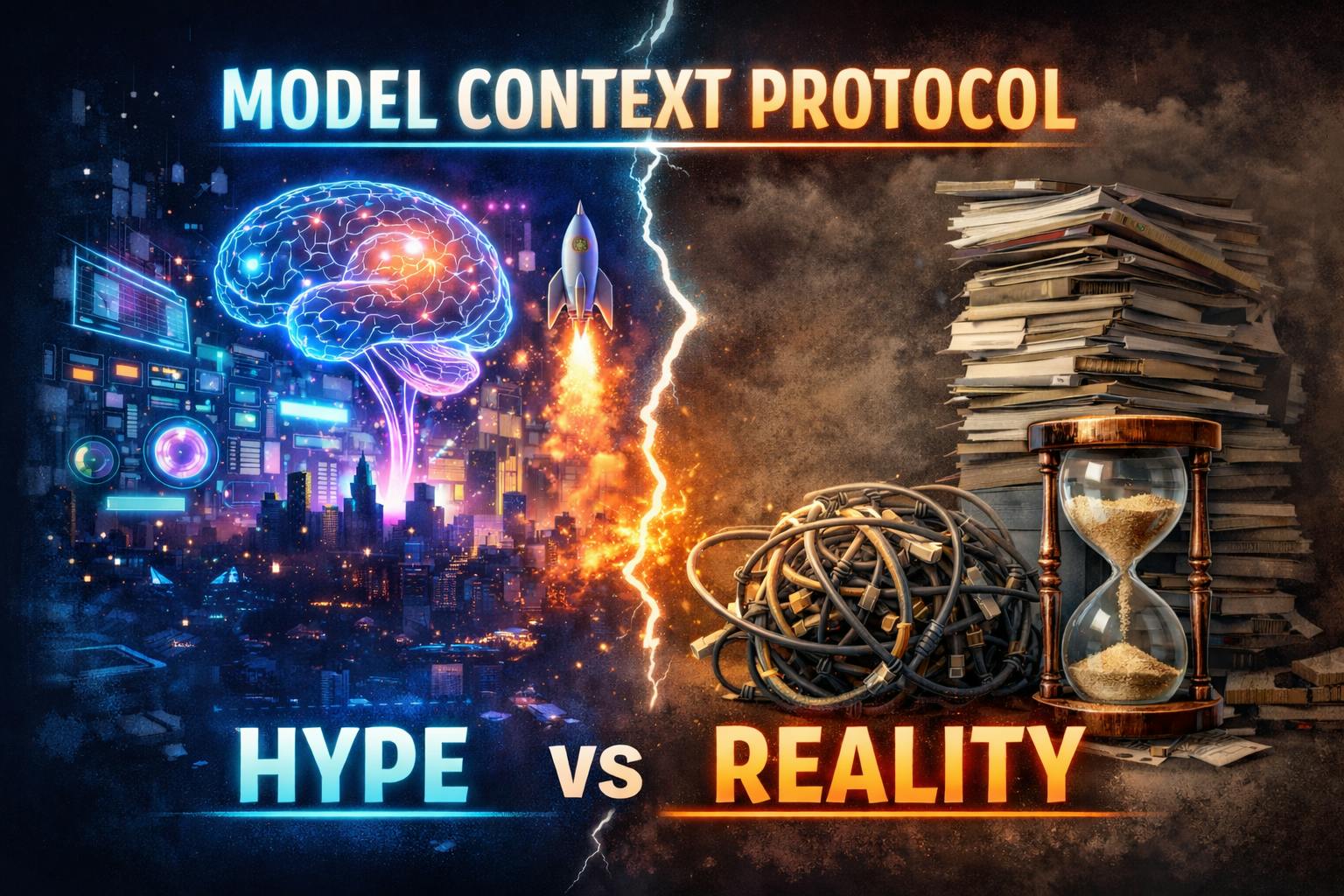
The pitch was undeniably seductive: a digital Rosetta Stone that would allow AI models to seamlessly discover and interact with any external service. The Model Context Protocol (MCP) arrived on a wave of hype, promising to be the “USB-C for AI.” Demos showcased models effortlessly calling APIs and orchestrating file systems on the fly.
But as we close out 2025, the engineering community is hitting a wall. While MCP is great for “local-first” developer tools like Cursor or Claude Desktop, its adoption in high-scale, enterprise-grade production systems is proving to be a nightmare of technical debt.
At my company, we tried to go all-in. What we found wasn’t a universal standard, but a series of architectural traps. If you’re thinking of moving your production tool-calling stack to MCP, here is why you should think twice.
1. The Adapter Trap: A Case Study in Architectural Pain
We didn’t start from scratch. Like most mature engineering orgs, we already had a robust, production-grade service for tool execution built on gRPC and Protobuf. It was fast, type-safe, and deeply integrated with our observability stack.
To satisfy client demand, we built a shim layer to translate incoming MCP requests into gRPC calls. This was a mistake.
This caused the translation of proto into json, and vice-versa adding unnecessary conversion and latency.
2. The Versioning Debt: Silent Breakages
The most dangerous flaw we discovered is MCP’s complete lack of tool-level versioning.
In an enterprise setting, we fine-tune our LLMs on specific tool descriptions and properties to ensure high accuracy. For us, the tool definition is the contract. But MCP provides no native way to version these tools.
If a tool definition changes on the server, the fine-tuned model—which still expects the old schema—fails silently. It doesn’t throw a 404; the model just starts hallucinating or passing malformed parameters. In production, this causes massive regressions. Without a standard way to request a specific version of a tool (e.g., get_user_v2), MCP is essentially “living on the edge” in a way that no serious enterprise API should.
3. The Context-Passing Blind Spot
In a real enterprise environment, tools require “side-channel” context that shouldn’t come from the LLM—think locale, device_info, or user entitlements.
MCP is built with a model-centric worldview. It assumes that if a tool needs a parameter, the model will generate it. There is no clean, standardized mechanism for passing this kind of metadata. We were forced into “ugly hacks,” stuffing critical enterprise context into non-standard metadata fields just to do basic authorization and localization.
4. The Security Illusion: OAuth 2.1 vs. Practical “God Mode”
Proponents will point to the recent inclusion of OAuth 2.1 in the MCP spec. On paper, it’s a win. In reality, it’s security theater.
The protocol lists authorization as OPTIONAL. Because the barrier to implementing a full OAuth 2.1 flow (with the new Client ID Metadata Documents) is so high, most community servers run “naked.” Even when implemented, MCP’s OAuth only authenticates the connection, not the intent. It doesn’t solve the “Least Privilege” problem. If you grant an agent a token to your database MCP server, there is no native way to ensure it only executes a SELECT and not a DROP TABLE.
5. Context Window Pollution: The Token Tax
The “Standard” way MCP handles tool discovery is through tools/list. In production, this is Context Window Pollution.
Even with a modest stack of 10 specialized MCP servers, we saw initial tool definitions balloon to over 40,000 tokens. Every description and JSON schema must be injected into the prompt before the model can even start “thinking.” You’re paying for the model to “read” documentation for 50 tools when it only needs one, leading to increased latency, higher costs, and degraded reasoning.
Conclusion: A Stepping Stone, Not a Destination
The ambition behind MCP is commendable. We desperately need to stop writing custom “glue code.” But in its current state, MCP is a Leaky Abstraction. It solves the problem of “how do I connect X to Y” while ignoring the actual engineering problems of scale, version control, and security.
Until MCP adopts production-grade gRPC support, bakes in tool versioning, and implements lazy-loading for tool definitions, it isn’t the Rosetta Stone—it’s just another wrapper we’ll eventually have to refactor.


