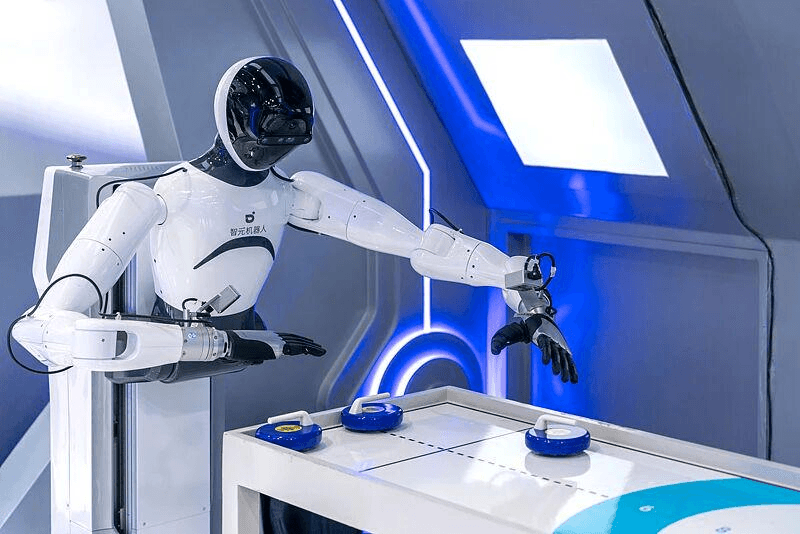
Though 2025 may be remembered for the artificial intelligence boom, not far behind has been the emergence of advanced humanoid robotics.
And while the U.S. and the West more broadly have somewhat lagged in robotics, China enters the new year arguably well ahead in the robotics game. According to a report Tuesday from Chia-focused tech site Pandaily on New Year’s Eve, Chinese company Qingtianzhu (Shanghai) Technology Co. Ltd. has launched a “1 RMB robot rental” service across 10 major cities, marking one of the most aggressive attempts yet to normalize on-demand access to humanoid robots. 1 RMB is 14 cents in U.S. dollars.
The initiative allows users to reserve humanoid robots for short-term use via QR code, with centralized scheduling designed to support deployment across multiple scenarios. The service is currently available in Beijing, Shanghai, Guangzhou, Shenzhen, Hangzhou, Zhengzhou, Chengdu, Suzhou, Xiamen and Chongqing. It’s positioned as a way to lower barriers to experimenting with humanoid robots in commercial and public settings.
Sina Finance reported Tuesday that the 1 RMB price is a promotional entry point that is intended to attract first-time users and accelerate adoption rather than reflect the full commercial cost of robot deployment. Qingtianzhu describes the offering as a “flash rental” model with rapid booking, standardized service workflows and dedicated on-site personnel to ensure stable operation during events.
The move is described by Chinese media as part of a broader effort to build a national robot leasing ecosystem. Qingtianzhu’s platform is acting as a kind of “robot Didi,” designed to match demand from businesses, exhibitions, conferences and brand activations with available robot inventory across cities. Didi is mainland China’s most popular ride-hailing service provider and is often described as the Uber of China.
The long-term goal is reportedly to scale robot leasing in a way that mirrors ride-hailing and equipment-sharing platforms rather than traditional industrial procurement.
The real significance of the initiative lies in distribution and utilization, not margins. The idea is that by encouraging frequent, short-term rentals, Qingtianzhu can gather operational data, refine deployment workflows and expose more customers to humanoid robots in real-world environments.
The 1 RMB price could also be described as a loss leader to introduce people to the benefits of renting robots and over time, drive demand for higher-value rentals, long-term leases, or customized robotic services.
Meanwhile, in the U.S., the idea of robot rental services is still a pipe dream, though some companies are getting closer with their robotic endeavors. Tesla Inc. debuted its Optimus robots in October 2024 to much fanfare, but not much has been heard of the offering since.
With China surging ahead in robotics, companies in the West have a lot of catching up to do, but as AI continues to improve and hence the ability to control robots, 2026 should see more movement in the market. The dream that one day there will be a robot in every house isn’t that far off, albeit one far closer to reality in the Middle Kingdom than in middle America.
Photo: Pandaily/Qingtianzhu
Support our mission to keep content open and free by engaging with theCUBE community. Join theCUBE’s Alumni Trust Network, where technology leaders connect, share intelligence and create opportunities.
- 15M+ viewers of theCUBE videos, powering conversations across AI, cloud, cybersecurity and more
- 11.4k+ theCUBE alumni — Connect with more than 11,400 tech and business leaders shaping the future through a unique trusted-based network.
About News Media
Founded by tech visionaries John Furrier and Dave Vellante, News Media has built a dynamic ecosystem of industry-leading digital media brands that reach 15+ million elite tech professionals. Our new proprietary theCUBE AI Video Cloud is breaking ground in audience interaction, leveraging theCUBEai.com neural network to help technology companies make data-driven decisions and stay at the forefront of industry conversations.