I became a robotics engineer in October. I did it in 30 minutes, without touching a single screw.
Back then, I wrote an article called “I Learned the Core of Robotics in 30 Minutes.” In that project, I built a “Brain in a Jar”—a Python script running in Visual Studio Code that could navigate complex mazes, remember where it had been, and backtrack out of dead ends. It was smart. It was capable. It was alive… inside my terminal.
Then came Christmas.
I unwrapped a SunFounder PiCar-X kit. The goal was simple: Take the “Brain” I had already perfected in software and upload it into a “Body” of plastic and metal.
It should have been a victory lap. Instead, it became a case study on why I am never leaving the safe embrace of software again.
The Architect and The Mechanic
I have a visual disability—20/400 vision in my right eye and zero peripheral vision. This makes hardware terrifying. To me, a dropped M2.5 screw isn’t a minor annoyance; it’s gone forever. A pin header isn’t just small; it’s invisible.
So, I couldn’t build the body. Enter “The Hands”: my dad.
We formed a classic engineering team. He was the Mechanic, spending hours wrestling with tiny nuts, bolts, and servo arms. I was the Architect, visualizing the code structure and preparing the logic that would drive the motors.
He did his job perfectly. The car was assembled. I retreated to my sanctuary—Visual Studio Code—to do mine. I wrote a clean, elegant loop to manage the robot’s state, totally free of physical friction:
class RobotBrain:
    def think(self, sensor_data):
        # The "Brain in a Jar" logic
        if sensor_data['distance'] < 20:
            print("[LOGIC] Obstacle detected. Initiating evasive maneuver.")
            return "TURN_LEFT"

        elif sensor_data['path_blocked']:
             # Advanced memory: "I have been here before."
            print("[LOGIC] Dead end recognized. Backtracking.")
            return "REVERSE"

        else:
            return "FORWARD"
It was perfect. The logic was sound. The body was ready. The soul was ready.
The Villain was a 32GB Card
The only thing left was the interface between us: the MicroSD card. To make the car think, I needed to flash the Raspberry Pi Operating System onto the card.
I am a software developer. I understand systems. I wasn’t worried.
I used the official Raspberry Pi Imager. I configured the “magic settings” beforehand—pre-loading my Wi-Fi credentials so the car would connect automatically, saving me from having to plug a monitor into a moving robot (a nightmare for someone with my vision).
I hit WRITE. The progress bar filled up. “Write Successful.”
Then, Windows chimed in with a helpful pop-up: “You need to format the disk in drive D: before you can use it.”
If you are a hardware veteran, you know this is a lie. Windows cannot read the Linux file system on the card, so it assumes the card is broken.
But I rely on my operating system to tell me the truth. Accessibility features and system prompts are my eyes. When the computer says “Error,” I believe it. So, I followed the instructions. I formatted the card.
And in doing so, I wiped the brain I had just tried to install.
I did this loop for hours. Flash the brain. Windows screams “Error!” I panic and format. Flash again. Error again.
I was gaslighted by a user interface. I had the logic (from October). I had the hardware (thanks to Dad). But the toolchain was so hostile to a blind user that it convinced me I was failing when I was actually succeeding.
The Realization
I eventually threw in the towel.
There is a humility that comes with disability. You learn to recognize when a wall is a wall. I could have bought a specialized monitor, found a magnifier, and crawled on the floor to debug the boot sequence manually. But why?
I realized that the “Brain in a Jar” I built in October was the real robotics project. The Sense-Think-Act loop? I mastered that months ago. The state management? Done. The logic? Flawless.
The fact that I couldn’t get the electrons to spin the physical wheels doesn’t undo the engineering. The “Body” rejected the transplant, but the “Brain” is still valid.
Back to the Code
I am closing the hardware box. It’s expensive, it smells like burning plastic when you mess up, and it lies to you about disk formats.
I’m going back to software. In software, if I can’t see something, I zoom in to 500%. If I break something, I press Ctrl+Z. And when I hit “Save,” it never asks me to delete my work.
To my dad: Thanks for building the body. It looks cool on the shelf. To the PiCar: You have a great brain; sorry you never got to use it. To the rest of you: If you need me, I’ll be in VS Code.
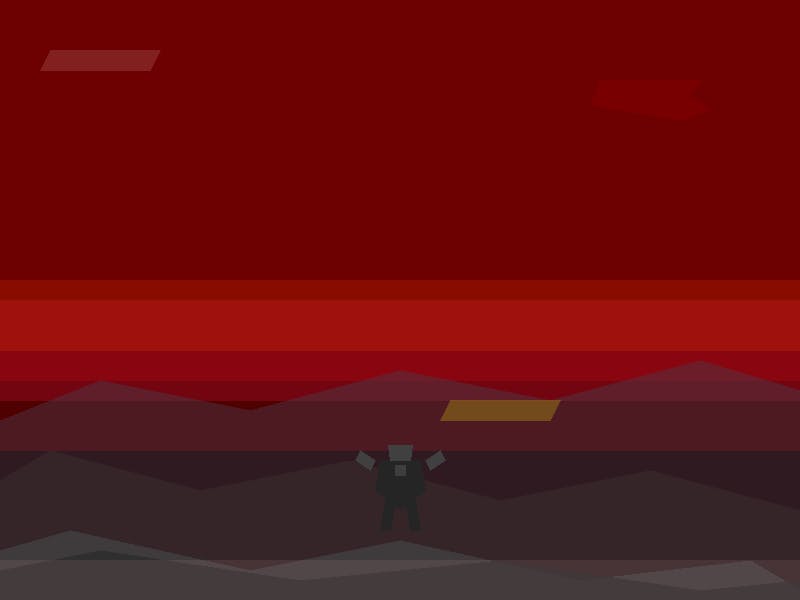
Genesis Art Engine Image Prompt: A landscape with a robot car driving around with red skies