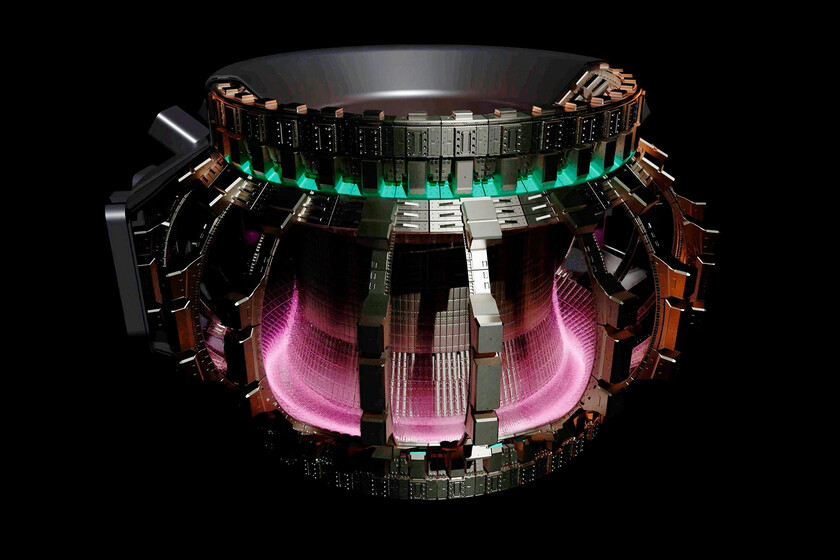
The “30 years to merger” joke is officially dead in Massachusetts. With the installation of the first high-temperature superconducting magnet in the SPARC reactor, the era of experimentation has given way to the era of manufacturing. With a calendar marking 2027 as the year of the ‘First Plasma’, humanity is just months away from proving that the Sun can be bottled commercially.
The rebirth in the desert. The epicenter of this change is the alliance between Commonwealth Fusion Systems (CFS), chip giant Nvidia and industrial powerhouse Siemens at CES 2026 in Las Vegas. As detailed by the agencies, the three companies have joined forces to create a “digital twin” of SPARC, the demonstration reactor that CFS is building outside Boston.
This announcement is not just a declaration of intent. As Seeking Alpha reports, CFS has already installed the first of 18 high-temperature superconducting magnets that form the heart of SPARC. According to CFS CEO Bob Mumgaard, speaking to Fortune: “These magnets are powerful enough to lift an aircraft carrier out of the water.”
The paradox of AI. As Roland Busch, CEO of Siemens, warned on the CES stage, AI factories and data centers require constant gigawatts of electricity to operate, but AI is, in turn, the tool that will allow them to achieve that energy.
Controlling a plasma at 100 million degrees Celsius is an engineering challenge that the human mind cannot solve alone. As Latitude Media explains, the collaboration with Nvidia allows us to compress “years of manual experimentation into just weeks of virtual optimization.”
The Digital “Brain” of Fusion. The key to CFS achieving what no one has been able to in decades lies in an unprecedented digital infrastructure. The company isn’t just welding steel; He is building the reactor twice: once in the real world and once in the virtual one. To do this, it uses the Siemens Xcelerator ecosystem in industrial design and Nvidia’s Omniverse platform to give life to an exact replica of the SPARC reactor.
This system works as a sophisticated flight simulator. Bob Mumgaard, CEO of CFS, details that they use an aerial analogy to explain this technological hierarchy; While the digital twin developed with Nvidia acts as the “virtual plane”, Google’s DeepMind artificial intelligence functions as the “co-pilot” that helps navigate the plasma turbulence.
This strategy allows you to say “goodbye to guesswork.” As Del Costy, CEO of Siemens, states, “the data doesn’t lie.” The real value of this collaboration is the ability to run thousands of virtual scenarios before moving a single magnet in the physical plant. This technology is what allows engineers to observe in real time what happens inside the magnetic “doughnut” (the tokamak) without having to open the machinery, eliminating the uncertainty that has held back the industry for half a century.
The political board. So far, the merger is one of the few issues that enjoys bipartisan support in the United States. However, a new player has shaken the board: Trump Media & Technology Group. According to World Nuclear News, President Donald Trump’s company has merged with TAE Technologies in a $6 billion deal. The goal is to create the first publicly traded fusion energy player to ensure America’s “energy and AI supremacy.”
Although CFS and TAE use different technologies – CFS relies on the tokamak and superconducting magnets, while TAE uses particle accelerators and hydrogen and boron fuel – the competition to be the first to inject electricity into the grid is total. CFS is also looking askance at Helion, the startup backed by Sam Altman (OpenAI), which already has a contract to supply power to Microsoft.
The horizon. The roadmap presented by CFS, supported by capital from Bill Gates and Mitsubishi, appears tangible for the first time:
- Late 2026: End of SPARC construction in Massachusetts. It will be the time when the “virtual airplane” designed by Nvidia and Siemens fully materializes in the physical world.
- 2027: The moment of the “First Plasma”. SPARC must turn on its magnetic heart to produce its first plasma and scientifically demonstrate “Q greater than 1”: generating more energy than it consumes.
- Early 2030s: ARC debuts in Virginia. A 400 megawatt commercial plant capable of supplying 300,000 homes with clean energy literally extracted from hydrogen particles present in water.
The end of the “30 years” joke For decades, the scientific community joked that fusion was always 30 years away. But with the backing of Nvidia and Google, the merger has ceased to be a laboratory project and has become a manufacturing industry. “Lego” is complicated, but with instructions from AI and capital from tech giants, the Sun is closer than ever to being bottled up on Earth.
Imagen | CFS
WorldOfSoftware | Russia wants to be the one who turns on the light on the Moon: its plan includes an operational nuclear reactor before 2036