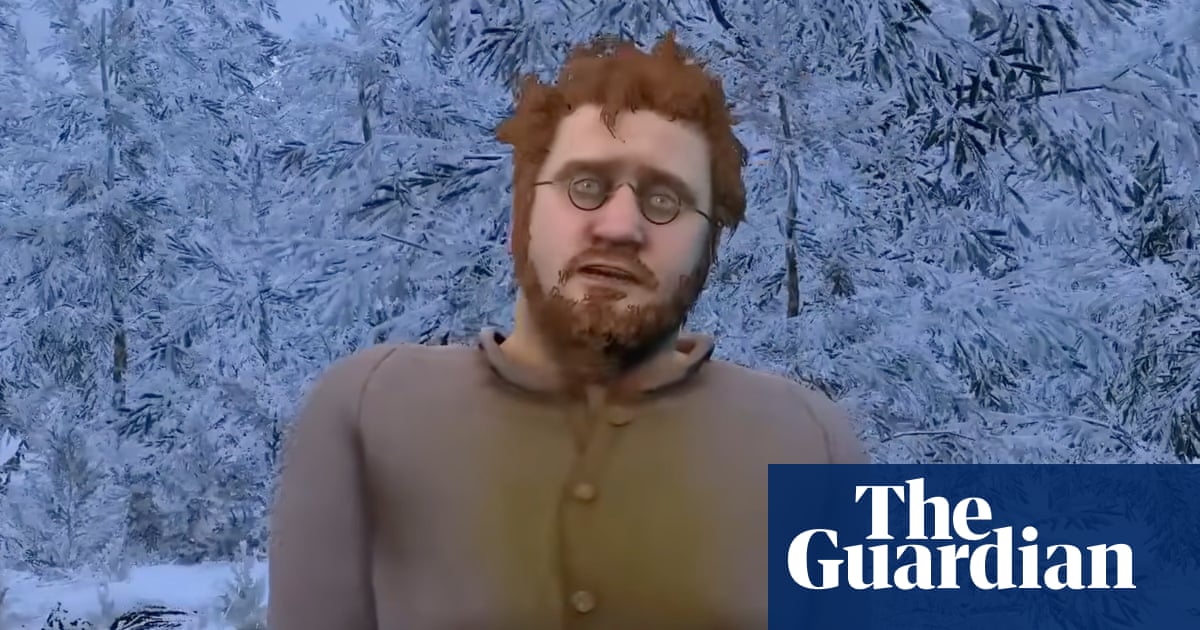
“I don’t know why he is in a onesie and has a big ass,” shrugs game developer Gabe Cuzzillo. “Bennett just came in with that at some point.”
“I thought it would be cute,” replies Bennett Foddy, who was formerly Cuzzillo’s professor at New York University’s Game Center and is now his collaborator. “Working on character design and animation brings you over to liking big butts. I could give you an enormous amount of evidence for this.”
Foddy and Cuzzillo are talking about Nate, the impressively pathetic manbaby protagonist of their profound and ridiculous comedy game Baby Steps, developed together with Maxi Boch. When I was preparing to talk to them, I felt like I was about to meet my tormentors: I spent a week last year in the grip of this purposefully, transcendentally frustrating game about going on a horrible hiking holiday with the world’s most incompetent loser.
Baby Steps’ premise seems like a cruel joke at first: watch the hapless man suffer! And you will suffer too! But the more I played it, the more meaning I found in it. As the hours passed and I helped Nate overcome his own uselessness and get himself up the mountain, I came around to him.
“People coming around to him is common,” Foddy says. “We’ve had a lot of people say they hated him at the outset – and then they started either identifying with him or identifying him with other people in their lives. Some people end up sexualising him. The commonality between all these things is people coming around in some way, and that is the core philosophy of the game. It should be that it starts out feeling arduous and awkward and annoying and hostile, and then we try to bring you around to find pleasure in it … that happens to Nate in the story as well. He would never go outside for a hike.”
Nate is a large, bearded, russet-haired 35-year-old guy with glasses who lives in his parents’ basement. He is socially awkward, a shy urinator, whiny and massively averse to accepting help from anyone. Early in the game you come across another hiker who offers you a map of the mountain; a little mini-map pops up in the corner of the screen for a few seconds before Nate refuses it and it disappears. I guffawed at this. Like most of Baby Steps, it’s a joke about the comfortable, streamlined gaming experiences that we’ve become used to. But it’s also a joke about Nate, and the kind of guy he is.
Talking to Cuzzillo threw me off at first because he is also the voice of Nate; he and Foddy improvised every line in the game. But he also has a deeper connection to the character. “Nate is one manifestation of my personality,” he says. “He’s an aspect of who I am. He’s not a made-up guy. I totally have refuse-the-map guy within me. That’s deep in who I am. If someone tries to help me, I run away screaming. Sometimes that’s a joyful part of who I am, and sometimes it isn’t.”
“In video games you do this too – you immediately put it on the hardest setting and turn off the assists,” attests Foddy.
Like (almost) all game characters, Nate was once a stickman with a block for a head and tissue boxes for feet. Foddy and Cuzzillo ran through nine or 10 prototypes before alighting on the concept for Baby Steps, prototypes that Cuzzillo describes as “very bad”. “We were looking for something with legs,” adds Foddy, straight-faced.
Foddy’s games are full of ostensibly pointless suffering. It’s a theme of his work, alongside the idea of awkwardly moving a character’s body: a previous game of his, Getting Over It, has you trying to fling a guy in a cauldron up a hill with a sledgehammer. This prototype, in which you’d individually control a character’s feet to walk them around, fit that bill: within a couple of days the blockman had become a helicopter pilot, an off-the-shop placeholder asset. It was a couple more years before he became Nate, and six more before the game was finished.
“The idea is that he’s not prepared and he’s out of shape,” says Cuzzillo. “Having an unprepared character gives the player an excuse if they’re feeling like they’re insufficient. They can blame him,” Foddy elaborates. “We had the idea of a cute lumberjacky guy with a little backpack, based on one of our friends, who will never need to know that he was the inspiration.”
Another of Foddy and Cuzzillo’s friends and colleagues was the source of Baby Steps’ name. They both now teach at NYU’s Game Center, whose chair emeritus Frank Lantz burst into their office with an idea for the name; at that point the main character was a giant baby (you could argue that he still is). Plenty of infantilising imagery remains, from rivers of breast milk to massive sandcastle toys to the gigantic woman who picks Nate up and cradles him in one especially surreal scene.
As they were playtesting the game with their friends, another aspect of Nate’s personality began to emerge: his misplaced pride. “This slightly obstinate vein of toxic masculine play starts coming out, from seeing some of our friends play it in a certain kind of way,” Foddy says. One of those friends, Julian Cordero (maker of Despelote), started looking very intently off the edge of cliffs after climbing them, inspiring a scene in which Nate’s fellow hiker Mike sits on the edge of a platform contemplating throwing himself all the way down again.
Baby Steps’ interesting exploration of what masculinity means to a guy like Nate is delivered both through the story and the experience of play. You can unlock short, abstract, playable flashbacks to his childhood and the humiliating experiences that have shaped him. There are also somewhat less subtle symbols around, such as the omnipresent phallic imagery. An interesting thing about this game’s meditations on masculinity is that it doesn’t involve women at all: at a time when men’s insecurities are continually being lumped on women and feminism by common-or-garden internet misogynists, this is refreshing. As Foddy says: “Men can have problems with masculinity just by themselves.”
There is one thing that Nate straightforwardly loves: fruit. Pieces of shiny fruit hang tantalisingly in almost-inaccessible places, tempting you to waste a chunk of your life trying to reach them. If you do, you are treated to a ludicrous close-up of Nate’s face as he noisily consumes it before screaming its name into the wind.
“We needed something to put on top of stuff,” explains Cuzzillo, deadpan. And a selection of increasingly esoteric fruits was the obvious choice? He explains that rewarding the player would be antithetical to the game’s philosophy. “[So] what if it’s a reward for Nate? What if it’s something he loves, so you get to vicariously watch him get a reward? The day we came up with it, we recorded the first five vocal takes … It’s funniest when you’ve tried hardest for it, and what’s at the top is just him having this crazy fruit orgasm.”
The inspiration for the dumb camera angle – the wide-angle lens from the top of the forehead – was trainspotter Francis Bourgeois. “Something we both got into during Covid, when we were doing initial exploration on this game, is the vein of culture that emerges when people are critically bored,” explains Foddy. “The idea is that these fruit cutscenes are coming when the player is feeling as unhinged as Nate is when he’s enjoying the fruit.”
That is the joke that Baby Steps keeps coming back to: you might hate Nate, but also if you’re playing a game like this, then in some way you are Nate. After many, many hours on the mountain, out in the snow, you reach an ending when Nate finds a cabin owned by a donkey-man whom he’s sort of befriended on his journey. After a few false starts, he finally knocks on the door and asks to be let in from the cold. You can go for a walk after that concluding scene, but the game goes to great lengths to warn you that there’s no point. There’s nothing else out there.
Baby Steps’ final joke is that it’s lying to you: there is a final cutscene at the top of the mountain. You can go find it if you want, if you’re just irredeemably that kind of person. But for me, the game’s true ending is Nate finally learning to ask for help. I was rather moved by it.
After Cuzzillo finished his first commercial game, 2019’s Ape Out, he felt ambivalent about it. “I wasn’t sure whether it was worth it; whether, once I was at the top of the mountain, I really wished I had climbed it,” he says. But he’s feeling much better about Baby Steps in retrospect, and about Nate.
“I understand it way more now after finishing it. I feel like I’m re-realising all the things the game is about… Nate is a microcosm of the whole game, where it’s both a piss-take and sincere at the same time. It’s not one or the other.”