
Startups On Our Radar spotlights African startups solving African challenges with innovation. In our previous edition, we featured five game-changing startups pioneering artificial intelligence, e-commerce, and legaltech. Expect the next dispatch on January 23, 2026.
This week, we explore five African startups in the e-commerce, cryptocurrency, cleantech, and creator economy sectors and why they should be on your watchlist. Here are our picks for today:
Vyre Africa wants to eliminate P2P crypto scams (Cryptocurrency, Nigeria)
Vyre Africa, founded in 2025 by Harvey Anafuwe and Alex Amatobi, is a blockchain-based financial platform focused on reducing fraud and friction in peer-to-peer (P2P) crypto trading, particularly within Africa’s high-volume but scam-prone crypto market.
Although cryptocurrency transactions in sub-Saharan Africa reached $205 billion between 2024 and 2025, Chainanalysis, a blockchain data analysis company, estimates that up to $17 billion was stolen in crypto scams and fraud in 2025.
The idea behind Vyre Africa grew directly out of Anafuwe’s personal experience losing money to P2P crypto scams, and similar incidents affecting friends and other users in Nigeria.
Vyre Africa is a web-based platform built for instant, trustless, peer-to-peer exchanges between crypto and fiat, without requiring both parties to be registered users.
Its flagship product is Vyre Africa’s P2P trading system, where a market maker creates a buy or sell order (for buy orders, the user sends crypto and receives fiat directly into their bank account; for sell orders, the user sends fiat and receives crypto into a provided wallet address) by locking funds in their Vyre wallet.
Each order generates a shareable trade link that can be sent to anyone, anywhere, and recipients can complete a transaction anonymously by opening the link, entering their contact details, and selecting a payout method.
Vyre Africa does not rely on manual confirmation flows. Instead, funds are locked when the order is created and released automatically once transaction conditions are met. Trades are processed instantly, without direct communication between counterparties.
Vyre currently supports USDC-based trades and enables payouts to bank accounts across multiple African countries, including Nigeria, Ghana, Kenya, Tanzania, South Africa, and Egypt.
The platform enforces minimum trade limits (for example, a minimum of 3 USDC on certain orders) and allows market makers to set exchange rates and order sizes.
Vyre Africa also includes a cross-border remittance product that allows users to send stablecoins such as USDC or USDT and have them automatically converted and deposited into foreign bank accounts. The company says its system supports about 45 currencies across Africa, Europe, and parts of Asia. It also has an internal wallet-to-wallet transfer feature that lets users send crypto to other Vyre users using only an email address, dubbed Vyre Transfers. These transfers are instant and incur no transaction fees.
Vyre Africa charges a percentage-based fee to the users who create buy or sell orders on the platform. Anonymous traders do not pay fees at this stage, though the startup plans to introduce additional revenue streams for other user categories in the future. Vyre Africa conducted a pre-launch in September 2025, initially rolling out its cross-border remittance and wallet transfer features before activating P2P trading.
Why we’re watching: Vyre Africa is tackling the trust issue in crypto’s peer-to-peer transactions, a persistent problem in emerging markets. By enabling anonymous link-based trades and automating fund release, the startup positions itself as a safer alternative. This link-based model also allows the platform to facilitate trades for users who haven’t yet signed up, effectively expanding its reach beyond its registered user base.
Ulo Helps wants to make finding trusted domestic workers easy and fast (Services, Nigeria)
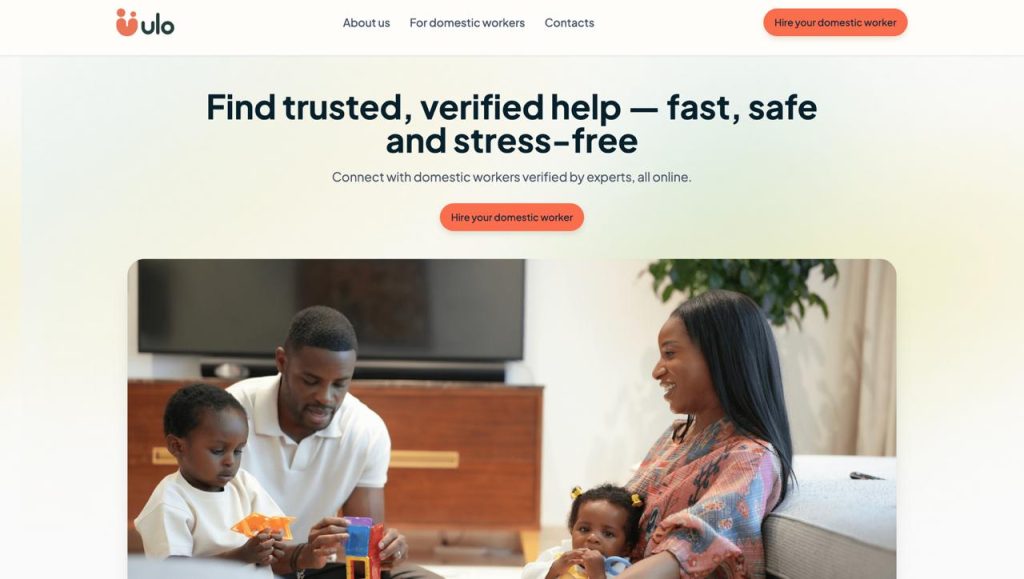
Founded in 2025 by Chiamaka Igwe, Ulo Helps is a digital platform designed to replace the often unreliable process of hiring domestic staff through traditional agents. Born from Igwe’s personal frustration with finding nannies and a desire to replicate the ease of care platforms she used in the United States, Ulo Helps connects households with verified caregivers, cooks, nannies, and housekeepers and functions as a self-serve marketplace.
Employers register on the web app, select the type of domestic service they need, filter by location, and browse worker profiles that include photos, short bios, availability status, age, work history, and other relevant details. To contact a worker directly on their mobile phone number, email, or WhatsApp, employers must subscribe to a service-specific subscription plan. The basic plan costs ₦15,000 ($10.53) monthly, giving access to all profiles within a selected service category, with unlimited replacements during that period.
For users who prefer a more hands-off approach, the assisted plan costs ₦30,000 ($21.06) monthly. Under this option, Ulo Helps pre-screens candidates, shortlists five workers based on the employer’s requirements, and sends them for final interviews. The company also offers an optional premium verification service after employment, which includes police reports, fingerprinting, and address verification to ensure safety for employers.
For domestic workers who want to be onboarded on the app, they pay a ₦5,000 ($3.51) one-time registration fee, which covers identity checks, facial verification, and guarantor verification. Ulo Helps does not take a percentage of workers’ salaries and does not manage payroll or wages, as compensation negotiations are left entirely between both parties. However, compensation benefits are usually communicated and agreed upon by both parties before the domestic worker shows up for the task. The platform says it currently lists over 100 fully verified domestic workers, and maintains a broader pool of about 700 unverified workers in its outreach channels. Verified workers have paid the one-time registration fee and has undergone identity checks, while unverified workers have not undergone identity verification.
Why we’re watching: Ulo Helps differentiates itself in Nigeria’s informal labour market by prioritising ethical treatment of workers. Unlike traditional agents who often confiscate a part of or half of a worker’s first-month salary, Ulo Helps charges zero commissions on wages, in a bid to attract higher-quality talent. The startup is also laying groundwork for scale across Africa and the Middle East by studying hiring patterns from its assisted plan. It has the goal of replacing manual matching with an AI-driven system.
Paylo wants to turn small businesses into AI-discoverable storefronts (e-commerce, Nigeria)
Founded in 2025 by software developer Samson Odo, Paylo is a platform that provides a unified system for small businesses which currently rely on disconnected tools for inventory, payments, customer messaging, and online sales. According to Odo, this fragmentation becomes more problematic as AI-driven systems become central to how products are discovered and recommended.
Paylo enables businesses to manage products, orders, fulfillment, messaging, payments, and analytics from one backend while selling across multiple apps or social platforms. The product has two apps: a business management app for merchants and a consumer app for buyers.
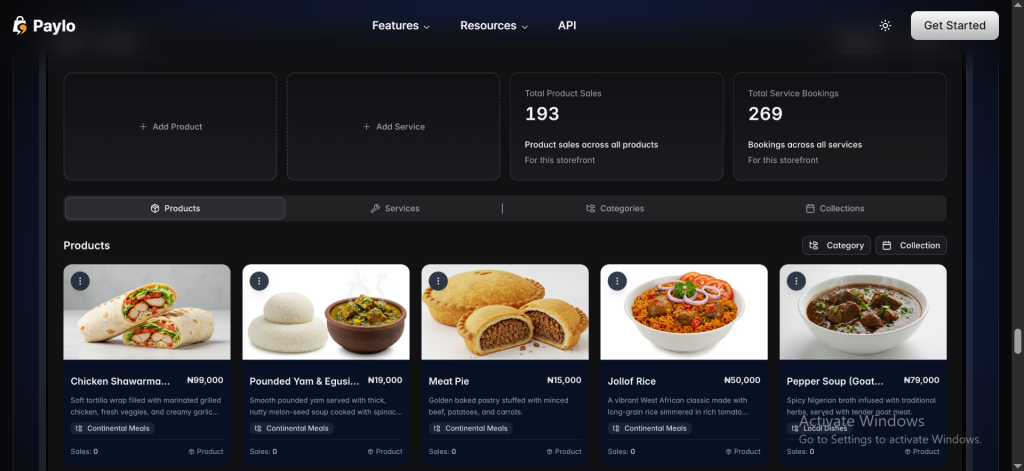
For merchants, onboarding starts with creating an account and filling out a storefront form, including uploading a logo and business details. Once the form has been filled, Paylo automatically generates a digital presence with a website, a storefront within Paylo’s consumer app, and visibility across emerging AI-driven discovery systems. On this backend, merchants can list products, track orders, record transactions, and manage customer interactions without switching tools, as changes stay synchronised across all platforms.
While sign-up and storefront creation are currently free, Paylo plans to monetise through a tiered subscription plan that unlocks additional features as the pricing gets higher. Depending on the selected payment plan, merchants will either pay up to 3% commission per transaction or opt for higher subscription fees with zero transaction commissions. Although the platform has yet to generate revenue. Paylo says it has 20 active storefronts processing live transactions and a growing waitlist of businesses primarily based in Lagos and Abuja.
Why we’re watching: Paylo is built with a mobile-first and multi-tenant architecture (meaning it can work across platforms) optimised for emerging markets. The startup openly cites competitors such as Flutterwave Store, Bumpa, Shopify, and marketplace models like Jumia, but differentiates itself by focusing on a unified backend that synchronises operations across websites, mobile apps, social platforms, and conversational AI surfaces. It is betting on AI-native commerce as the next distribution layer for small businesses.
Eneagex wants to unlock liquidity for African renewable energy (Cleantech, South Africa)
Eneagex, founded by Xolani Khumalo, a Chartered Accountant, is a blockchain-based platform designed to create a secondary market for renewable energy assets in Africa.
The startup targets investors and developers locked into long-term renewable energy projects with limited exit options.
In South Africa, power purchase agreements (PPAs) typically span 15 to 25 years, trapping capital and preventing investors from recycling funds into new projects. Existing exit routes, like mergers and acquisitions or IPOs, are inaccessible to many players because of the size of the investment.
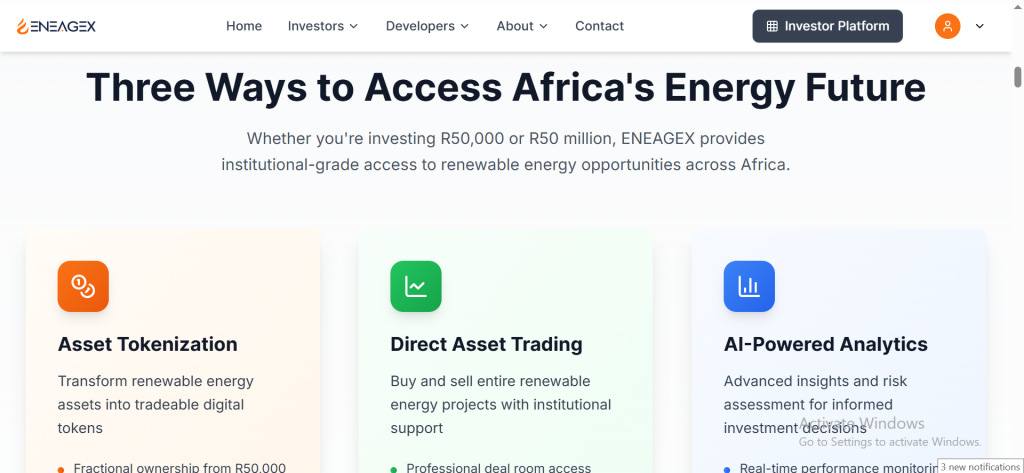
Through its Energy Securities Platform, ENEAGEX enables developers to securitise renewable energy assets and tokenise them using blockchain technology, allowing them to be partially owned and traded. Assets go through assessment and valuation before being tokenised, and then smart contracts will manage the participation of investors, revenue distribution, and secondary market trading. The platform integrates AI-powered tools for real-time performance monitoring, risk assessment, predictive analytics, and asset valuation.
ENEAGEX earns from multiple revenue streams, including asset listing fees, transaction fees of 1% to 3% per transaction, tiered monthly subscription fees for analytics and trading tools, consulting fees for secondary market advisory services, and ad hoc fees for services such as risk ratings, valuation, and reporting. The startup has participated in incubation and accelerator programs run by Standard Bank/Tuksnovation, Lisk & VC Labs, and the Founders Institute MENA Accelerator. ENEAGEX is currently raising $750,000 to $1.5 million in a pre-seed round to complete platform development, meet regulatory requirements, and hire technical staff.
Why we’re watching: ENEAGEX is tackling a structural inefficiency in Africa’s renewable energy market by focusing on the secondary market, rather than primary project financing. With over $16 billion invested in renewable energy in South Africa, the startup is betting that demand for flexible exits will grow as the sector matures.
TrendAI wants to turn Africa’s creator economy into a jobs engine (Creative Economy, Kenya)
Evalyn Oloo wanted to provide a space for African content creators to generate a reliable income from brands and SMEs that want to run ads. So, she founded TrendAI in 2024 to do just that. Africa’s creator economy is expected to reach $29.84 billion by 2032, yet 54% of African content creators earn less than $62.02 monthly, with only 11.9% earning from ad revenue.
TrendAI claims to enable brands and small and medium enterprises (SMEs) to launch creator-led digital campaigns in under five minutes. Creators can onboard through WhatsApp to use the service, receive tasks, and submit proposed content to clients, who submit campaign briefs through a web-based dashboard. TrendAI’s AI-powered matching engine then pairs campaigns with relevant creators based on audience, niche, and performance, delivering a 96% approval rate, according to the company.
Clients then review and approve content through the dashboard, after which creators receive payment for the content. The startup claims to work with over 500 verified creators across Kenya and Nigeria and has completed over 100 campaigns for enterprise clients. TrendAI generates revenue by taking a 30% platform fee on campaign spend, alongside a 15% enterprise service layer for premium features.
Why we’re watching: TrendAI is distinguishing itself by building infrastructure to connect companies to creators, rather than acting as traditional ad agencies do. Its WhatsApp-first approach for creators lowers barriers to entry compared to competitors like Upfluence or Wowzi, which often require more complex onboarding. TrendAI claims an ad launch time of under five minutes and processes weekly payouts for creators.
That’s all for today. Expect our next dispatch on January 23rd. Know a startup we should feature next? Please nominate here.