The process of moving an artificial intelligence prototype to production has a lot of moving parts and can get bogged down quickly. To break up this logjam, database services provider MongoDB Inc. released a series of new capabilities this week designed to help developers build and implement AI solutions more rapidly and with greater accuracy.
Building on its purchase of Voyage AI Inc. nearly a year ago, the company announced the general availability of the Voyage 4 family of embeddings models aimed at streamlining retrieval of information for key AI tasks.
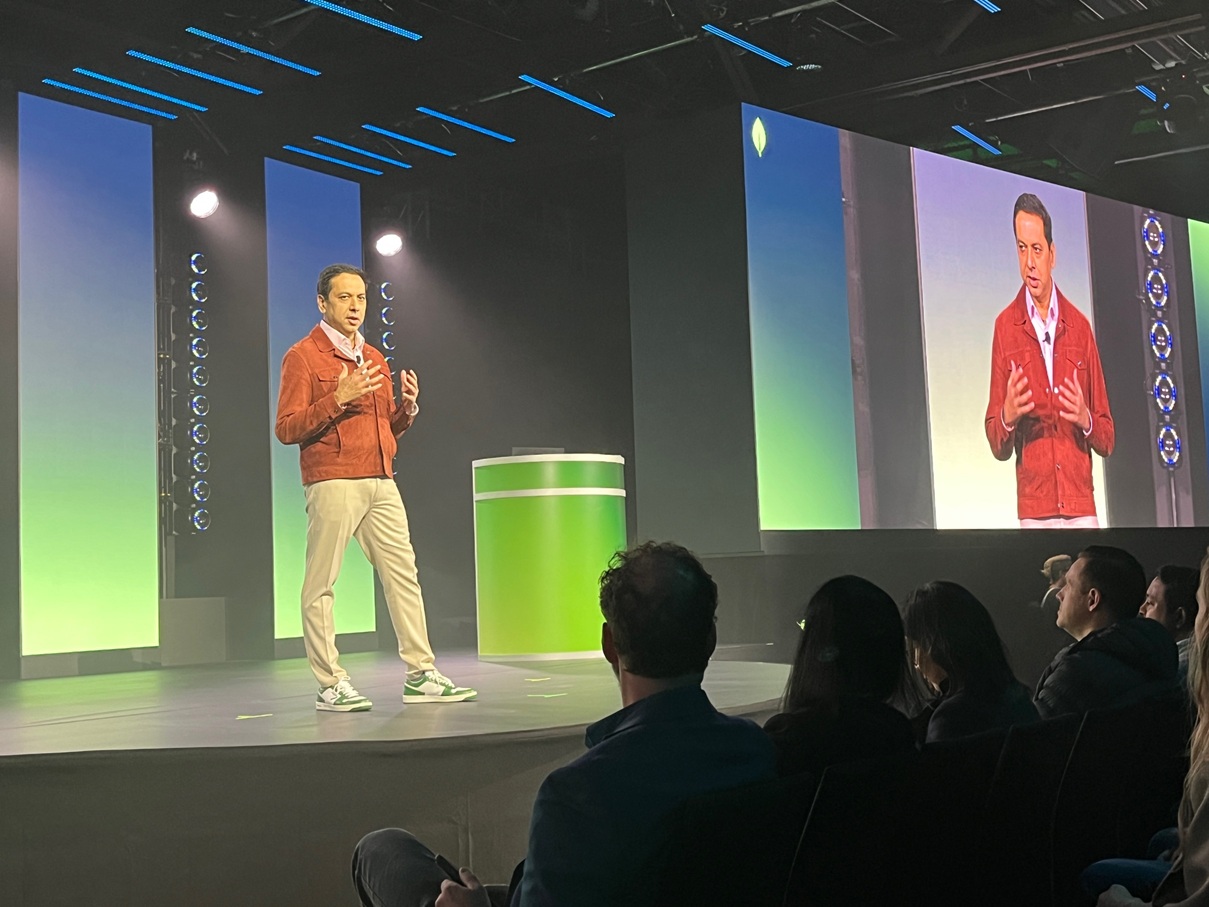
“From my standpoint, speed matters,” CJ Desai (pictured), president and chief executive officer of MongoDB, said during a presentation in San Francisco on Thursday. “Are you building as fast as you can? If you fall behind, investors or customers are going to ask, ‘What is the future of your company?’”
Leveraging the vector search future
MongoDB’s focus on embedding models highlights the growing importance of vector search. Embeddings capture semantic meaning as vectors, converting data in the form of text, images or audio into numerical representations to power modern AI applications.
The company believes that approach will appeal to developers seeking higher retrieval quality at lower storage cost with less friction.
“Vector search is the new frontier,” Pete Johnson, field chief technology officer for AI at MongoDB, said in a briefing on Thursday. “The key to building good AI applications is getting good at vector search.”
MongoDB’s acquisition of Voyage AI and the announcements this week illustrate a shift in how databases handle AI workloads. Retrieval and vector search have been managed as separate solutions in the past. By embedding these capabilities directly into its core Atlas platform, MongoDB reflects a broader industry trend towards consolidating AI tasks into databases to simplify development and improve the results that artificial intelligence can bring.
“To get insights out of that data is with embeddings,” Frank Liu, Voyage AI research manager at MongoDB, said in an interview with News. “We really are still in the very early innings of vector search.”
Specialized use cases for AI
MongoDB’s latest announcements also provide a window into the direction AI may take over the coming year. During the company’s event on Thursday, Desai spoke with Konstantine Buhler, a partner at Sequoia Capital, about the progression of AI offerings through agents and frontier models in 2025. The coming year will see a shift in how AI is used within the enterprise, according to Buhler.
CJ Desai of MongoDB and Konstantine Buhler of Sequoia Capital talked about AI’s future during MongoDB’s San Francisco event.
“2026 is going to be about the specialization of AI,” Buhler said. “We will see it in specialized models and specialized use cases.”
Indeed, MongoDB is already seeing a move in this direction. Among the announcements the company made this week was an expansion of its Startups program, an initiative designed to help founders and builders of small companies propel applications into global deployment.
MongoDB for Startups companies now account for more than $200 billion in combined valuation, and include Mercor Inc., whose AI models streamline the hiring process, and Spendflo Inc., which provides AI-powered SaaS management.
“Where MongoDB started was powering startups,” Suraj Patel, vice president of MongoDB Ventures and corporate development, told News. “We are starting to see some of these interesting, specialized models.”
Momentum for data strategy
MongoDB’s strategy to leverage its Voyage AI acquisition, focus on vector search, and build a startup ecosystem has shown positive financial momentum in recent months. The company reported a strong fiscal quarter in December, as it produced adjusted earnings to reverse a loss a year ago, and saw revenue climb 19% year-over-year.
The company’s hire of Desai is also a fairly new development. The CEO noted in remarks on Thursday that he was now in his 62nd day on the job. Desai is an industry veteran, having started his career at Oracle Corp. and served in a series of high-level executive positions with Symantec, Dell/EMC, ServiceNow Inc. and Cloudflare Inc., before taking the helm at MongoDB in November.
“This database was created for builders and developers,” Desai said. “We take care of all of the data elements that are needed.”
Taking care of the data elements means redefining AI-powered search and retrieval expectations. The company’s approach is guided by an understanding of the pain points for developers and then delivering a set of solutions, through Voyage and Atlas, that address the need for simplicity in the complex, evolving world of AI.
“It gives us a ton of relevancy with developers in these communities,” Ben Cefalo, senior vice president and head of core products and Atlas Foundational Services at MongoDB, told News. “It’s all about stitching things together. That’s really wonderful for the developer because now they can just continue to build.”
Photo: Mark Albertson/ News
Support our mission to keep content open and free by engaging with theCUBE community. Join theCUBE’s Alumni Trust Network, where technology leaders connect, share intelligence and create opportunities.
- 15M+ viewers of theCUBE videos, powering conversations across AI, cloud, cybersecurity and more
- 11.4k+ theCUBE alumni — Connect with more than 11,400 tech and business leaders shaping the future through a unique trusted-based network.
About News Media
Founded by tech visionaries John Furrier and Dave Vellante, News Media has built a dynamic ecosystem of industry-leading digital media brands that reach 15+ million elite tech professionals. Our new proprietary theCUBE AI Video Cloud is breaking ground in audience interaction, leveraging theCUBEai.com neural network to help technology companies make data-driven decisions and stay at the forefront of industry conversations.