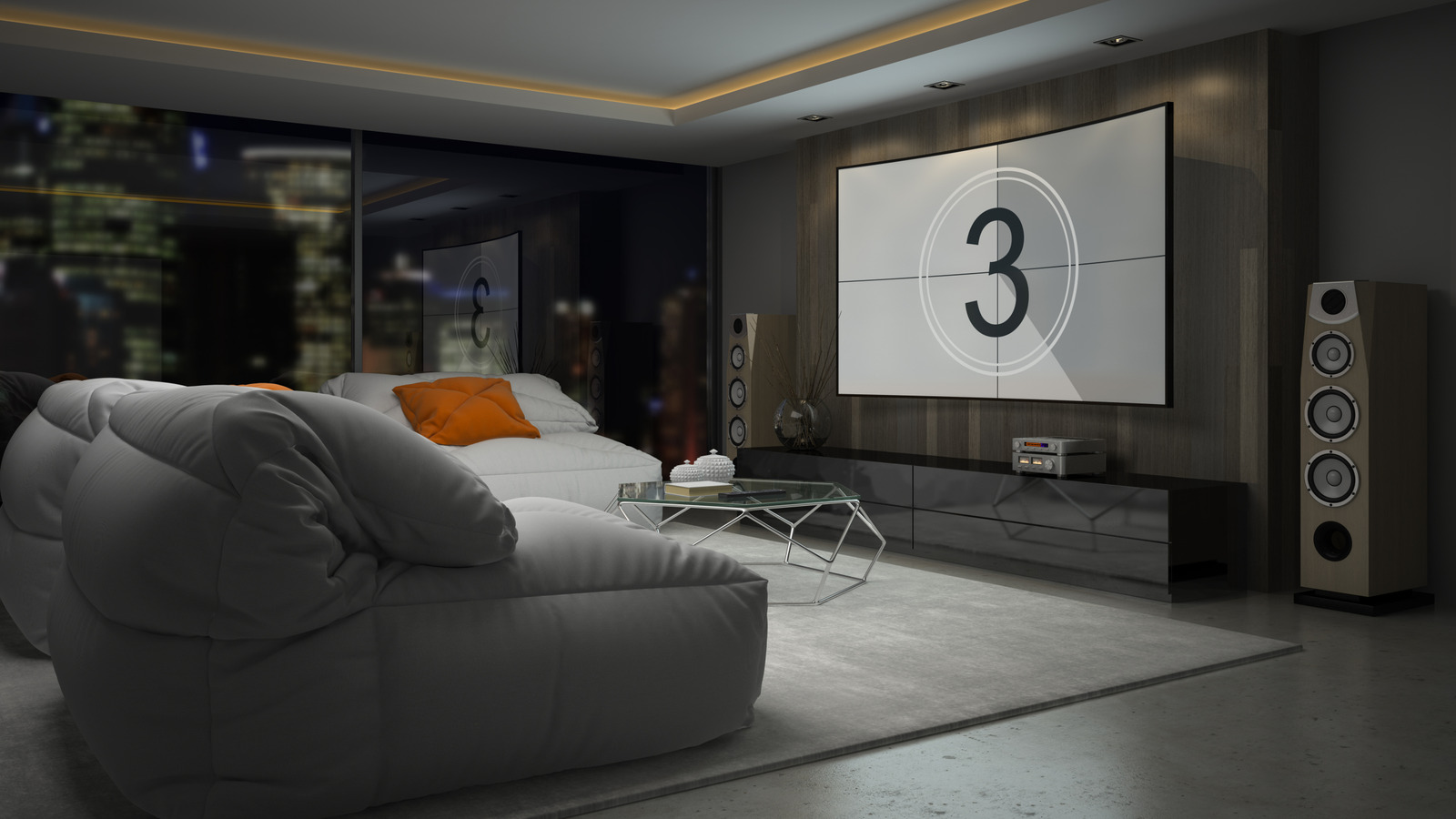
Many fixate on TV screen size and panel type, with audio sometimes an afterthought. They assume the speakers built into a TV will be good enough, especially after spending all that money on the display. However, they rarely are. Underpowered audio that never quite surrounds you can ruin the watching experience of even a great film.
In some cases, adjusting a few overlooked TV audio settings can help things up a bit. When that doesn’t work, that’s usually the point where cinephiles start looking beyond their TV’s built-in speakers. Here, you’ve got a few different paths you can take to turn your TV space into a home cinema. Some home theater systems have compact soundbars with built-in height channels. Others have separate speakers placed around the room. The second approach often sounds more immersive.
However, it also introduces additional setup challenges, such as finding DIY solutions to hide messy cables. What matters most is building the system around how you actually watch cinematic content. There are several factors to consider before buying one, such as room size and placement flexibility. We’ve rounded up home theater systems that deliver meaningful audio upgrades across a range of price points and formats. If you’ve ever felt that the content you’re watching could sound better, these are the systems worth your consideration.
Sonos Ultimate Immersive Set with Arc Ultra
The Sonos Ultimate Immersive Set is arguably at the top of Sonos’ home theater lineup. It pairs the Arc Ultra soundbar with two Era 300 speakers and a Sub 4 subwoofer. All of them can be connected wirelessly and treated as a single home theater system once set up. Everything can be organized in the Sonos application. Moreover, Sonos’ room calibration handles much of the balancing automatically, reducing the need for manual adjustment. Format support is broad enough to cover how most people actually watch content.
Standard Dolby formats play back cleanly without noticeable sync issues. The sound feels deliberate rather than exaggerated, with the upward-firing drivers and the rear speakers filling in the room. It doesn’t aggressively push height effects. However, there’s enough vertical presence to make Atmos feel different from standard surround. Dialogue-heavy shows tend to come across clearly. When a show isn’t doing voices any favors, Sonos’ speech enhancement tools can adjust settings in the right direction.
Night mode also has real utility here, if you don’t want bass swings pulling attention away from dialogue. Speaking of bass, it is handled by the dedicated subwoofer. Low-end effects carry weight without sounding loose, and action scenes have enough impact to feel convincing. Moreover, music emphasizes clarity, with vocals sounding clear. Unfortunately, the bundle doesn’t provide a graphic equalizer, and a single HDMI eARC port does most of the work, which means it’s not especially flexible.
Technics SC-CX700
The Technics SC-CX700 is a home theater system that feels like it has real engineering worked into it. Each cabinet uses a two-way coaxial driver. There is a small ring tweeter mounted inside the 15cm subwoofer. The bass reflex port fires forward, which reduces issues with its placement. A soft Dinamica microfiber material wraps around cabinet panels. In particular, the terracotta brown finish has an appealing presence. Moreover, there are understated options, such as silky gray and charcoal black.
For what’s packed inside, speakers remain fairly compact. They are just over 310mm tall and 200mm wide. One of the speakers handles all controls and input. The other speaker has built-in amplification and an Ethernet port for a wired connection between the pair. You can choose which one works as the left or right speaker during setup. The top panel provides touch-sensitive inputs with physical buttons for power, volume, and mute. Additionally, daily control can be done through the Technics Audio Centre app.
The system walks you through placement options using the Space Tune feature. Regarding connectivity, there’s an HDMI input with ARC support for your smart TV, a USB-C port, an optical digital input, and even a built-in magnet phono stage for turntables. It supports wireless options like Google Cast, AirPlay, and Bluetooth. During listening, the bass hits with authority, and the low frequencies feel deep. The stereo image widens, with instruments occupying clear positions, and detail levels remain consistent throughout the mix.
Sony BRAVIA Theatre Quad With Subwoofer
The BRAVIA Theater Quad Atmos-compatible surround sound system has four separate speakers, paired with Sony’s SA-SW5 wireless subwoofer. It also includes a compact control box. The included speakers are slim and rectangular. They’re easy to set up in a room. Sony’s dual stand or mount setup gives you flexibility there. The four speakers create a wide soundstage as long as they’re spaced sensibly. Sony’s Soundfield Optimization also helps with their placement, adapting the sound to the room. The system performs well across different types of content.
It doesn’t rely on heavy processing, which keeps things from sounding artificial. Each speaker includes up-firing drivers that can contribute to a height effect with Atmos content. The subwoofer fills in the low end with enough impact to handle action scenes. Moreover, voices come through cleanly across the four speakers. A dedicated Voice Mode can push speech forward if a mix feels crowded. Since there’s no standalone center speaker, dialogue is spread across the system by default.
For this, you can use Acoustic Center Sync if you have a Bravia TV. This lets your TV speakers act as a center channel. Music playback leans toward balance rather than exaggeration. Mids come through with clarity, and highs carry warmth. For movies, the subwoofer provides the impact needed for explosions. The system can handle fairly high volumes. However, pushing it all the way can risk long-term damage. Additionally, there is a limitation in tuning control. There aren’t EQ preset options to customize the sound.
Q Acoustics 3050i 5.1 Cinema Pack
The Q Acoustics 3050i 5.1 Cinema Pack home theater system builds on the foundation of the smaller 3010i bookshelf speaker setup. It adds the front speakers for a pair of 3050i floorstanding speakers. Moreover, there is a 3090ci centre speaker and a 3060s subwoofer. It is available in four color options, including carbon black, arctic white, graphite gray, and English walnut. Here, Internal point-to-point bracing is used to stiffen key areas and keep unwanted cabinet noise in check.
The front baffle is thick, offering better support for the tweeter and mid/bass drivers with recessed terminals built into the cabinet itself. Each 3050i floorstander uses a 20mm soft-dome tweeter that’s isolated from the baffle through a suspension system. This keeps vibrations from the twin 16.5cm woofers from blending into the high frequencies. Additionally, there is a damped tube that works to absorb excess energy and tame internal resonances inside each cabinet, thanks to Q Acoustics’ HPE design. The 3010i has a 10cm mid/bass driver, while the 3050i uses a 16.5cm one.
There’s plenty of sound energy in the package. The larger front speakers’ sound is immersive while balancing with the lighter surrounds. Dialogue is handled by the centre speaker, making speeches clear. They also blend well with the rest of the setup. Low frequencies aren’t handled by the subwoofer alone. The floorstanders also add depth to the bass rather than just more volume. There’s a noticeable lift in detail as a result.
Samsung HW-Q990F
The HW-Q990F is a direct follow-up to Samsung’s earlier Q990D, and the similarity between the two is easy to see. The meaningful update happens with the subwoofer. It now uses a sealed enclosure and a shorter cabinet. Still, it relies on 8-inch drivers. The difference here is that bass duties are handled by two drivers rather than a single driver. The system supports a wide range of audio formats, including Dolby Atmos and Eclipsa Audio. Picking the right audio input port influences how well these formats play.
With it, connectivity is rarely a limiting factor. Sound customization is extensive, with access to a seven-band graphic EQ. Moreover, channel levels and heights are adjustable, and it offers two separate voice modes. Taken together, these options allow the system to be customized around personal preference. Out of the box, the balance leans toward punchy bass that doesn’t sound overly aggressive. Dialogue-focused content benefits from the system’s room correction and dedicated center channel. Speech remains clear, even when background effects pick up.
The voice modes can push dialogue forward when mixes get crowded, though the change is fairly restrained. Music playback maintains that same balanced approach. It allows soundtracks to spread across the 11.1.4 layout. Automatic room correction plays a big role in dictating sound, keeping bass present without sounding overwhelming. Mids come through evenly, and the top end carries enough detail to keep vocals and instruments defined. The overall sound remains evenly distributed between the bar, subwoofer, and rear speakers.
Dali Oberon 5 Speaker System
Leading this system are the Oberon 5 floorstanders. Surround sound duties are handled by either the Oberon 1 bookshelf speaker or Oberon’s on-wall speakers. All of them are housed in MDF cabinets and are available in several colors, including light oak, white, black ash, and dark walnut. The Oberon 5s use a relatively large 29mm soft-dome tweeter. It easily reaches down into lower frequencies, which helps it blend sound more naturally with the woofers.
The floorstanders are a pair of 13cm mid/bass drivers, built from wood-fibre material. It is a design choice by Dali to balance low resonance and stiffness. They are designed with spider suspensions to deliver sound detail rather than smoothing it over. Their sensitivity is at 88dB, with a nominal 6-ohm load. The Oberon 1 surround speakers follow the same design approach. They use a single mid/bass driver and are designed to be flexible, with a wall-mounting option included.
The Oberon Vokal centre speaker uses the same drivers as the floorstanders, arranged with the tweeter centrally placed and a front-firing bass port underneath. This layout is intended to evenly distribute sound. Bass support comes from Dali’s subwoofer E9-F. Inside it is a 23cm aluminium woofer, pushing sound downward through a vented base. It is slightly raised by 3cm from the floor on rubber feet to give the port enough space. Around the back, you’ll find controls for gain and crossover.
LG S95TR With Rear Speakers
The LG S95TR is a 9.1.4 system that steps in for the S95QR and brings a few enhancements rather than a full revamp. One of those is an up-firing center channel, which LG positions as a way to improve height performance. For everyday use, the S95TR comes across as flexible to use. The sound leans balanced mostly, though there’s a noticeable emphasis on the low end. To address this, LG includes several sound adjustments to work around it.
Audio format support is broad, with Dolby Digital and Dolby Atmos on the list. The rear speakers do a good job of producing sound around the room. However, their height output doesn’t stand out much. This is largely because they don’t play the sound as loudly as the main bar. The dedicated center channel keeps voices accurate. There’s also a dialogue-focused mode if speech needs more presence. The latency stays low during content. Nevertheless, if sync issues arise, the companion app lets you manually fine-tune the delay.
The tuning works across different genres of music. If the bass feels a bit heavy, the EQ presets in the app offer extensive customization. For movies, it can reach room-filling levels. Moreover, effects like impacts or passing vehicles come through with enough emphasis. You also get LG-specific features like WOWCAST Ready, which allows a wireless connection to compatible LG TVs. In addition to this, there’s WOW Orchestra, where the TV’s speakers play alongside the soundbar.
Wharfedale Diamond 12 Series
There are a lot of options in how you can set up a home theater system around the Wharfedale Diamond 12 series. The range includes three bookshelf speakers, two floorstanders, a dedicated centre speaker with a surround speaker, and a SW 10 subwoofer. All the speakers are visually minimalist with color options, including black, light, white, and walnut pearl. Wharfedale focused heavily on the cabinet’s build. Panels of varying MDF thickness are combined with targeted bracing to control resonance. The cabinets feel solid without looking bulky.
Even the Diamond floorstanders are adequate in size. Around the back, every speaker in the lineup has bi-wiring terminal pairs. The bookshelf speakers use a rear-ported layout. Here, two 13cm drivers handle the mid and low frequencies, with one working higher up the range and the other focusing on bass. Both drivers use Wharfedale’s Klarity cone material. It is a polypropylene blend combined with mica to improve stiffness. These are paired with magnets that include aluminum compensation rings, whichreduce changes in inductance as the voice coil moves.
There is a 25mm soft-dome tweeter made from coated woven polyester. The dome is largely exposed and finished with a glossy coating. The SW-10 subwoofer includes a 25cm driver that pushes sound forward. There’s texture to the vibrations, and it integrates smoothly with the floorstanders. They deliver sound with a sense of weight, while the surrounds build cinematic atmosphere effectively. With music, the system keeps layers distinct when multiple instruments are playing.
Sony BRAVIA Theater Bar 9 with Subwoofer and Speakers
The Sony BRAVIA Theater Bar 9 with subwoofer and speakers is the expanded version of Sony’s Bar 9. You can buy the soundbar separately or pair it with the SA-SW5 subwoofer and the SA-RS5 rear speakers. This setup will make it act as a full home theater system. This bundled system is clearly meant for places where there’s enough space for a full bar, a sub, and surrounding speakers.
In stereo playback, the tuning feels balanced, thanks to its solid bass presence and a brighter top end. However, the low end starts to compress if you push the volume high. Format support is broad, with Dolby Atmos, DTS:X, and IMAX Enhanced. Therefore, Blu-rays and streaming content audio play as intended. Stereo and center-channel sound is even, with speech easy to follow. There’s a healthy amount of low-end underneath without speech getting buried. Connectivity is flexible thanks to HDMI inputs and eARC.
Additionally, Sony includes Night and Voice modes for late viewing and dialogue-heavy content. For movies, the setup provides strong low-end impact and keeps dialogue intelligible during busy scenes. That said, latency is noticeable enough that A/V sync adjustments will likely be needed. The stereo soundstage itself doesn’t stretch especially wide. When switching to 5.1 content, clarity drops a bit. Moreover, there aren’t many options available to further customize the sound. Height effects from the up-firing drivers are present and adjustable. Yet, they don’t dominate the experience.
Klipsch Reference Cinema System
The Klipsch Reference Cinema System provides a convincing home cinema experience. Here, you have ten channels in total. This system has four satellite speakers. Moreover, it includes a dedicated centre speaker and a 10-inch subwoofer. All of the satellite speakers are identical in size and design. Therefore, their sound moves smoothly around the room. The small speaker cabinets also make placement less of an issue thanks to their compact footprint. They’re easier to place than full-size speakers and visually cleaner than many multi-piece soundbar setups.
In comparison, the centre speaker is wider to accommodate Klipsch’s familiar two copper spun drivers alongside its tweeter. On the other hand, the satellite speakers use a single spun-copper driver. It is paired with an LTS aluminium tweeter mounted in a Tractrix horn. Each satellite speaker has an additional driver on top that throws sound upward for Atmos effects. It relies on ceiling reflections to create the sense of height. The bass is handled by a subwoofer.
You’ll find the usual physical controls around its back, and there is a single set of RCA inputs. Its power is rated at 150 watts, with a frequency response of 32Hz-120Hz. Setting it up is one area that asks for a bit of patience because none of the speaker wires are labeled. The system sounds cohesive once you’re done with setup. Dialogue stays clear, even during busy scenes. Surround effects move cleanly from speaker to speaker. It delivers a noticeable impact with films and handles Dolby Atmos convincingly.
Methodology
To rank the best home theater systems, we evaluated them across several performance metrics. Our emphasis was on performance in living rooms, where space and acoustics aren’t always ideal. We included a mix of multi-speaker packages and best soundbar-based systems for audiophiles. Each system was assessed on its speech delivery, available channel layout, format support, and its effectiveness in accommodating surround sound and height effects with cinematic content.
This included the movement of sound around the room and the integration of rear or up-firing speakers with the rest of the system. Bass performance was evaluated, especially at higher volumes. Systems without dedicated center speakers were assessed for their even dialogue distribution. Furthermore, room flexibility was a factor in their selection. We looked at how forgiving each system is when placement isn’t perfect.
Calibration tools and customization options were considered, particularly for users who don’t want to spend hours fine-tuning settings. Additionally, physical media was part of our evaluation, since many systems perform differently with a Blu-Ray player compared to streaming apps. Finally, price and complexity were weighed against performance. Our aim with this wasn’t to award a single best home theater system, but to highlight options that provide a cinematic experience at home at different levels of investment and provide meaningful audio improvements for cinephiles.