Enterprise AI didn’t slow because the technology wasn’t ready. It slowed because people weren’t sure what to trust, what to learn or where to begin. Over the past year, conversations with Google Cloud leaders and industry experts revealed a consistent pattern: Enterprise AI adoption advances when confidence replaces complexity.
That pattern became clear over the course of the “Google Cloud: Passport to Containers” interview series, as enterprise AI adoption shifted from experimentation to execution. But beneath the infrastructure story lies a different narrative — one about the AI learning curve that people and organizations are navigating together: The uncertainty, the fear and the questions no one had answers to yet.
Across 12 interviews, a consistent thread emerged. Success in enterprise AI adoption depends less on mastering new technology than on reducing trepidation, asking better questions and recognizing that the skills teams already have remain remarkably relevant.
“What I’ve really appreciated about this series is we do a lot of demystification, and we separate the myth from reality in terms of what people are doing, what tools are actually working for that, and talk a lot about the dreams that are obtainable now versus the things that we’ll see farther along in the future,” said theCUBE Research’s Savannah Peterson. “I think it helps ease the fears of folks ramping up and educates those making some really expensive decisions right now.”
This feature is part of News Media’s coverage of how businesses use AI inference and container platforms to scale efficiently in the cloud. (* Disclosure below.)
Simplifying AI adoption
The AI learning curve can feel steep, but much of the intimidation around AI adoption comes from terminology rather than entirely new concepts. Terms such as “transformers” or “retrieval-augmented generation” can sound daunting, yet they often describe patterns developers have encountered before, just with updated names. Many of the skills teams already possess, from system orchestration to foundational coding, remain highly relevant, according to Jason Davenport, technical lead for DevReal at Google LLC, and Aja Hammerly, director of DevX AI at Google Cloud.
“I spend a lot of time explaining that the hype and the reality, there’s a difference, but a lot of it is just around terminology and that the skills we already have are useful still,” Hammerly said. “We have a lot of the basic skills we need to work with these tools. There’s not that much more to learn.”
That message is also reaching the classroom. At the University of Michigan, faculty teach students that there’s no shortcut to the hard work of building foundational expertise. AI can accelerate iteration and compress timelines, but it can’t replace the discipline of struggling through complex problems, which builds the judgment needed to navigate AI adoption, according to Greg Latterman, executive director of the Zell Lurie Institute for Entrepreneurship; Ang Chen, associate professor of computer science and engineering at the University of Michigan; and David Jurgens, associate professor of electrical engineering and computer science at the University of Michigan.
“The slog of trying to do really hard things that you’re kind of struggling through, there’s so much that you can gain there,” Jurgens said. “Then once you know that, seeing how to augment those really hard-earned skills. But … using it as an assistant to augment your skills, that itself is a skill that we have to learn.”
Students are already living that reality. Google recently hosted a weeklong immersive event bringing cloud tools and AI workflows directly to the University’s campus. Students are navigating their own AI learning curve largely on their own, according to Calvin Kraus, a University of Michigan business major.
“The University has definitely taken efforts to start to implement it into their curriculum,” said Kraus, who hopes to work at a startup when he graduates. “But for the most part, I think there’s a lot of self-learning that’s been going on with students. There’s so many free online resources that people are using.”
How platforms absorb complexity
As AI adoption matures, the goal isn’t to make teams smarter about the plumbing, but to make it invisible. Across the series, a consistent theme emerged: The platforms that work best are the ones that disappear.
That shift is already showing up in how enterprises approach Kubernetes. Not long ago, customers wanted full control over every configuration setting, but the conversation has changed. Google has seen a 40-times increase in Google Kubernetes Engine users adopting automated resizing, according to Jeremy Olmsted-Thompson, principal engineer at Google, and Roman Arcea, group product manager at Google.
“The conversation right now is literally, ‘I don’t want to babysit my [central processing units], my memory, my pods,’” Arcea said. “Make sure you deliver my objectives. I couldn’t care less if you run it on this shape or that shape, as long as the price, performance, time to market and ease of operations are there.”
Platform engineering takes that philosophy further. By giving developers a “vending machine” experience — push a button, get a fully scaffolded environment — internal platforms reduce cognitive load and free teams to focus on business logic, according to Ameenah Burhan, solutions architect at Google Cloud, and Nick Eberts, product manager, Google Cloud.
“It’s not about just starting quicker, it’s about being able to do more experiments in volume,” Eberts said. “But then there’s a whole other side of value … if you abstract away the infrastructure from the developers, then you can move it around and re-bin, pack it and replace it as you need to and do things in a much more efficient, cost-effective manner.”
For Shopify Inc., that abstraction plays out on a massive scale. The e-commerce platform supports millions of merchants, providing infrastructure that can handle unpredictable traffic spikes — from Black Friday surges to viral flash sales — without requiring entrepreneurs to worry about the underlying systems. By offloading infrastructure management to Google Cloud, Shopify’s engineering team can focus on building tools that help merchants succeed, according to Drew Bradstock, senior product director for Kubernetes & Serverless at Google, and Farhan Thawar, vice president and head of engineering at Shopify.
“We say AI replaces tasks, not jobs,” Thawar said. “You can remove that task and just be focused on building a great product — that’s all we’re focused on. Using Google allows us to not have to worry about the infrastructure as much and just let our entrepreneurs thrive in our ecosystem.”
Nobody left behind: Widening the circle
The “Passport to Containers” series began and ended with the same voice: Bobby Allen, cloud therapist at Google. His perspective captures the democratization thread that ran through the entire year. When the series launched, AI adoption was already spreading far beyond the traditional developer base, according to Allen and Brandon Royal, product manager of AI infrastructure at Google Cloud.
“You can’t go anywhere without someone sprinkling some AI on a little bit of everything,” Allen said. “I think even grandmas and grandpas are messing with AI at this point. I think what we’re also seeing is that it’s becoming … futuristic, but it’s also bleeding into everything. The range of people that want to play with this stuff, that want to touch it, they want to understand it and they want to get their mind wrapped around it. I think people can see the pace or feel the pace speeding up every day.”
That broadening of AI adoption is reflected in Google’s Cloud Run, which enables what some call “vibe coding,” where non-developers can turn ideas into functional applications with minimal friction. The approach lowers barriers for people who aren’t classically trained engineers but have problems they want to solve, according to Belinda Runkle, senior director of engineering for serverless at Google Cloud, and Lisa Shen, product manager at Google Cloud.
“Vibe coding is all about how you turn the ideas into code with minimum friction,” Shen said. “Cloud Run [is] a natural fit, and the next step where then you turn your source code into a live, functional app, with no time and with minimum infrastructure to manage. Then, vibe coding is also all about this instantaneous feedback loop, and Cloud Run basically gives you all these faster iterations.”
By the time the series closed in late 2025, Allen’s perspective had sharpened. The technology had matured and the tools had multiplied, but the core challenge remained: Making sure the people who could benefit most from AI weren’t left behind. For Allen, that meant refocusing on intent.
“The people who feel like ‘let’s not leave anybody behind’ … that’s going to be huge,” he said. “AI can help you get to the answer faster, but if you’re going down the wrong path, why we’re doing this is going to be so much more important than just what we do. I don’t want to build a three-story house for someone in a wheelchair. I want to make sure I’m contextualizing the solution based on what people need.”
(* Disclosure: TheCUBE is a paid media partner for the “Google Cloud: Passport to Containers” interview series. Neither Google Cloud, the sponsor of theCUBE’s event coverage, nor other sponsors have editorial control over content on theCUBE or News.)
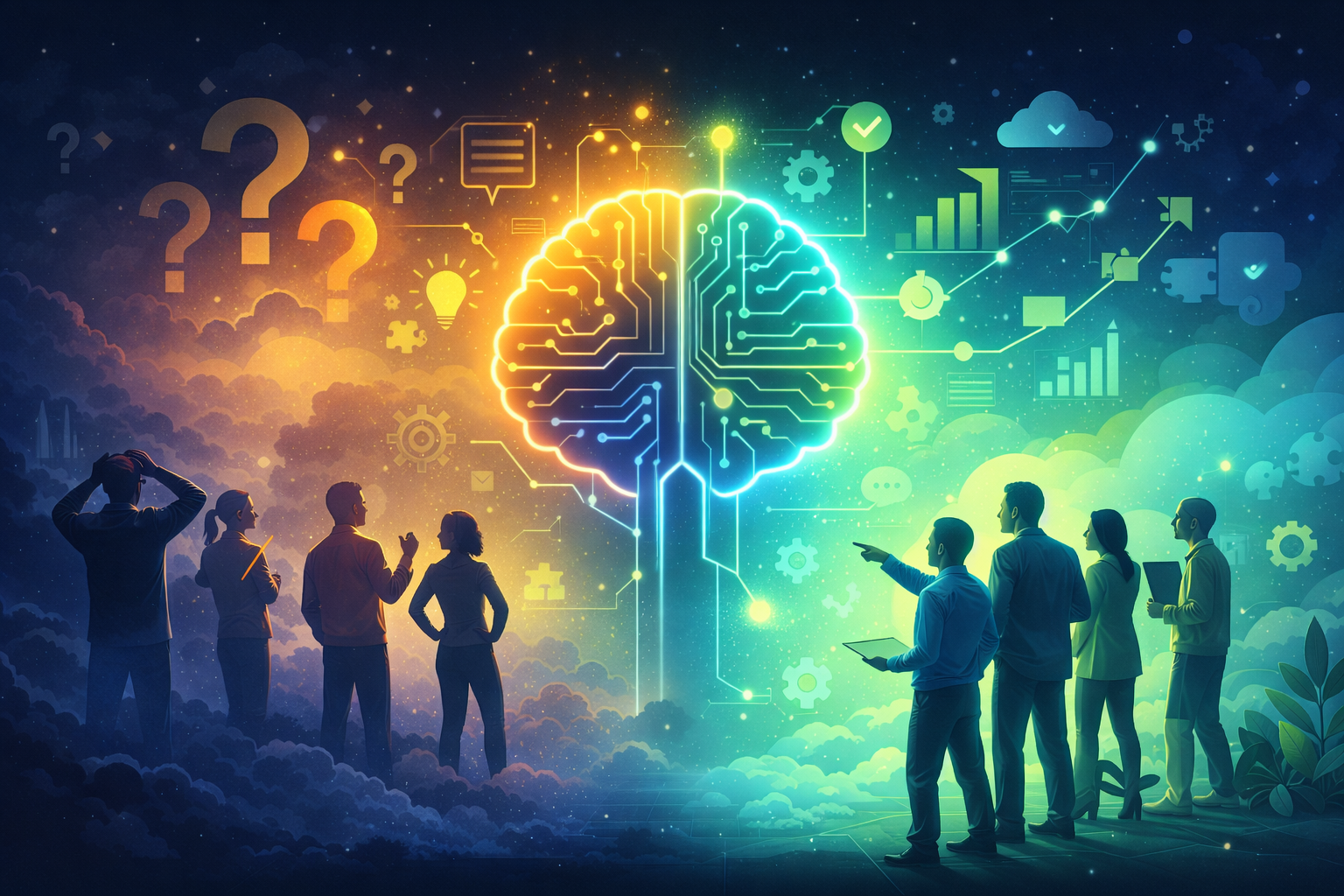
Image: News/ChatGPT
Support our mission to keep content open and free by engaging with theCUBE community. Join theCUBE’s Alumni Trust Network, where technology leaders connect, share intelligence and create opportunities.
- 15M+ viewers of theCUBE videos, powering conversations across AI, cloud, cybersecurity and more
- 11.4k+ theCUBE alumni — Connect with more than 11,400 tech and business leaders shaping the future through a unique trusted-based network.
About News Media
Founded by tech visionaries John Furrier and Dave Vellante, News Media has built a dynamic ecosystem of industry-leading digital media brands that reach 15+ million elite tech professionals. Our new proprietary theCUBE AI Video Cloud is breaking ground in audience interaction, leveraging theCUBEai.com neural network to help technology companies make data-driven decisions and stay at the forefront of industry conversations.