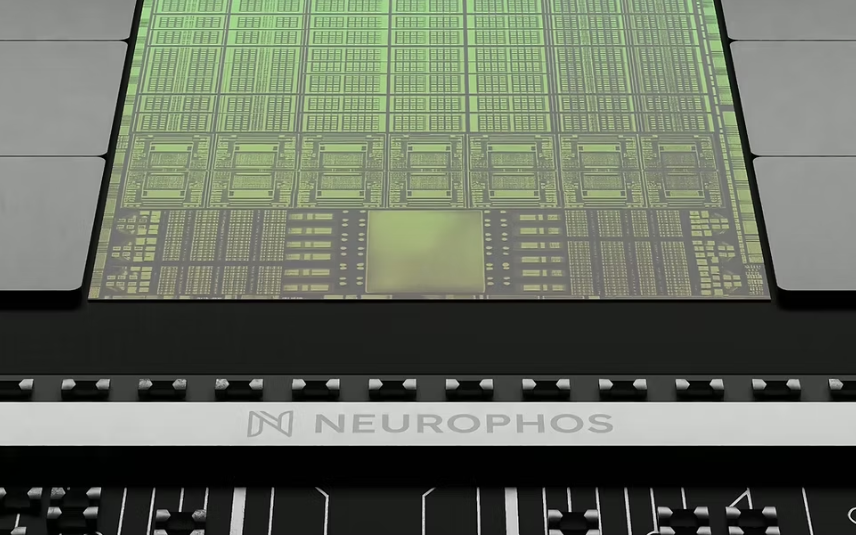
Another day, and another artificial intelligence chipmaker is raking in millions of dollars in funding. Today it’s a startup called Neurophos Inc., which has just closed on an oversubscribed early-stage funding round worth $110 million, bringing its total amount raised to $118 million to date.
The Series A round was led by Gates Frontier and saw the participation of laundry list of other investors including Microsoft Corp.’s venture capital arm M12, Carbon Direct Capital, Aramco Ventures, Bosch Ventures, Tectonic Ventures, Space Capital, DNX Ventures, Geometry, MetaVC Partners, Morgan Creek Capital, Silicon Catalyst Ventures, Gaingels and more.
Like many other chip startups, Neurophos says it’s looking to solve the growing shortage of compute capacity that will be required to fuel the adoption of artificial intelligence technologies in the coming years. It explains that data centers struggle with critical limitations in terms of the total compute power and scalability they can provide, as well as the enormous energy they require, and it argues that the current trend of racing to build even more of them isn’t the solution.
Neurophos’ answer is an entirely new kind of AI accelerator chip, called an “optical processing unit” or OPU, which integrates more than a million micron-scale optical processing elements on a single chip. The company says its prototype chips deliver up to 100 times the performance of existing AI processors, and will eventually provide data center operators with a vastly more powerful drop-in replacement for the graphics processing units they rely on today.
Neurophos is led by its co-founder and Chief Executive Patrick Bowen, who says that the AI industry cannot afford to wait for Moore’s Law to keep up with its humongous demands for compute capacity. “Our breakthrough in photonics unlocks an entirely new dimension of scaling by packing massive optical parallelism onto a single chip,” he said. “This physics-level shift means both efficiency and raw speed improve as we scale up, breaking free from the power walls that constrain traditional GPUs.”
The startup’s key innovation is the development of proprietary micron-scale metamaterial optical modulators, which are 10,000 times smaller than existing photonic elements, enabling photonic computing to become a reality for the first time. It integrates these modulators with compute in-memory technology to overcome traditional hardware bottlenecks by merging memory and processing to speed up the matrix multiplications central to AI, as well as reduce data movement.
Neurophos’ chips use photons to bypass the speed and energy limitations of electrons and achieve clock speeds of more than 100 gigahertz. In other words, it’s developing an entirely new kind of AI accelerator that promises immense efficiency gains over GPUs, and it has already demonstrated an impressive performance of more than 300 trillion operations per second per watt in early tests, far surpassing existing standards. The design of its chips also results in a significant reduction in power consumption, the company said.
The startup, which is partnering with the Norwegian data center operator Terakraft to launch a real-world pilot of its optical AI accelerator in 2027, says it’s hopeful it can manufacture its first complete systems by early 2028, before gearing up production later that year. M12 Managing Partner Michael Stewart said the timeline is realistic enough that he’s more than happy to underwrite it.
Holger Mueller of Constellation Research said investors are willing to throw huge amounts of money at promising chip startups because the anticipated demand for AI compute is expected to become an unprecedented opportunity, and Nvidia can’t fulfill it alone. Indeed, the analyst said, many companies are looking for faster and more affordable ways to run their AI models, as the scarcity of Nvidia’s GPUs keeps on driving prices up.
“There’s a lot of innovation coming from the startup camp, and Neurophos is a great example of this, trying to squeeze millions of optical processing units onto its silicon chips,” Mueller said. “The funding will help Neurophos to try and reach its next major milestone and show that it can produce and operate its OPUs in commercial quantities. The success of these efforts will help to determine if the OPU acronym becomes a household name in the same way that GPU has already become.”
Microsoft has emerged as one of the startup’s biggest fans. It’s not just backing it financially, but actively exploring the benefits of its OPUs. “Modern AI inference demands monumental amounts of power and compute,” said Marc Tremblay, Microsoft’s corporate vice president and technical fellow of core AI infrastructure. “We need a breakthrough in compute on par with the leaps we’ve seen in AI models themselves, which is what Neurophos’ technology and high-talent density team is developing.”
Neurophos said the funds from today’s round will accelerate the delivery of its first integrated photonic compute system, including data center-ready OPU modules, complete with a full software stack and early access developer hardware. In addition, it’s planning to expand its Austin, Texas-based headquarters and open a new engineering center in San Francisco, where it’ll be able to demonstrate its technology to prospective buyers.
Image: Neurophos
Support our mission to keep content open and free by engaging with theCUBE community. Join theCUBE’s Alumni Trust Network, where technology leaders connect, share intelligence and create opportunities.
- 15M+ viewers of theCUBE videos, powering conversations across AI, cloud, cybersecurity and more
- 11.4k+ theCUBE alumni — Connect with more than 11,400 tech and business leaders shaping the future through a unique trusted-based network.
About News Media
Founded by tech visionaries John Furrier and Dave Vellante, News Media has built a dynamic ecosystem of industry-leading digital media brands that reach 15+ million elite tech professionals. Our new proprietary theCUBE AI Video Cloud is breaking ground in audience interaction, leveraging theCUBEai.com neural network to help technology companies make data-driven decisions and stay at the forefront of industry conversations.