In the age of electricity, time is no longer measured in minutes, but in milliseconds. As Fatih Birol, executive director of the International Energy Agency (IEA), explains, the world has fully entered a new era where electricity consumption grows twice as fast as general energy demand. However, this advance has an “Achilles heel”: network stability. Renewable energy, although necessary, is inherently unstable.
The great fear of operators is that a small failure in a grid saturated with solar and wind energy will cause a domino effect that ends in a total collapse. Faced with this scenario, China has deployed technology capable of detecting, isolating and recovering the network from a failure in just 0.1 seconds.
From hours of darkness to the blink of an eye. Historically, managing power grid failures was a slow and manual process. As a South China Morning Post report recalls, restoring power after a community blackout used to require between 6 and 10 hours of work. That year, China already marked a milestone by testing an artificial intelligence system that reduced that time to 3 seconds.
However, that is no longer enough. The recent achievement of 100 milliseconds (0.1 seconds) is the fruit of a collaboration of more than a decade between elite universities (Tianjin and Shandong), the state corporation State Grid and automation specialists such as Beijing Sifang Automation. This technology is not only faster, but is capable of identifying “micro-currents” of just 100 milliamps, almost invisible faults that previously went unnoticed until it was too late.
“Self-healing” versus intermittency. The fundamental problem, detailed in the study published in Energy Informaticsis that modern networks are much more complex. The massive incorporation of renewables and extreme weather conditions make traditional diagnostic methods based on static rules fail due to lack of precision and adaptability.
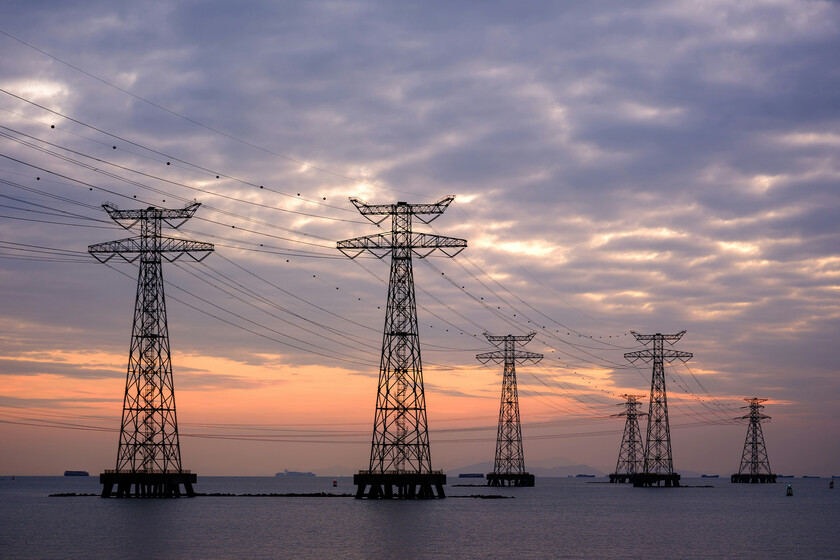
This advance means that China’s power grid—the largest in the world, with projected consumption in 2025 of more than 10 trillion kWh—is moving from a reactive system to a “self-healing” one (self-healing). This capability is so strategic that China has already exported the technology to 12 nations, cementing its influence not only as a panel manufacturer, but as the architect of global electrical security.
The algorithms behind the miracle. To understand how this speed is achieved, we must look at the academic study of Qi Guo and his team. The system is supported by a dual structure of intelligent algorithms:
- Fault Location Algorithm (FLA): Uses a fault classifier Support Vector Machine (SVM) with a radial basis function (RBF) kernel. This “brain” analyzes variables such as voltage, line impedance and weather conditions to predict with 92% accuracy where exactly the problem has occurred.
- Fault Isolation Algorithm (FIA): Once the critical point is located, a decision tree logic comes into play that evaluates the severity. According to the research, if the fault is critical (such as a short circuit near a substation), the system orders the immediate isolation of that section and redirects the energy along alternative routes almost instantly.
This hybrid approach allows the system to learn from historical data and adapt to dynamic conditions, something that conventional distance protection systems simply cannot do as effectively.
The new geopolitical battlefield. The energy transition not only redefines how energy is produced, but also who controls the rules of the new industrial system. While the West focuses its response on ensuring the supply of critical minerals through initiatives such as ReSourceEU, China is advancing in a less visible but more decisive field: the standardization, digitalization and integration of the infrastructures that will sustain the low-carbon economy. Rather than competing for resources, the dispute revolves around who designs the technological architecture on which global growth will function.
The ability to recover a network in 0.1 seconds is not just a technical record; It is the life insurance of a highly electrified economy. The greatest current risk is that this clash of strategies between powers ends up slowing down decarbonization. However, in the race for stability, China has shown that while the rest of the world continues to search for the switch in the dark, they have already designed a system that never allows the light to go out.
Image | Unsplash
WorldOfSoftware | China dominates the world of renewable energy, but it has an Achilles heel: it depends on the West more than it admits