
In February, New Delhi will host the AI Impact Summit, a gathering of policymakers, industry leaders, and researchers, with the tagline “People, Planet, Progress.” This summit arrives at a turning point, as the center of gravity on artificial intelligence (AI) adoption shifts toward emerging economies, home to three-quarters of the world’s population. With the summit, India, already a leader in AI skill penetration, is positioning itself as a “shaper” rather than a mere “adopter” of these technologies.
But the success of the New Delhi summit will depend on how effectively it moves beyond rhetoric to address the realities of AI adoption, including the need for workforce development. To this end, on January 23, the hosted an official pre-summit event in partnership with the Indian embassy in Washington, DC. The event opened with remarks by Ajay Kumar, minister (commerce) at the Indian embassy in Washington, DC, as well as Tess DeBlanc-Knowles, senior director of the ’s Technology Programs. This was followed by a panel discussion with Martijn Rasser, vice president for technology leadership at the Special Competitive Studies Project; Nicole Isaac, vice president for global public policy at Cisco; and Peter Lovelock, chief consultancy and innovation officer at Access Partnership. Below are some of the key takeaways from that discussion, as well as several of the panelists’ recommendations for how to approach these issues heading into the AI Impact Summit. The discussion underscored that while the potential for AI-driven growth is immense, the hurdles, ranging from a global talent shortage to fragmented labor data, require more than just market forces to overcome.
The global AI talent gap
The current global AI talent landscape can be viewed as a pyramid, according to Rasser. At the apex, he said, sits a cohort of around ten thousand elite PhD-level researchers and machine learning engineers. While the United States and China currently dominate this top layer of researchers, the real opportunity for emerging powers lies at the applied level. India possesses significant depth in its service sector, but the true challenge is building institutional readiness, ensuring that organizations can effectively channel available talent into high-value applications.
The most underappreciated deficit is not in raw coding but in AI-adjacent skills. There is a pressing need for product managers and domain experts who can bridge the gap between technical tools and organizational needs. For emerging economies, said Lovelock, the goal should not be to replicate Silicon Valley’s research labs, but to build an ecosystem where AI is “burned into” industrial applications such as supply chain management and export-import calculations.
AI infrastructure as workforce policy
“At its core, AI is designed, built, and deployed by humans,” noted Knowles. Indeed, a persistent theme for the global majority is that connectivity cannot be separated from workforce policy. Without reliable digital access, Isaac noted, billions remain excluded from the transformative benefits of AI. Security is another foundational layer; as AI environments become more complex, training in cybersecurity and digital resilience becomes essential to protect vulnerable populations from bad actors.
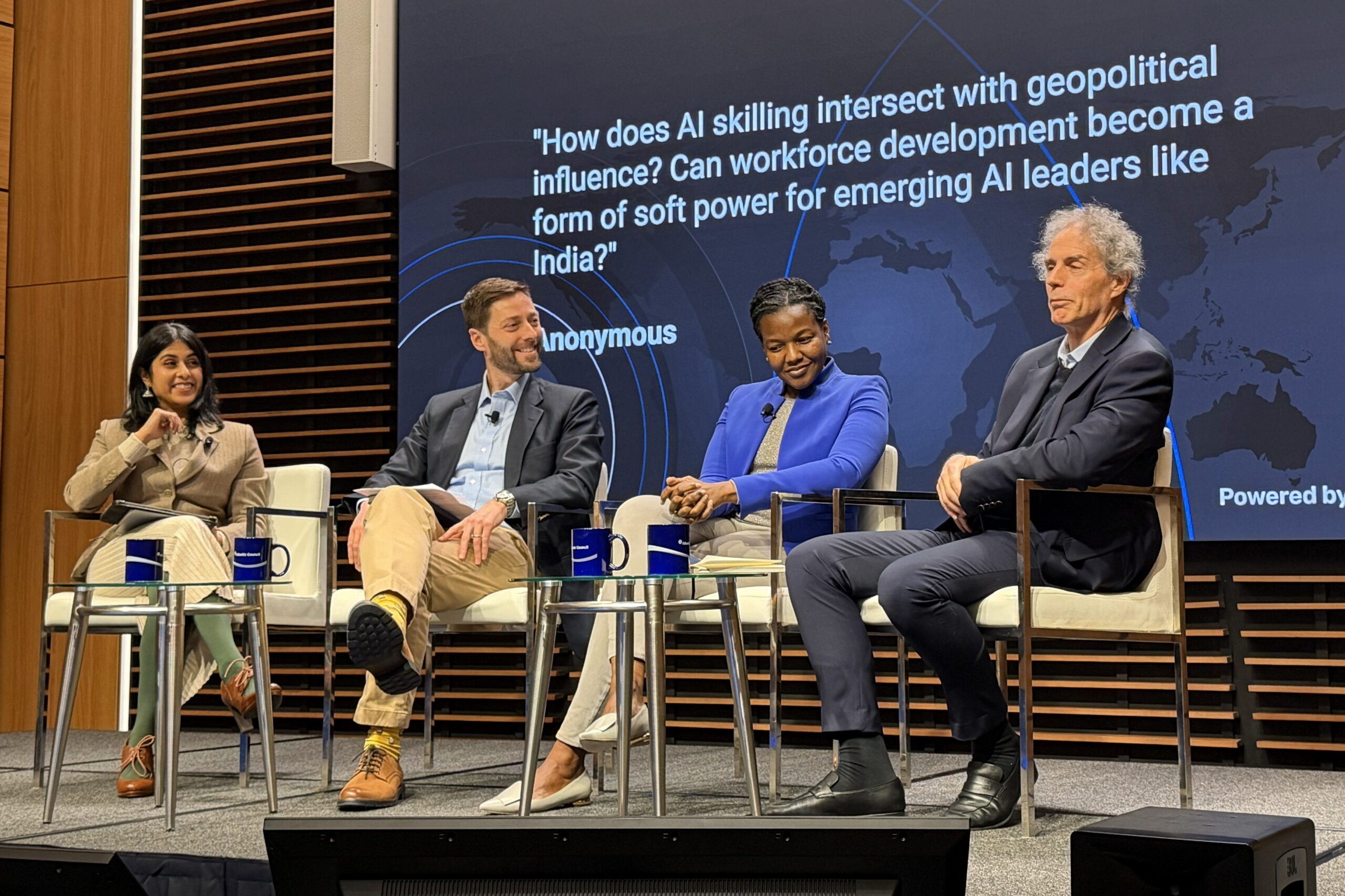
Kumar, the Indian embassy official, laid out India’s strategy for a comprehensive five-layer “AI stack,” including sovereign models, semiconductors, and data centers. By providing compute power to educational institutions at a fraction of the global market rate, he argued, the government aims to democratize access across smaller cities. However, the widening digital divide remains a threat. If certain segments of the population are left behind, the resulting “have and have-not” divide could persist for generations, he said.
The other data problem
We cannot manage what we cannot measure. Policymakers, said Lovelock, are currently operating with “static” data that looks in the rearview mirror. Traditional labor statistics, often based on outdated surveys, are ill-suited for a fast-moving technology. Furthermore, labor data is often fragmented across various ministries, making it difficult to understand where the actual skill gaps lie.
Standard adoption metrics are increasingly irrelevant because individual AI use is highly varied. Instead of tracking who is using the technology, said Lovelock, governments need a “diffusion framework” that measures the actual impact of AI use on the economy. Only then can they make the strategic bets required for a long-term return on investment.
Four pillars for the summit’s AI talent agenda
Following from the panelists’ insights, the AI Impact Summit can deliver a scalable and inclusive AI talent framework by coalescing the global community around four primary actions:
- Modernize education through personalized AI tools. Rather than sticking to the “one-to-many” broadcast model of traditional schooling, curricula should be reformed to put AI tools directly in the hands of students. This shift allows for personalized learning and ensures that students learn by doing, preparing them for a rapidly changing job market.
- Create an AI Diffusion Index to measure actual adoption. Policymakers should move away from static adoption statistics and toward real-time data signals that measure how AI is being embedded into industrial and public services. This requires supplementing government surveys with nontraditional data sources to better align educational output with actual labor market demand.
- Treat connectivity and security as foundational workforce issues. Investment in fiber and satellite infrastructure must be paired with training in digital resilience and cybersecurity. This ensures that the benefits of AI are shared broadly and that new users are protected from the heightened risks of an AI-ready environment.
- Position government as the “first user” of new technologies. The public sector should take the lead in adopting AI for the delivery of public services in agriculture, healthcare, and education. By demonstrating the usefulness and accessibility of these tools within government, the state can send a powerful signal to the broader population and help accelerate national adoption.
The success of the AI Impact Summit will be measured not just by the declarations its participants make, but by the structural cooperation that survives past February. The summit offers a rare opportunity to pool global resources to solve the AI workforce crisis, replacing anecdotal evidence of AI adoption with rigorous data and flexible approaches to meet shifting workforce needs. At the summit, New Delhi has the opportunity to transform a week of dialogue into a sustained, collaborative framework that can help enable emerging economies to tap the benefits of AI adoption.
Trisha Ray is an associate director and resident fellow at the ’s GeoTech Center.

The GeoTech Center champions positive paths forward that societies can pursue to ensure new technologies and data empower people, prosperity, and peace.