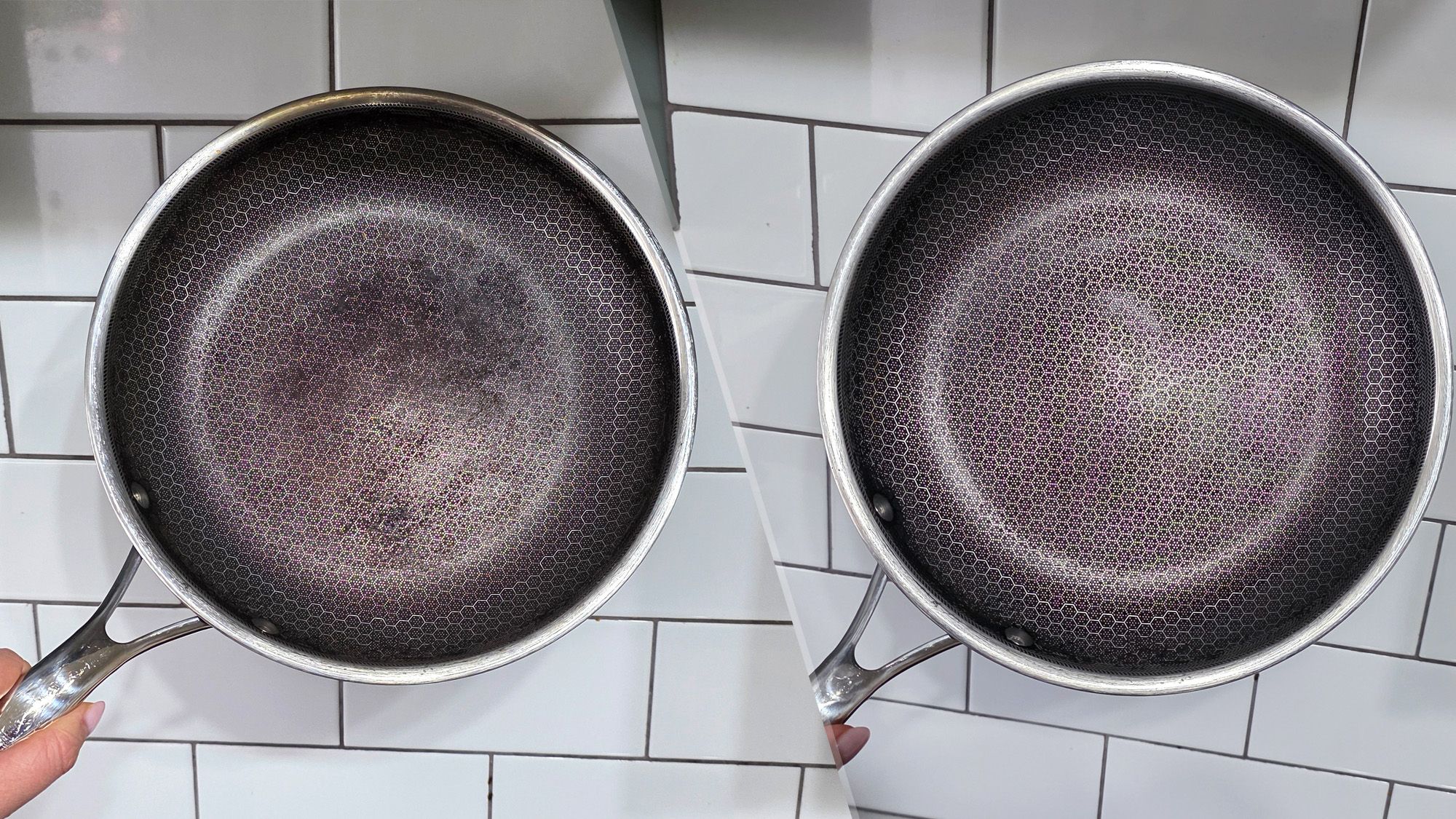
I’ve been a HexClad fan for years. In my ever-growing collection, you’ll find a range of saucepans, frying pans, and even roasting tins that I use daily. But if you’ve also made the switch to hybrid cookware, you may be making the number-one mistake that can prevent your pans from performing at their best.
That’s right. Just like cast iron pans, your HexClad needs seasoning. But the good news is, you only need a few minutes to do it, and they’ll be back to performing like they’re brand new.
Why does your HexClad need seasoning?
Not quite non-stick, not quite stainless steel, HexClad cookware features a laser-etched hexagonal grid that allows food to glide over its surface without sticking, but with none of the fussy requirements of coated cookware.
“Whenever I get a new HexClad pan, it’s really tempting to put it straight on the heat and start cooking,” says Michelin Star chef Paul Ainsworth. “But to get the best cooking results, you need to ‘season’ them first.
“I heat the pan over a low-medium heat, take some kitchen paper and rub light cooking oil all over the inside of the pan. I do this three times, and then the pan is ready to go!”
Essentially, by seasoning your pan with a neutral oil, you restore the nonstick properties of its coating layer. In the long term, you should find that this minimizes the need for cooking with lots of oil, and also prevents foods like egg from sticking.
How to season your HexClad cookware
Fortunately, the seasoning process only takes a matter of minutes, and it doesn’t need to be done regularly.
In fact, you may find that regular use will naturally replenish the seasoning on your pan, as the oils add an extra layer of protection to the non-stick layers.
1. Clean your pan
Give your pan a good wash and dry it thoroughly. You may wish to heat it up on the stove over a low heat to ensure it’s fully dry before seasoning.
2. Rub some oil inside the pan

Rub a tablespoon of neutral oil around the inside of the pan — I recommend an oil with a high smoke point, such as avocado or vegetable oil.
I use a square of kitchen paper to ensure this thinly covers the entirety of the pan. You don’t want too much oil, as the plan is to let it absorb into the pan itself.
3. Heat the pan

Turn up the heat and let your oil begin to bond with the pan’s surface. The goal is to create a thin layer of polymerized oil that acts as a natural non-stick layer.
You could also put your pan in a hot oven for a few minutes to let the oil ‘bake’, if preferred. Just keep in mind that it might need a little longer as your pan won’t be subject to direct heat.
4. Let it cool

Once a few minutes have passed, you can take your pan off the heat and begin to cool. Once cooled fully, wipe away any excess oil and give the pan a light wash.
Now, your pan should be fully seasoned and good as new!

Follow Tom’s Guide on Google News and add us as a preferred source to get our up-to-date news, analysis, and reviews in your feeds.