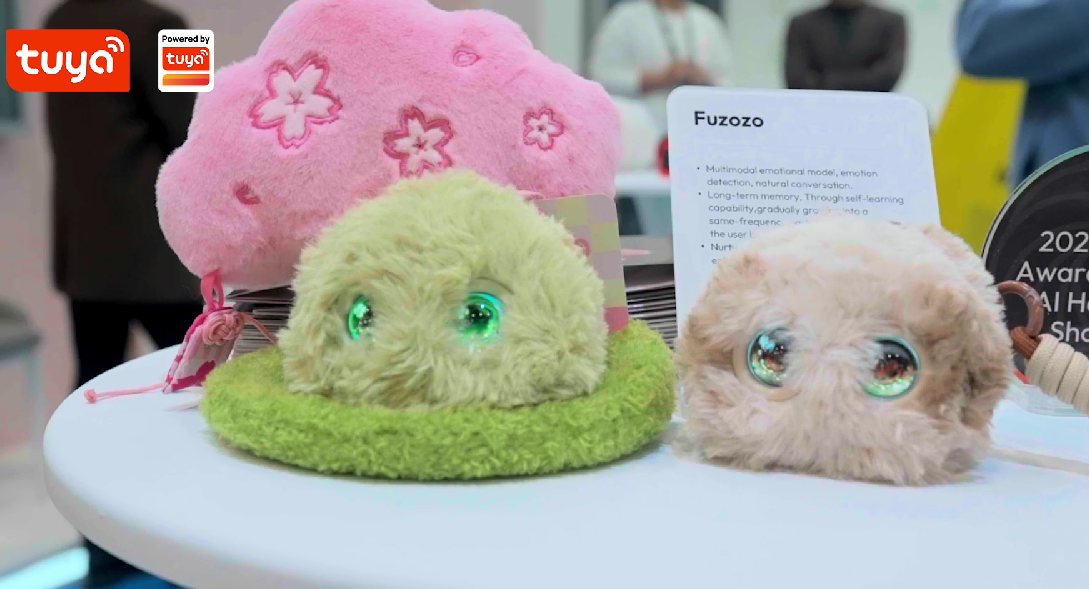
Compared with some products that are positioned more as AI toys, Fuzozo appears to be shifting the focus away from short-term novelty toward longer-term use. The AI emotional companion was developed by Robopoet, with underlying AI and connectivity support provided by Tuya. Its small, furry, pet-like form factor is designed to be easy to carry and to fit more naturally into everyday life.
Fuzozo places more emphasis on ongoing interaction itself. By retaining elements of past conversations and usage states, the device can gradually develop a relatively consistent personality over time, rather than operating as a series of isolated questions and responses.
As Alan Ren, Marketing Director of Tuya, noted in an interview with TechNode, the core of an AI emotional companion is not whether individual interactions are entertaining, but whether the device can build a sustained and evolving emotional connection with its user.
From Wi-Fi to cellular, AI companions step outside the home
One of the key technical differences comes down to connectivity. Many AI emotional devices still rely heavily on Wi-Fi, which often limits their use to indoor settings. By adding built-in cellular connectivity, Fuzozo is trying to address a common constraint: AI companions that only work at home.
With cellular access, the device can stay connected while users are commuting, spending time outdoors, or traveling abroad, allowing the companion experience to continue across different parts of daily life instead of being tied to a single location.
From Tuya’s perspective, connectivity is not just another feature upgrade, but a core part of the overall experience. As Alan Ren said, lower latency and more stable connections make conversations feel smoother and emotional responses more natural, helping make long-term companionship a more realistic use case rather than a purely conceptual one.

A new AI hardware playbook behind the scenes
Tuya isn’t directly involved in designing Fuzozo’s emotional interactions. Instead, it provides the underlying support through its AI developer platform and global cloud infrastructure. This layer handles things such as device connectivity, data management, and global rollout—freeing Robopoet’s team to focus more on the emotional model itself, interaction design, and how the product’s personality takes shape over time.
This division of labor also reflects a broader trend in the AI hardware sector: meaningful differentiation is no longer driven by model capabilities alone, but increasingly by the coordinated design of AI models, hardware form factors, and connectivity capabilities.

Beyond emotional value: what else are AI companions exploring
As emotional value becomes a buzzword, what actually counts as meaningful emotional companionship is still an open question. Fuzozo’s approach is to go beyond reacting to emotions in the moment. By recording and revisiting users’ longer-term moods and experiences, it aims to build a more continuous relationship over time, rather than a series of disconnected interactions.
The product is also designed to encourage real-world interaction. When two users carrying their own Fuzozo devices meet in person, a simple physical touch or close-range interaction allows the devices to recognize each other and log that encounter. The device isn’t meant to socialize on the user’s behalf, but to act as a light, low-pressure bridge that makes it easier for people to connect offline. In that sense, Fuzozo positions AI as a catalyst for human relationships, rather than a replacement for them.

Whether AI emotional companions will become the next mainstream hardware category remains to be seen. What is clear, however, is that as connectivity, AI models, and hardware form factors continue to evolve, these products are gradually moving beyond the concept stage and into more practical, everyday use.