
Social media measurement is all about using data to make informed decisions that support business goals.
In this post, we’ll explore how social measurement can drive real results for your business.
Key takeaways
- Social media measurement connects social activity to business goals.
- Measurement reveals who your audience is, how competitors perform, and what content works.
- Strong measurement programs combine clear goals, the right metrics and tools, and CRM-connected reporting.
Social media measurement is the process of using social data and analytics tools to evaluate how well your brand is doing on social media.
By checking results regularly, you can better understand your audience and find ways to improve results.
Social media measurement also helps you see how social supports your brand as a whole, not just how individual posts perform. It gives you helpful insights into your brand, your competitors, and your audience.
Social media measurement reveals how your audience thinks, behaves, and engages with your brand compared to competitors.
Through smart measurement, you can uncover:
Audience insights
On the surface, measurement is useful for understanding basic audience demographics. This includes:
- Age,
- Gender,
- Location,
- Language,
- and so on.
These insights can shape your social media strategy, brand voice, and even product development.
At a deeper level, measurement reveals what your audience likes, what they don’t like, and what they expect from your brand. This gives you critical insight into their behaviors, like when they’re most likely to be online.
Target market preferences and pain points
Social media measurement helps you identify your true target market and what problems your brand is best positioned to solve.
But first, a quick distinction:
- Your social media audience is everyone who follows or engages with your brand.
- Your target market is a more specific set of people. It’s those who are most likely to actually buy your product and services.
By measuring how these groups interact with your content, you can see what matters most to your ideal customers and tweak your messaging, content, and strategy to match.
Competitive insights
Social media measurement helps you identify your top competitors and understand how they’re using social media to connect with your shared audience.
This allows you to benchmark your own overall performance against relevant accounts, spot new competitive threats as they emerge, and identify gaps in your own social strategy.
For example, you can take a look at how often your competitors post, what types of content they post, and how those factors impact their engagement rates.
You can also zoom out and see what kinds of topics they cover and how much of the overall industry conversation they own.
Content performance
Social media measurement allows you to understand the performance of your social content at both the micro and macro levels.
On the macro level, you can see how things are trending overall. What are the big picture shifts in your engagement, follower growth, and reach?
Ultimately, this broad view helps you see whether your social strategy, in general, is on the right track. You can also measure the ROI of your social media efforts as a whole.

On the micro level, you can measure the performance (and ROI) of individual posts and marketing campaigns.
Here, you’re looking at more detailed insights. What specific types of content perform best (photo, video, text, etc.)? What caption length and style see the most engagement? What calls to action drive the most clicks?
Brand awareness, perception, and reputation
Social media measurement can show how visible your brand is and how people feel about it.
This includes quantitative data — like what percentage of the online conversation is about you — with qualitative data, like sentiment, to give you a complete picture of brand perception.
Most importantly, ongoing measurement helps you spot sudden shifts in brand reputation, so you can lean into your wins and nip impending crises in the bud.
The most important social media metrics to measure are engagement, reach, conversions, and audience metrics.
That said, the right metrics are the ones that matter most to your brand. If a metric doesn’t give you visibility into your goals — or help guide strategic decisions — it’s probably a nice-to-have.
Here are the key areas to focus on when measuring the success of your social media efforts.
Engagement
Engagement metrics measure how much people interact with your social content. It’s an important measure of how well your content connects with your target audience.
High engagement also gives you credibility with new visitors and sends powerful signals of content quality to the algorithms.
Engagement metrics to track include:
- Total engagements: The total number of likes, comments, shares, and saves, either for a specific post or for a certain time period
- Engagement rate: Total likes, comments, shares, and saves divided by number of followers x 100 to get a percentage
Note: Measuring engagement rates is actually a whole topic in itself, thanks to its many formulas. We’ve got a whole blog post on calculating engagement rate to help you out!
It’s also important to think of engagement quality, and not just volume. For instance, comments typically signal more interest than likes, and saves signal even stronger intent.
Not sure what engagement rate to aim for? Here are the overall engagement rates for the last two quarters based on Hootsuite’s own data:

Engagement rates vary a lot by industry. The best social media measurement tools include benchmarking features that allow you to compare yourself to your peers. (More on those tools below.)
Reach
Reach metrics give you a sense of how large your social audience is. They’re one of the clearest ways to understand brand awareness and whether your content is reaching beyond your existing audience.
Important social media reach metrics include:
- Reach: The number of people who see your content
- Impressions: The number of times people saw your content. This can be higher than reach if people look at your content more than once.
- Social share of voice (SSoV): How much of the social conversation in your industry is about you. This is a tricky one to calculate manually, so look for a measurement tool that calculates it for you.
When measuring reach, look at how much of your reach comes from followers compared to non-followers.
For instance, a high percentage of non-followers indicates that your content is being shared or getting a bump from the algorithm. These are both signs of quality content.
Video performance
Video performance metrics show how your video content resonates with viewers beyond basic engagement and reach.
The most important video metrics to track are:
- Video views: The number of times your video has been watched. On Facebook and Instagram, 3 seconds counts as a view. On TikTok, it’s as soon as a video starts playing. On LinkedIn, a view counts when there’s 2 or more continuous seconds of playback while the video is at least 50% on screen
- Video completion rate: The number of people who watch your video to the end divided by the number of impressions x 100 for a percentage
- Watch time: The total amount of time people spent watching your videos over a certain period
To put video performance in context, compare it with other content formats. For example, Hootsuite’s latest data shows that videos (Reels) have lower engagement than carousels on Instagram.

If engagement is your top priority, it could be beneficial to test non-video content types.
Conversion
Conversion metrics indicate how your social content is contributing to real business outcomes, like leads, sign-ups, and sales.
Key social media metrics to track for conversion are:
- Conversion rate: The number of people that performed a desired action (purchase, sign-up, etc.) divided by the number of clicks on your social links
- Click-through rate (CTR): The total number of clicks divided by the number of impressions x 100 to get a percentage
- Social media ROI: (The value generated from social media – the costs of social media investment) divided by those costs. Multiply by 100 to get a percentage. Or go the easy route and use our free ROI calculator.
If you connect with your audience through multiple touchpoints (say, email and podcast ads in addition to social media), consider using attribution models to determine how much influence social media had in the conversion path. We get into this in our post on social media performance.
Audience metrics
Audience metrics help you understand who your audience is, how it’s growing, and how they feel about your brand.
The most important audience metrics to track are:
- Follower count: A tally of how many followers you have, either overall or on each individual social media account
- Audience growth rate: Net new followers divided by total number of followers x 100 to get a percentage
- Social media sentiment: This is a measure of how positive or negative the social conversation about your brand is. It’s tricky to measure, but the best social media measurement tools will calculate it for you.
- Demographics: Basic aspects of your audience, like gender, age, location, as well as when they’re most often on each social platform.
For your comparison, here are our latest findings on the average follower growth rate.

Looking at these metrics over time helps you spot meaningful changes in your audience. For example, after a major spike or drop in follower growth, dig into demographics to see whether your audience still matches the market you’re trying to reach.
If you’re getting followers you didn’t expect, it may be that your target market is evolving, and your content strategy needs to shift accordingly. Or, it could be that you need to refocus on your audience rather than going for broad appeal.
‘For more details on these and other social marketing metrics, check out our post on essential metrics to measure social media success.
You can set up a smart social media measurement process by aligning goals, metrics, tools, and reporting into a repeatable system.
Here are the five key steps:
- Set clear social media goals
- Choose the metrics you’ll track
- Set up analytics and social listening tools
- Connect your measurement tools to your CRM
- Report, reassess, and optimize
1. Set clear social media goals
To get the most of your social marketing efforts, connect your social media metrics to real business goals.
Keep in mind that your goals and associated measurement strategies may vary by platform, or even by campaign. The important thing is to know what you want to achieve with your data, rather than just collecting it because you can.
We’ve got a whole blog post dedicated to social media goal-setting and another on how to create key performance indicators to work toward those goals.
2. Choose the metrics you’ll track
The metrics you track should help you gauge your progress towards your stated goals and KPIs.
For example, if your primary goal for TikTok is building brand awareness, focus more on reach and audience metrics there. If you’re using shoppable posts on Instagram to drive sales, you’ll want to track conversions.
3. Set up analytics and social listening tools
All major social media platforms have native analytics tools. These are a good place to get started with social media measurement, since they’re free to use and require very little set-up.
We cover all the major native analytics solutions (plus Google Analytics) in our post on social analytics tools (this link takes you directly to the section on free tools).
We’ve also created a free social media reporting template where you can collect all your data for analysis.
For competitive and audience insights, you’ll also want to set up social listening. We’ve got a post dedicated to the best social listening tools to help you choose the one that works best for you.
If you’re not sure what to track, or how to find the social media data you need, check out the reporting templates in your social analytics tool of choice. Choose one that aligns with your goal, as it will be pre-populated with the most relevant metrics.

4. Connect your social measurement tools to your CRM
Connecting your social media measurement tools to your CRM helps you understand how social supports your sales funnel and greater business objectives.
When your social data lives alongside customer and lead data, every team gets a clearer, more complete view of performance.
You gain richer audience insights, stronger attribution, and a better understanding of how social contributes to pipeline and revenue
5. Report and reassess
Many stakeholders across your organization are interested in your social media measurement findings. Plan out a regular reporting schedule to keep everyone informed with the data they need.
For instance, you’ll likely want the social team to review the data at least weekly, with a more in-depth dive to look for longer-term trends every month. For more senior stakeholders, a high-level monthly analytics report might do the trick.
The key is to consider how people will use the data you report to them. Don’t overwhelm team members and stakeholders with data points that aren’t relevant to their role or decision-making.
When you review your data, assess whether your social marketing strategy is working. Are your goals still realistic? Is there something new on the horizon you need to start tracking? Every report is an opportunity to reassess and optimize.
Pro tip 💡: Make sure reports connects your social team’s contributions to real business value. A focus on social performance reinforces the importance of your work and your social media measurement plan.
Here are our top tools for measuring social media success, depending on your goals, team size, and social goals.
1. Hootsuite

Hootsuite is a social media measurement tool that combines social analytics and social listening (plus a comprehensive set of other social media management features).
You easily measure the performance of all your social channels in one place, benchmark against competitors, and track brand sentiment in real time.
You can set up custom boards that give you an overview of your most important metrics at a glance. The tool also makes it easy to create custom reports to showcase your results to your boss and share insights with your team.
Key feature: Get personalized recommendations for the best time to publish on each of your social platforms without having to calculate this manually.
Best for: Teams focused on combining social listening data with social measurement metrics for a full social performance report.
Price: Hootsuite plans start at $199/month
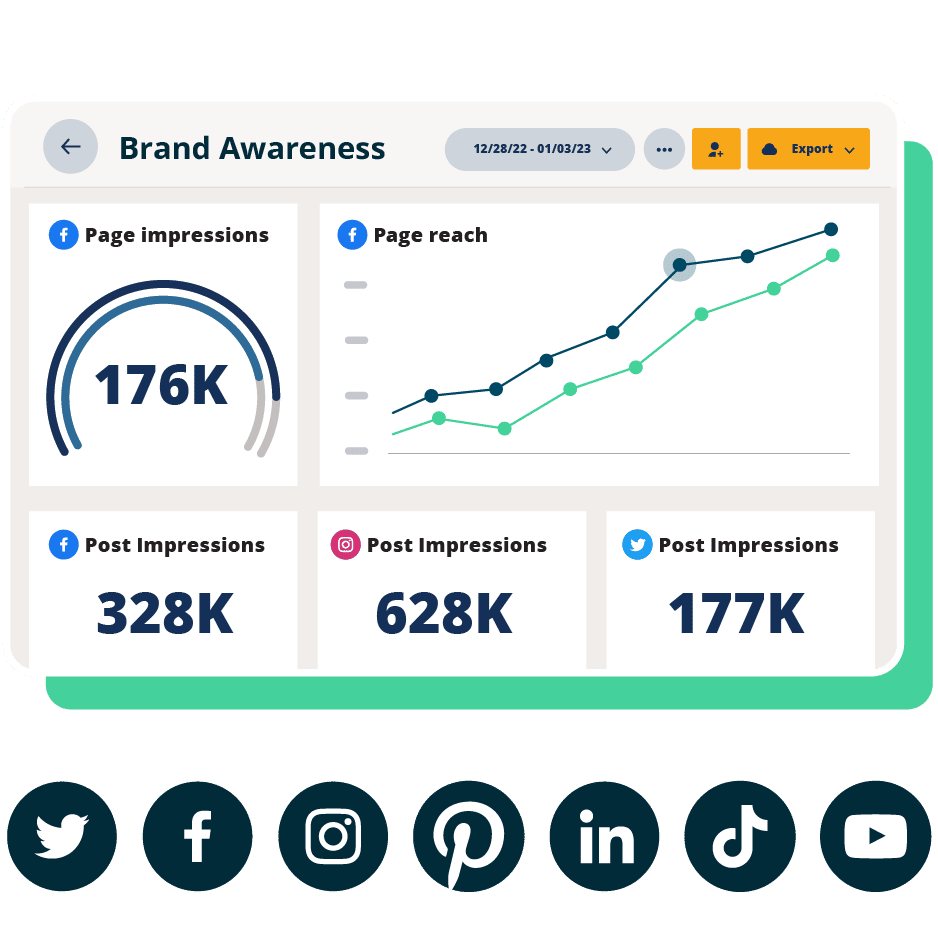
#1 Analytics Tool for Growth
Beautiful reports. Clear data. Actionable insights to help you grow faster.
Start free 30-day trial
2. Talkwalker

Talkwalker is a powerful social measurement tool that combines social listening and audience insights, plus media monitoring and social benchmarking.
It can help you identify positive and negative trends, understand where you fit in your niche, and gain deeper insights into your customer base.
Key feature: Talkwalker uses AI to analyze social sentiment on your most important topics and predict how it will change over the next 30 to 90 days.
Best for: Social teams that collaborate with PR, marketing, and other communications teams to make the most of social measurement insights.
Price: Pricing available on request
3. RivalIQ

RivalIQ is an analysis tool designed to help you make data-driven decisions quickly. It can measure and compare searches of brand mentions, hashtags, and topics to give you an understanding of what’s most popular in your sphere.
Key feature: Boosted post detection based on machine learning helps you understand why a competitor is seeing greater engagement rates.
Best for: Agencies, nonprofits, and large brands.
Price: Plans start at $239/month
FAQ: Social media measurement
What is social media measurement, and which metrics matter most?
Social media measurement is the process of tracking social data to understand how your content and channels are performing. The metrics that matter most are engagement, reach, conversions, and audience metrics, because they show what’s working and how social supports your brand.
How do enterprises measure social media ROI?
This often includes tracking conversions, connecting social data to CRM systems, and using attribution models to understand social’s role across the customer journey.
What are best practices for social media measurement and reporting?
The best practice is to focus on metrics that matter most to your brand and report on them regularly. Strong measurement programs use clear goals, consistent reporting, and ongoing review so insights lead to action, not just more data.
What KPIs should brands track for social media performance?
Brands should track KPIs that align with their goals, such as engagement rate, reach, conversion rate, audience growth, and social media ROI. The right KPIs show both short-term performance and long-term progress.
How do social media analytics tools support better measurement?
Hootsuite supports better measurement by combining social analytics, social listening, and reporting in a single platform. This helps teams track performance across channels, benchmark against competitors, and clearly show how social contributes to business results.
Save time managing your social media presence with Hootsuite. Publish and schedule posts, find relevant conversions, engage your audience, measure results, and more — all from one dashboard. Try it free today.