Welcome back to 3 Tech Polls, HackerNoon’s Weekly Newsletter that curates Results from our Poll of the Week, and related polls around the web. Thanks for voting and helping us shape these important conversations!
This week, we’re talking about the humanoid robots that stole the show at CES 2026.
CES (the Consumer Electronics Show) can be described as the “World Cup of Technology.” It is the premier global stage where the world’s biggest brands debut their most ambitious breakthroughs before they hit the market.
CES 2026 provided a glimpse into a future where humanoid robots might actually work alongside humans. But which one has the most potential?
We want to hear from you!
:::tip
Vote in this week’s poll: Would you pay $20–$30/month to use ChatGPT’s most advanced model without ads?
:::
HackerNoon Poll Result
122 Voters weighed in on “Which Humanoid Robot From CES 2026 is the Most Promising”, and the results are clear:
Atlas (Boston Dynamics) dominated the poll with 39% of the vote. For good reasons, Boston Dynamics unveiled the production-ready version of Atlas at CES 2026, winning CNET’s “Best Robot” award. The fully electric humanoid is already in production, with deployments scheduled for Hyundai’s manufacturing facilities and Google DeepMind in 2026. Atlas can lift up to 50 kg, has 56 degrees of freedom, and can autonomously swap its own batteries without human intervention.
HackerNoon Senior Editor, Asher Umerie, summed up the Atlas enthusiasm perfectly:
Seeing as it was one of the only showcases with a production-ready humanoid, my money’s on Atlas from Boston Dynamics.
Coming in second place with 16% was The Laundry Assistant (Dyna Robotics). This robot is described as “boring, practical, and already deployed.” Sometimes boring is exactly what the market needs as long as it gets the job done.
Dyna Robotics showcased its laundry-folding robot at CES 2026, demonstrating a pair of robotic arms with arcade game-esque claw “hands” efficiently folding laundry and organizing linens. While the robot often needs up to five attempts to catch a corner of a garment, it represents one of the most successful real-world deployments in commercial robotics.
Third place went to The Convenience Store Assistant (Galbot) with 11%, representing a clear example of service robots in real settings. The humanoid robot was synced with a menu app where customers would select an item from the menu (like Sour Patch Kids), and the robot would autonomously navigate to the shelf, retrieve the product, and deliver it to the customer.
The remaining options were closely matched:
-
Other: 11%
-
The Boxer (EngineAI) — Unpolished, but a glimpse at expressive humanoid movement: 10%
The EngineAI T800 made its global debut at CES 2026 in a mock boxing ring, performing shadowboxing demonstrations and martial arts movements. Standing 1.73 meters tall and weighing 75 kg, the T800 is built on a magnesium-aluminum alloy frame with joint actuators capable of delivering up to 450 Nm of peak torque and 14,000 watts of instantaneous joint peak power.
-
Dancing Humanoid (Unitree) — More capable than it looks, even if mostly for show: 7%
Unitree Robotics showcased multiple dancing and boxing demonstrations with its G1 humanoid at CES 2026. The G1 stands 130 cm tall, weighs 35 kg, and is priced at approximately $13,500-$16,000, roughly half the price of many comparable humanoids. The G1 is already on the market and available for purchase.
-
The Home Butler (LG’s CLOiD) — Early, slow, but clearly aimed at everyday domestic use: 7%
LG Electronics unveiled its CLOiD home humanoid robot at CES 2026 under the exhibition theme “AI Robotics, From the Lab to Life.” The robot is part of LG’s “Zero Labor Home” vision aimed at reducing daily household burdens so customers can focus on more meaningful moments. LG is positioning CLOiD as a domestic helper that can cook, do laundry, and bring items from around the house, targeting everyday home use rather than industrial applications.
The HackerNoon community clearly values production readiness over flashy demos. After years of impressive parkour videos and viral stunts, Boston Dynamics is finally delivering a robot designed for factory floors rather than YouTube views and voters rewarded this practical approach with a decisive win.
That’s the HackerNoon community’s stance on the subject. But what does the broader prediction market community think about humanoid robots reaching the real world?
:::tip
It’s not too late to join the conversation. Weigh in on the poll results here.
:::
🌐 From Around The Web: Polymarket Pick
Will Tesla release Optimus by…?

The Polymarket community is tracking broader questions about the humanoid robotics industry. While specific CES 2026 robot predictions aren’t yet available on the platform, traders are actively betting on Tesla’s Full Self-Driving capabilities and robotaxi launches, which are technologies that share the same AI foundation models with humanoid robots.
Interestingly, Polymarket showed 5% odds that Tesla would launch unsupervised Full Self-Driving by June 30, 2026 and 15% odds that the launch must have taken place by December 31, 2026.
This suggests that while traders are skeptical of Optimus specifically, they have more confidence in Tesla’s underlying AI capabilities.
🌐 From Around the Web: Kalshi Pick
Tesla Optimus released this year?
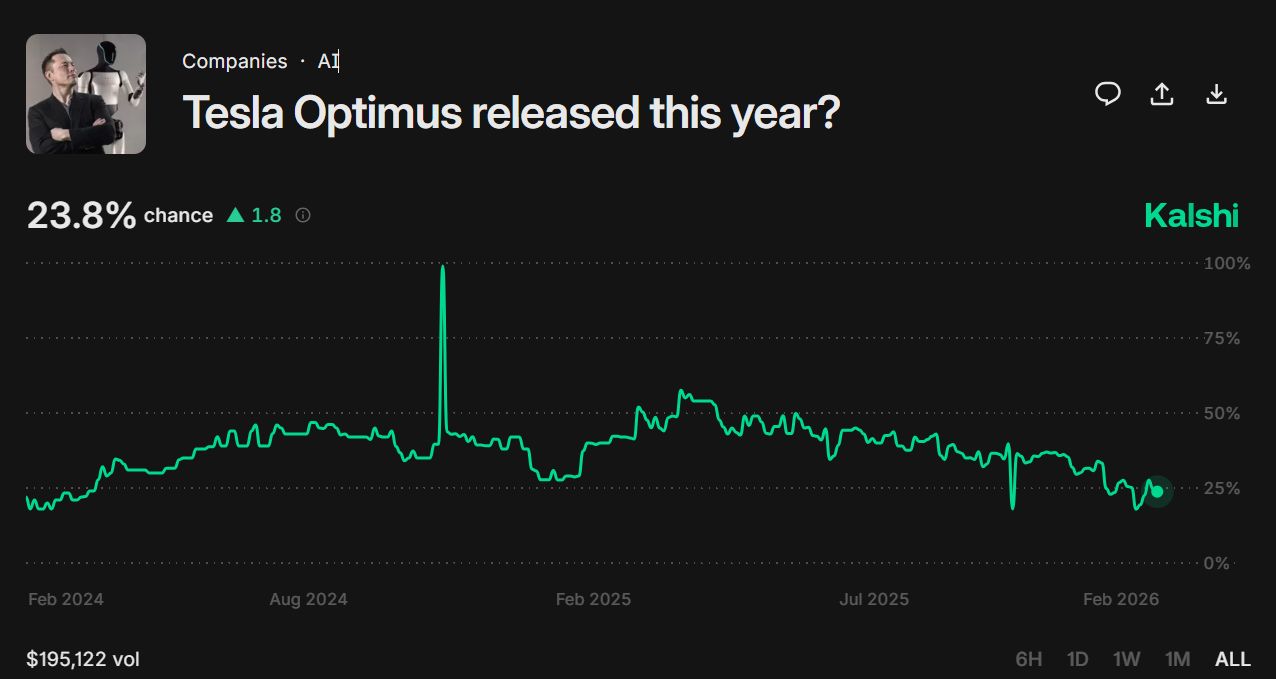
According to Kalshi’s prediction market, traders are giving Tesla’s Optimus robot only a 23.8% chance of being released to the public in 2026. This is particularly notable given Tesla’s ambitious plans.
But prediction market traders are skeptical, and for a good reason. Elon Musk’s track record on timing is notoriously unreliable. His own biographer, Walter Isaacson, says Musk is “always wrong by two or three times” on his timeframes. Even Musk himself has acknowledged this pattern, albeit in his characteristic backhanded way.
The latest version, Optimus Gen 3, won’t enter mass production until Q1 2026, according to Tesla’s own timeline. At CES 2026, Tesla was notably absent from the humanoid robot showcase, while Boston Dynamics took center stage with a production-ready product.
The market’s message is clear: Don’t bet on timeline, bet on production reality.
The internet has spoken. After decades of research, demos, and science fiction promises, 2026-2027 appears to be the inflection point where these machines finally move from labs to factory floors. The question is no longer “can we build them?” but “can we build them at scale, safely, and profitably?”
For now, the smart money is on the robots that prioritize production capability over parkour tricks. Boring, perhaps, but that’s exactly what real-world deployment requires.
That’s all for this week.
Until next time, Hackers!