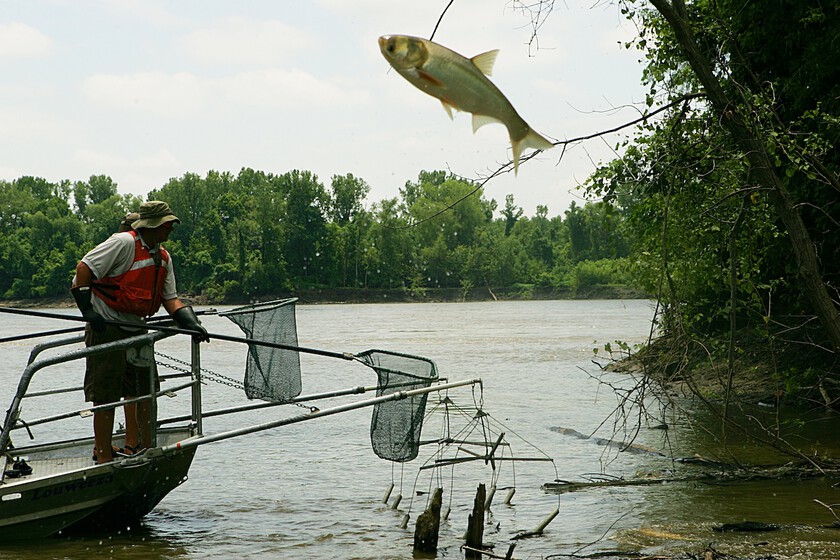
Back in the 1970s in the United States, someone came up with an idea to control the growth of algae, weeds and parasites from aquaculture farms in the southern states: introduce four species of carp from Asia, more specifically the bighead carp, the black carp, the grass carp and the silver carp. If you know a little about biology or have ever encountered a tremendous catfish while fishing, what happened next will not surprise you: it got messy.
Tonight we cross the Mississippi. These four voracious “natural herbicides” released in Arkansas colonized the river network, first ascending the Mississippi River and its tributaries and helped by floods to reach open rivers until they threatened the Great Lakes located in the northern United States. This chronology of expansion and reproduction is detailed by the United States Geological Survey (USGS).
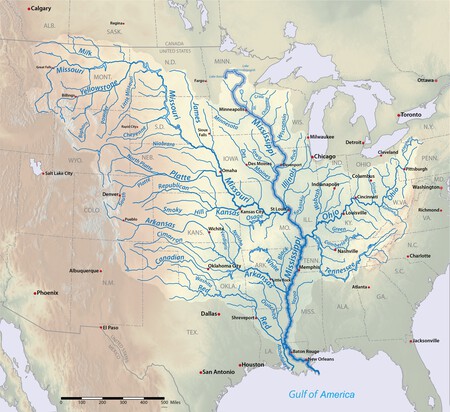
The impressive Mississippi basin or how carp left Arkansas for the Great Lakes. Via Shannon1
They are true titans. Carp are a great example of adaptive management of invasive species: they are able to withstand different environments, can live for several decades and lay millions of eggs. Carp are in their element at the bottom of lakes, ponds or rivers and they swallow everything, since practically any organic matter will do, from plankton to small fish. So they gobble up food that native species could eat.
Destination: Great Lakes. Present in every state of the continental United States, the northern Great Lakes are a destination as desirable as it is devastating. In addition to the damage to the ecosystem, a large-scale invasion would cause a catastrophe to the local economy while decimating the fishing industry, which generates approximately $7 billion a year. So the Administration, scientists and environmentalists have been drawing up plans for years to keep them out of there. Grass carp have already been sighted in Lake Erie.
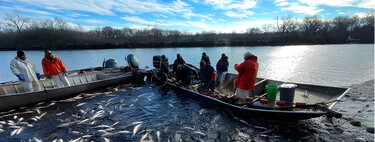
How many Asian carp can you catch? The first measure they implemented was to increase their fishing, with tournaments such as the Redneck Fishing Tournament so that those who participate try to catch as many as they can. The problem is that fishing is not enough to decimate a species with such a reproductive desire. Michigan DNR aquatic species expert Seth Herbst concludes that 80% would need to be eliminated so that their population does not recover.
If you can’t handle it, eat it.. In 2022 the Illinois Department of Natural Resources had an idea: use large-scale commercial fishing as an aquatic management tool to reduce population pressure. In other words: encourage human consumption of carp, which they renamed “Copi.”
Carp meat is rich in protein and is consumed in China and other Asian countries, so why not in the United States? The campaign is still alive and well (like the tents): on the campaign website there is a long list of recipes and restaurants in different states where you can try them. And speaking of recipes, this one from “Can’t Beat ‘Em, Eat ‘Em” gives more ideas for cooking this and other invasive species.

The delicious Asian carp taco
Chicago’s electric wall. Since 2013, the United States Army Corps of Engineers has operated a series of permanent electrical barriers in the Chicago area waterway system with a direct current field of 2.3 Volts per square inch (about 0.35 Volts per square centimeter).
This spark does not kill the carp, it only paralyzes them so that they do not advance and remain downstream. Of course, this method is not infallible: changes in water levels or the salt used for defrosting can alter the conductivity of the water and, therefore, the effectiveness of this method. In addition, smaller specimens can escape into shelters that form between boats. And a no-brainer: it affects carp and non-carp fish, thus altering their behavior. And yet, it continues to be used.
Looking for the infallible system against carp. In the river basins of Illinois they have tried walls of bubbles made from a pipe, thus obstructing their vision. Its sound also serves as a warning. The problem? That also affects native species. And one step further, a variant in the form of cavitation curtains in which the bubbles are broken to disturb the fish. This method was the winner of the Carp Tank contest, with a handsome reward of $500,000 to whoever came up with the definitive idea.
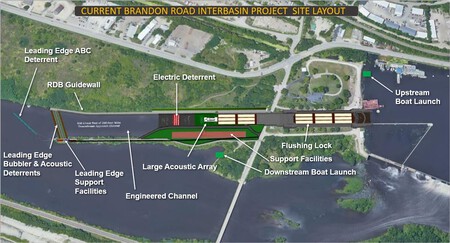
Brandon Road Dam Project
The chaos zone. Since electricity is not 100% infallible, in 2024 they allocated $858 million to build the Brandon Road Interbasind dam project that has it all: improved electric barriers, acoustic deterrents (the silver carp jump when they hear the noise of the engines) and bubbles to obscure your vision. The objective is to prevent the carp from crossing the dam at all, minimizing damage to the rest.
In WorldOfSoftware | The Iberian Peninsula is being invaded: more than 1,200 exotic species have come to stay
In WorldOfSoftware | The coypu, one of the 100 most harmful invasive species in the world, is at the doors of Barcelona
Cover | Flickr