Television had already learned before that a single scene could justify huge budgets if it served to fix a series in the collective memory: Game of Thrones burned millions in battles and dragons to redefine the television epic, Lost started its story with a pilot as expensive as it was risky to “leave the viewer nailed” from the first minute, and Friends turned special episodes into truly global events based on astronomical checks. Therefore, what is truly surprising is not that a series spent a lot of money on a key scene, but that a small and apparently cheap comedy like The Office decided to do it at “that” moment.
The millionaire exception. The Office was always built from budget containment, relying on scripts, rhythm and characters rather than great technical displays, but that logic was consciously broken with a specific scene: Jim’s marriage proposal to Pam at the beginning of the fifth season.
What on screen seems like an everyday moment, one almost improvised and without artifice, ended up becoming the most expensive sequence of the entire series, a deliberate contrast between narrative simplicity and technical complexity.
The simplest proposal… And more expensive. The scene we are going to see next lasts just 52 seconds and cost around a whopping $250,000, a totally disproportionate figure for an office comedy almost always shot indoors.
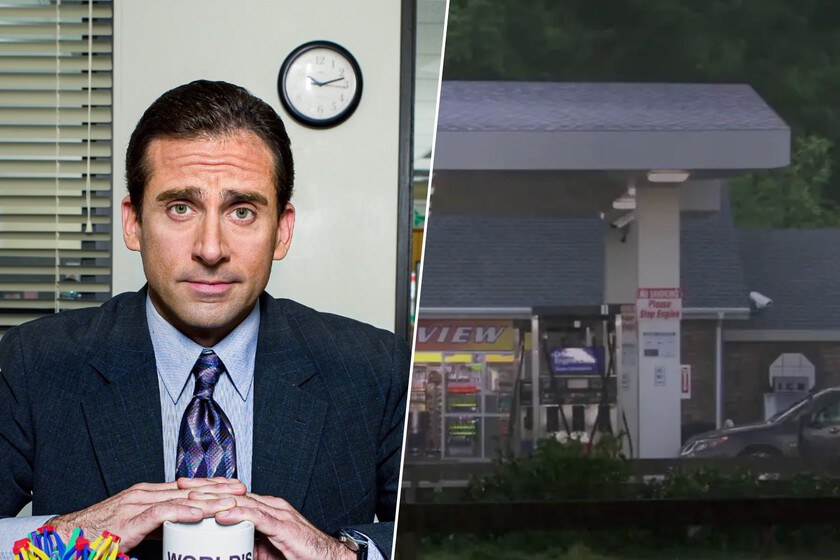
The original intention was for Jim Halpert’s proposal to Pam Beesly to arise in a completely ordinary and common place in the United States such as a highway gas station, and it was to reinforce the idea that important moments do not always occur in special settings. It was precisely this normality that forced an extraordinary production.
Let’s see the moment:
A fake highway in California. Filming in an authentic East Coast service area proved impossible, in part due to security restrictions imposed after the 9/11 terrorist attack, so the team decided to rebuild it from scratch in a parking lot in Los Angeles.
As? Apparently inspired by a real Connecticut stop that series creator Greg Daniels knew about as a child. The team used Google Street View images to replicate every detail and then built the set in just nine days.
Trucks, rain and invisible tricks. Not only that. To simulate real highway traffic, a four-lane circular track was built around the set on which cars and trucks traveled at more than 80 km/h, vehicles driven by dozens of specialists, so that the wind and noise were real.
Added to this were enormous rain machines and subsequent digital work to erase Californian mountains and replace them with trees typical of the East Coast, completing an illusion that the viewer was never supposed to notice.
A decoration that was not what it seemed. Furthermore, the gas station seen on screen was, in reality, almost flat: the interior of the minimarket was barely eight feet deep and many of the products in the background were simply printed and laminated photographs.
As author Andy Greene said in the book The Office: The Untold Story of the Greatest Sitcom of the 2000s, everything was designed to fool the camera, not to exist as a functional space, reinforcing the paradox of a scene that appears to be the most realistic and spontaneous in the series.

Romanticism on toxic terrain. As a final irony, the place chosen to build the set was neither more nor less than an old industrial site with toxic waste sealed under the asphalt, a detail that did not affect the filming but added another layer to the story.
All in all, for its protagonists, the memory of filming the scene in question was genuinely romantic and the result fit perfectly with the tone of a unique series: a great emotional moment hidden within a seemingly insignificant setting.
Imagen | The Office
In WorldOfSoftware | In 1987 a death was filmed so savage that people had to cover themselves. The trick to achieve it turned RoboCop into a cult work
In WorldOfSoftware | In 1978 Christopher Reeve was chosen to play ‘Superman’. He got so beaten up that he literally couldn’t fit into the suit.