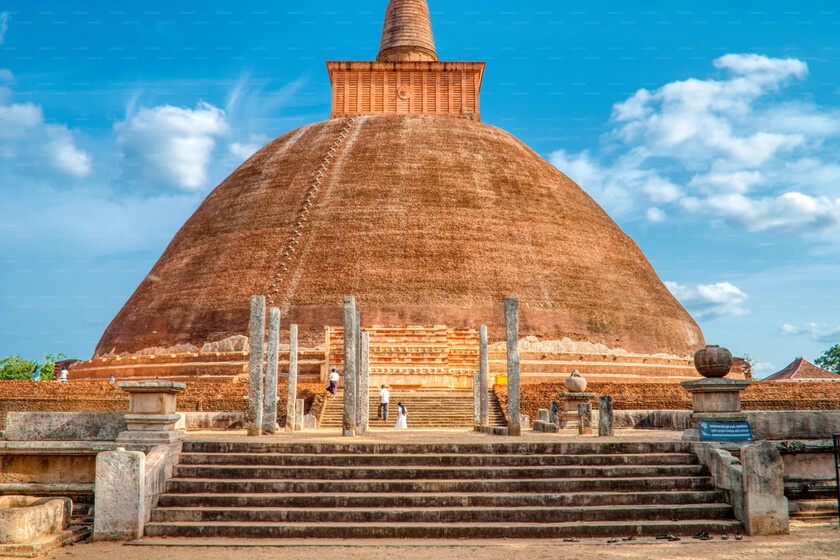
We live surrounded by increasingly modern cities, connected by transport networks, technology and services that seem to completely define our time. However, in different corners of the planet there persist material traces of ancient societies that built works destined to last long further than those who built them, reminding us that the human ambition to transcend is not an exclusive feature of the present. Some of these structures remain part of the everyday landscape thousands of years later, silent but imposing. One of them stands in Anuradhapura and, despite its extraordinary scale, remains little known outside its immediate surroundings.
In the central north of the island is the first major capital of the territory and one of the most sacred places of Buddhism, where religious practice continues to develop with a continuity unusual in the contemporary world. On full moon days, pilgrims dressed in white walk barefoot along dusty paths while monks sing chants at dawn and foreign visitors join in rituals that have been celebrated in this same environment for centuries.
Jetavanaramaya, the brick dome that defied time
The construction that dominates this complex is called Jetavanaramaya and its scale is difficult to assimilate without dwelling on the figures. The stupa was completed around 301 CE using some 93.3 million bricks of baked clay and reached around 122 meters high, one of the highest heights in the ancient world. Due to its size, when it was completed it was ranked as the third largest construction made by humans, only behind the pyramids of Giza. That material ambition alone sums up the magnitude of the project.
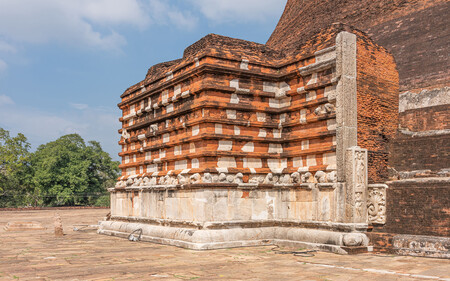
The current appearance of Jetavanaramaya is also the result of a long history of deterioration and recovery. After progressive collapses and stages of abandonment, the stupa today reaches nearly 71 meters in height, far from the image it projected in its origin. Despite this reduction, its volume remains the largest brick construction known, a scale so extreme that, according to a comparison recorded in historical sources, its bricks would be enough to build a wall about 30 centimeters thick and nearly three meters high between London and Edinburgh. The fact that it was covered by vegetation for centuries contributed to this feat of ancient engineering remaining relatively ignored outside the region.
Beyond its architectural dimension, the stupa was part of a complex religious organization that articulated the monastic life of the environment. The complex, called Jetavana Vihara, was designed to accommodate a large community of monks and situate spiritual practice around the permanent presence of the main construction, visible from any point in the complex.
The choice of brick as the main material completely conditioned the logistics of the project. Unlike the pyramids of Giza, built in stone, this stupa required preparing, transporting and assembling millions of pieces that were more vulnerable to erosion. Remains of ancient ovens found in the region confirm massive production, although without a conclusive attribution to the work or a secure dating to the beginning of the 4th century. The mobilization of labor necessary to complete construction remains one of the least clear aspects of the historical record.
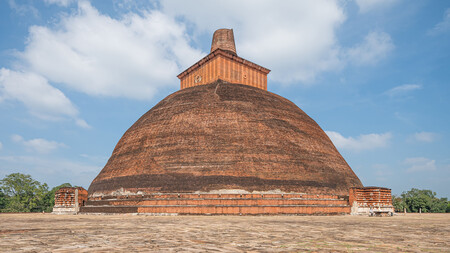
Part of the mystery surrounding the stupa comes from what has been found inside. Reliquary chests were found placed on various construction levels, an arrangement that confirms their function as a container of religious meaning in addition to technical prowess. Next to them appeared gold panels with representations of bodhisattvas, today preserved in the National Museum of Colombo. This set of findings provides material evidence of diverse doctrinal currents and suggests that the enclave participated in cultural networks connected with India and other regions around the Indian Ocean.

Perhaps the most striking thing is not only that a structure of these dimensions has survived for more than 1,700 years, but that for centuries no stupa of comparable scale was erected in the region. This fact places Jetavanaramaya as the culminating point of a construction tradition that later evolved towards other forms and proportions. Its current presence reminds us that societies long before modernity were already capable of coordinating work, technical knowledge and collective beliefs with extraordinary ambition.
Images | erdbeernaut (CC BY-SA 2.0) | Wimukhi Bandard (CC BY-SA 4.0) |
In WorldOfSoftware | 50 years ago a German started a futuristic paradise in Lanzarote. Nobody imagined that it would end up being the most famous ruin on the island