The autonomous enterprise is taking shape as companies move from AI that informs to systems that actually act. Across the enterprise market, the question around AI has shifted from “does this work?” to “does this actually move the business forward?”
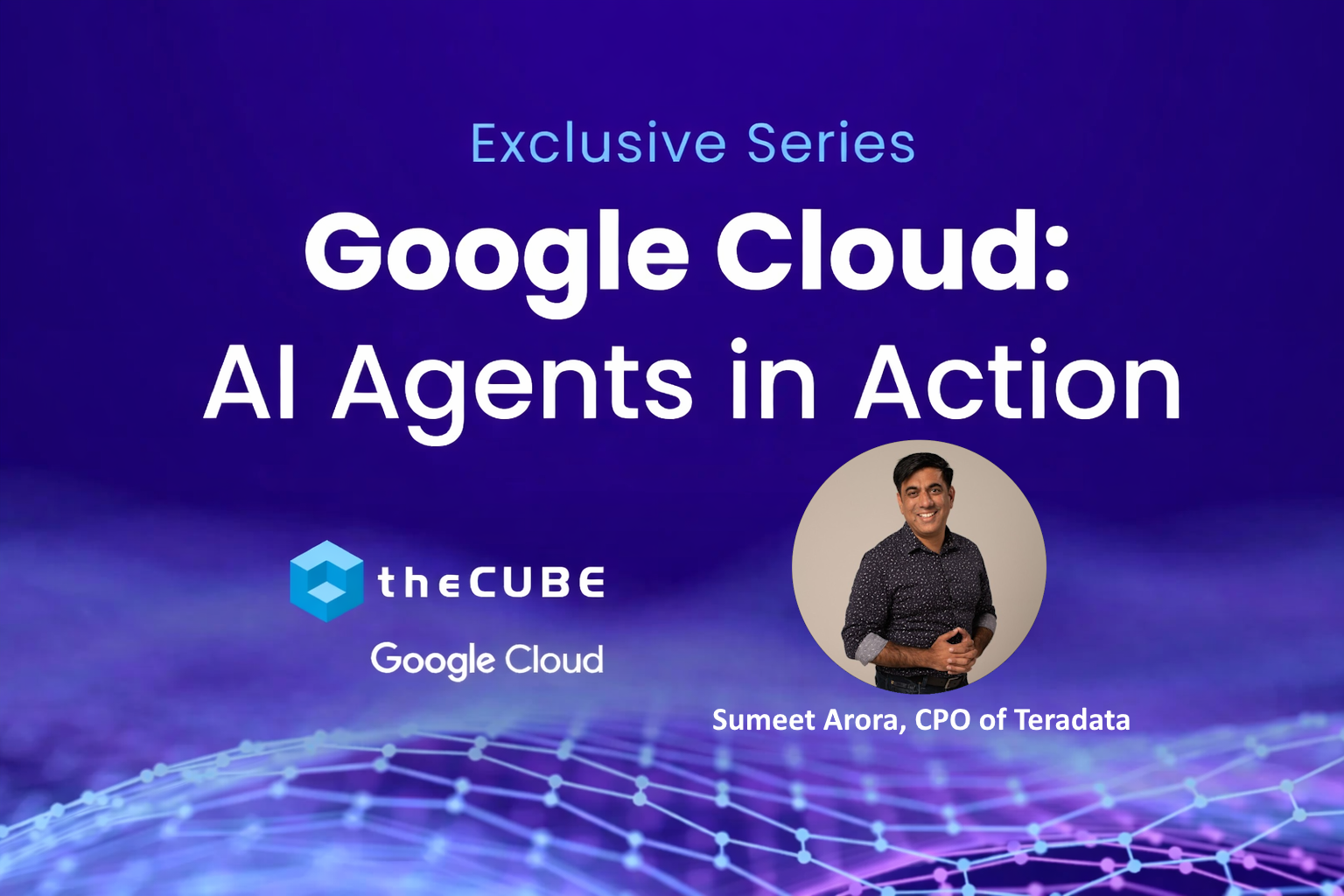
That evolution is playing out in partnerships throughout the enterprise, such as the one between enterprise software company Teradata Corp. and Google Cloud, where long-established data governance is being combined with emerging AI systems designed to turn enterprise knowledge into action and outcomes. By aligning agent development, security and distribution, the companies aim to show how autonomy can be operationalized at enterprise scale, according to Sumeet Arora (pictured), chief product officer of Teradata.
“If you look at the last three-plus years, what started as a global hackathon with AI last year turned serious and went agentic,” Arora said. “The big question that was asked in every forum last year was, ‘Hey, what about ROI?’ I think … this year and next year we are going to see this immense focus on measurable outcomes from agentic operations and agentic deployments.”
Arora spoke with theCUBE’s John Furrier for the Google Cloud AI Agents in Action Series on theCUBE, News Media’s livestreaming studio. They discussed how enterprise AI is moving toward autonomy by grounding intelligent agents in governed data and measurable outcomes. (* Disclosure below.)
Building the autonomous enterprise around knowledge
The idea of the autonomous enterprise hinges on more than just models — and more on how organizations structure and expose what they already know. Enterprise knowledge lives in data, processes and decisions, and autonomy depends on whether that knowledge can be organized and accessed in a governed way. Without that foundation, intelligent agents remain disconnected from the realities they are supposed to act on, according to Arora.
“The most important resource in that evolution is actually the enterprise knowledge,” he said. “That knowledge is in data, in the processes, in how they operate and how they make decisions. That knowledge is the most important asset for an enterprise.”
The partnership between Teradata and Google Cloud focuses on operationalizing AI, not just analytics. By combining Gemini models, agent tooling and serverless infrastructure with Teradata’s governed AI and knowledge platform, the companies deliver conversational, multi-turn access to enterprise knowledge without moving data, helping organizations turn trusted insights into real business outcomes consistently, Arora explained.
“What customers really care about is making sure the massive investments they’ve made in data and knowledge actually flow into every decision point,” he said. “By combining Google’s AI excellence with Teradata’s governed data platform — without moving the data — we’re enabling natural, multi-turn conversations that turn insight into action and outcome.”
This framing shifts autonomy away from user interfaces and toward infrastructure. Rather than optimizing workflows for humans, companies are beginning to optimize platforms for agents that operate continuously. That change places new pressure on enterprise platforms to deliver performance, governance and scale that can support constant machine-driven interaction, Arora noted.
“The last two decades of technology, especially in the cloud, was built with human usage patterns in mind,” he added. “You and I, we work hard, but we do go to sleep. However, agents do not sleep.”
Where autonomy meets platform design
As agent usage grows, the demands placed on enterprise platforms escalate quickly. Systems must handle persistent workloads, maintain accuracy and preserve governance even as access becomes more conversational and distributed, Arora explained. That is forcing vendors to rethink platform efficiency, especially as agents generate far more activity than traditional users.
“What I foresee is an era where platforms like Teradata — the data platforms, the knowledge platforms — are going to see a vigorous amount of usage,” he said. “It’s going to be many orders of magnitude more because these agents are going to just constantly harness the knowledge inside.”
This shift also changes how value is delivered to end users. Instead of dashboards that summarize the past, agents increasingly act as intermediaries between enterprise knowledge and decision points. The goal is not just faster insight, but insight that arrives precisely where action is required.
“The value of that must flow to every decision point,” Arora added. “That decision point could be a knowledge worker, could be an AI agent in a process. That decision point must be supplied with insights from the enterprise knowledge.”
Distribution becomes the accelerant
Even well-designed agent systems struggle if they remain isolated from how users actually work. Distribution has become as important as capability, especially as enterprises experiment with agent marketplaces and shared interfaces. Embedding agents inside familiar environments reduces friction and speeds adoption across teams, according to Arora.
“Distribution is everything in innovation,” he said. “I always say this to my own team: ‘We may have built the best car. We may have built a Ferrari, but if the Ferrari stays inside the garage and never comes out, nobody’s going to enjoy it.’”
Marketplaces and shared AI interfaces increasingly function as the front door to autonomous capabilities. Rather than navigating procurement cycles or custom integrations, organizations can access agents directly where work already happens. That shift reinforces the idea that autonomy succeeds when it blends seamlessly into existing enterprise behavior.
“It goes beyond procurement. It goes beyond just the logistics of retiring your cloud commitment,” Arora said. “It is much more about discovery, about seamlessly integrating with an environment where you can ask any sort of questions and it picks the right agent and gives you the answer.”
Here’s the complete video interview, part of News’s and theCUBE’s coverage of the Google Cloud AI Agents in Action Series:
(* Disclosure: TheCUBE is a paid media partner for the Google Cloud AI Agents in Action Series. Neither Google Cloud, the sponsor of theCUBE’s event coverage, nor other sponsors have editorial control over content on theCUBE or News.)
Photo: News
Support our mission to keep content open and free by engaging with theCUBE community. Join theCUBE’s Alumni Trust Network, where technology leaders connect, share intelligence and create opportunities.
- 15M+ viewers of theCUBE videos, powering conversations across AI, cloud, cybersecurity and more
- 11.4k+ theCUBE alumni — Connect with more than 11,400 tech and business leaders shaping the future through a unique trusted-based network.
About News Media
Founded by tech visionaries John Furrier and Dave Vellante, News Media has built a dynamic ecosystem of industry-leading digital media brands that reach 15+ million elite tech professionals. Our new proprietary theCUBE AI Video Cloud is breaking ground in audience interaction, leveraging theCUBEai.com neural network to help technology companies make data-driven decisions and stay at the forefront of industry conversations.